OBD1 vs OBD2: What Is the Difference?

OBD1 uses brand-specific connectors and code-reading methods. OBD2 uses the 16-pin SAE J1962 connector on most U.S. gasoline cars and light trucks from 1996 onward. Buy the wrong scanner and it may not plug in, or it may connect but read nothing useful. This guide explains the physical connector, the protocols, and how to check borderline model years before you buy.
OBD1 and OBD2 at a glance
| Decision factor | OBD1 | OBD2 | Winner |
|---|---|---|---|
| Physical connection | Manufacturer-specific connector shapes and pinouts | 16-pin SAE J1962 connector, usually under the dashboard near the steering column | OBD2 |
| Tool compatibility | Often needs brand-specific tools or jumper-wire procedures | Generic scan tools can read many compliant vehicles | OBD2 |
| Data depth | Limited data access, often basic fault output only | Live data, freeze-frame data, readiness monitors, and shared code formats | OBD2 |
| Borderline vehicle risk | High, because year and market exceptions are common | Lower on 1996-and-newer U.S. gasoline passenger vehicles | OBD2 |
| Classic-car fit | Often better for originality and simple blink-code checks | Usually unnecessary on pre-standard vehicles | OBD1 |
Physical connection
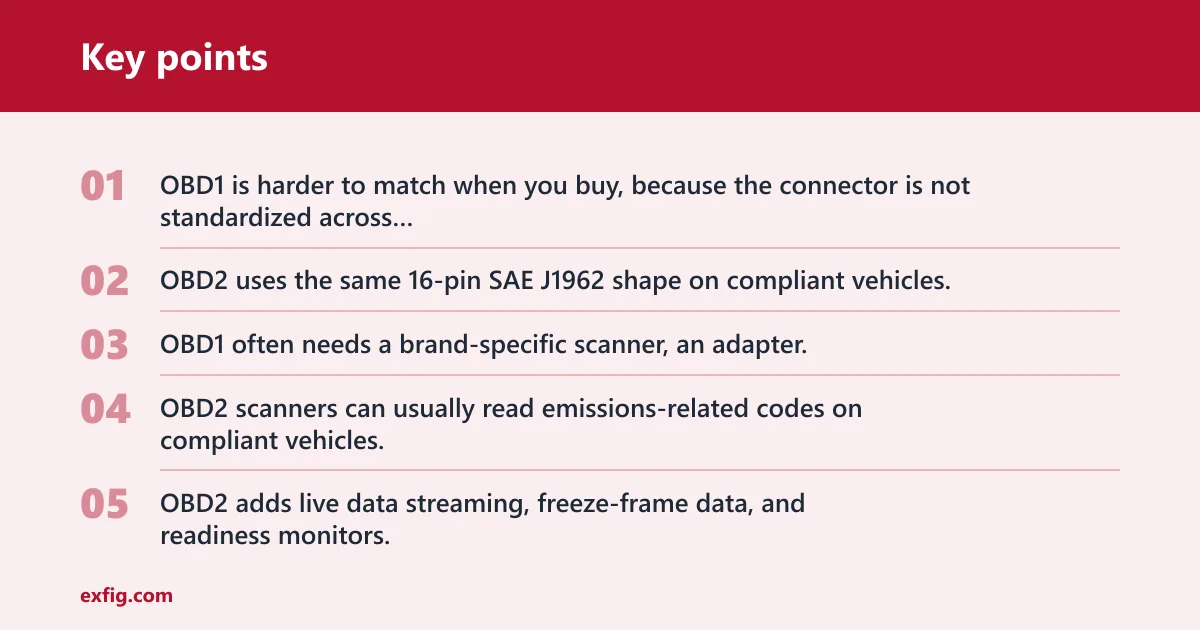
OBD1 is harder to match when you buy, because the connector is not standardized across brands. OBD2 uses the same 16-pin SAE J1962 shape on compliant vehicles, so a scanner buyer can start with the plug instead of guessing by badge.
Tool compatibility
OBD1 often needs a brand-specific scanner, an adapter, or a pin-jump procedure to pull codes. OBD2 scanners can usually read emissions-related codes on compliant vehicles, which is why the shopping process is simpler.
Data depth
OBD2 adds live data streaming, freeze-frame data, and readiness monitors. OBD1 usually offers much less, so a buyer looking for fuel-trim style detail or emissions monitor status should start with OBD2 support.
Borderline vehicle risk
The year alone is not enough on every car, especially near changeover dates and outside the U.S. A 16-pin socket can still hide partial OBD2 support, so the safer move is to confirm both the connector and the communication protocol before ordering a scanner.
Classic-car fit
OBD1 can still be the right answer for a simple, original setup. A basic blink-code system may be enough for a weekend car, and some owners prefer not to alter a factory harness just to force a modern scanner to fit.
What changed at the plug?
OBD1 and OBD2 differ first at the physical interface. OBD1 uses manufacturer-specific connectors and codes, while OBD2 standardizes the 16-pin SAE J1962 connector and places it in a common location, usually under the dashboard near the steering column.
OBD1 connectors and brand-specific wiring
OBD1 did not give buyers one universal socket to look for. The connector shape, pin count, and code-reading method could change by manufacturer, which is why many pre-1996 vehicles need a brand-specific cable or a jumper-wire method to flash codes.
SAE J1962 plug shape and common locations
OBD2 uses a 16-pin trapezoid connector. On many vehicles it sits under the dash near the steering column, which makes a quick visual check possible before you buy a tool.
Why a 16-pin socket is not the whole story
A socket that looks like OBD2 is not proof that the whole car behaves like OBD2. Some transition-year vehicles have the plug shape but not full generic scan support, so a buyer can end up with a scanner that connects physically yet cannot talk to the car the way expected.
A common first-timer mistake is to see a 16-pin port, order a generic scanner, and assume success. If the vehicle is a transition-year model, the plug may fit while the data stream still follows a brand-specific method.
OBD1 vs OBD2 matrix
| Vehicle age | Connector shape | Expected protocol support | Scanner type needed | Most common failure mode |
|---|---|---|---|---|
| Pre-1996 | Brand-specific connector, often not 16-pin | Manufacturer-specific, sometimes only blink codes | Brand-specific scanner, adapter, or jumper-wire code method | Generic OBD2 reader does not communicate |
| Transition-year | May be 16-pin, may be older style | Mixed support, depending on market and manufacturer | Scanner that supports the exact make, year, and protocol | Plug fits but reads only partial data or nothing useful |
| 1996-and-newer U.S. gasoline passenger vehicle | 16-pin SAE J1962 | OBD2 generic layer, with manufacturer-specific data layered on top | Standard OBD2 scanner, with protocol support matched to the vehicle | Buying a scan tool that lacks support for the correct protocol |
Pre-1996 vehicles
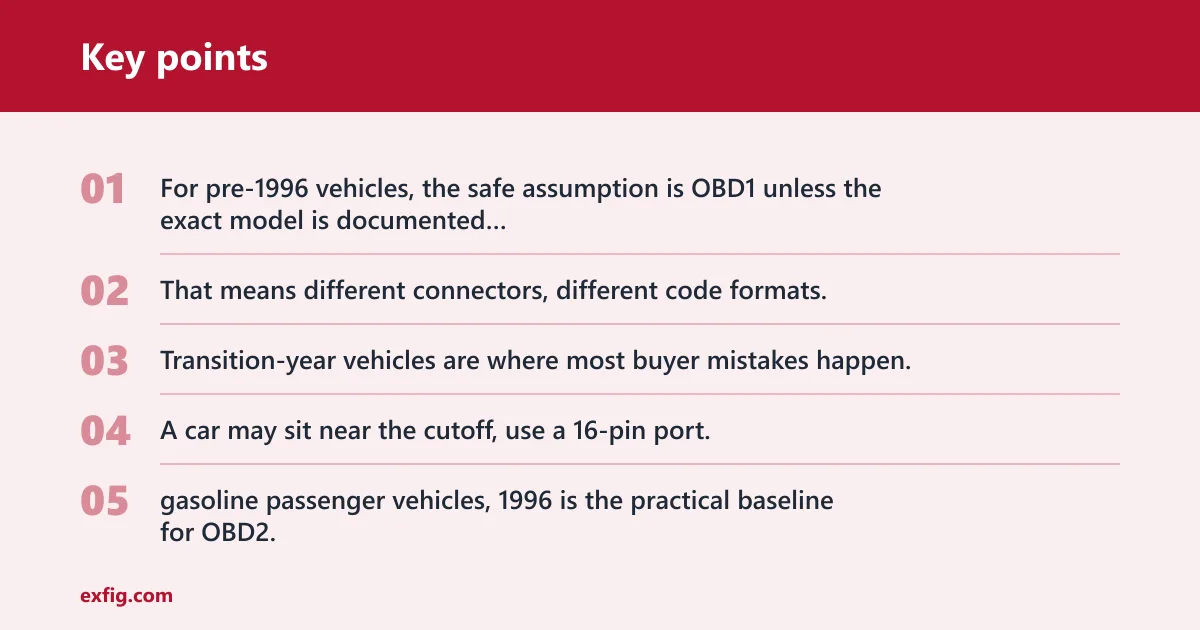
For pre-1996 vehicles, the safe assumption is OBD1 unless the exact model is documented as an exception. That means different connectors, different code formats, and a higher chance that a generic scan tool will be useless without an adapter or a specific procedure.
Transition-year vehicles
Transition-year vehicles are where most buyer mistakes happen. A car may sit near the cutoff, use a 16-pin port, and still not behave like a full OBD2 vehicle, so the scanner must match the make, model year, and market, not just the socket.
1996-and-newer U.S. vehicles
For U.S. gasoline passenger vehicles, 1996 is the practical baseline for OBD2. That does not mean every feature is the same on every car, but it does mean the generic emissions-related layer, code format, and connector are usually where a buyer should start.
Can you use an OBD2 scanner on an OBD1 car?
Usually no, not in the way buyers mean it. An OBD2 scanner may not plug into an OBD1 car, and even when an adapter makes the connection possible, the scanner still has to understand the older manufacturer-specific protocol or it will return little more than a dead-end.
When a basic code reader fails
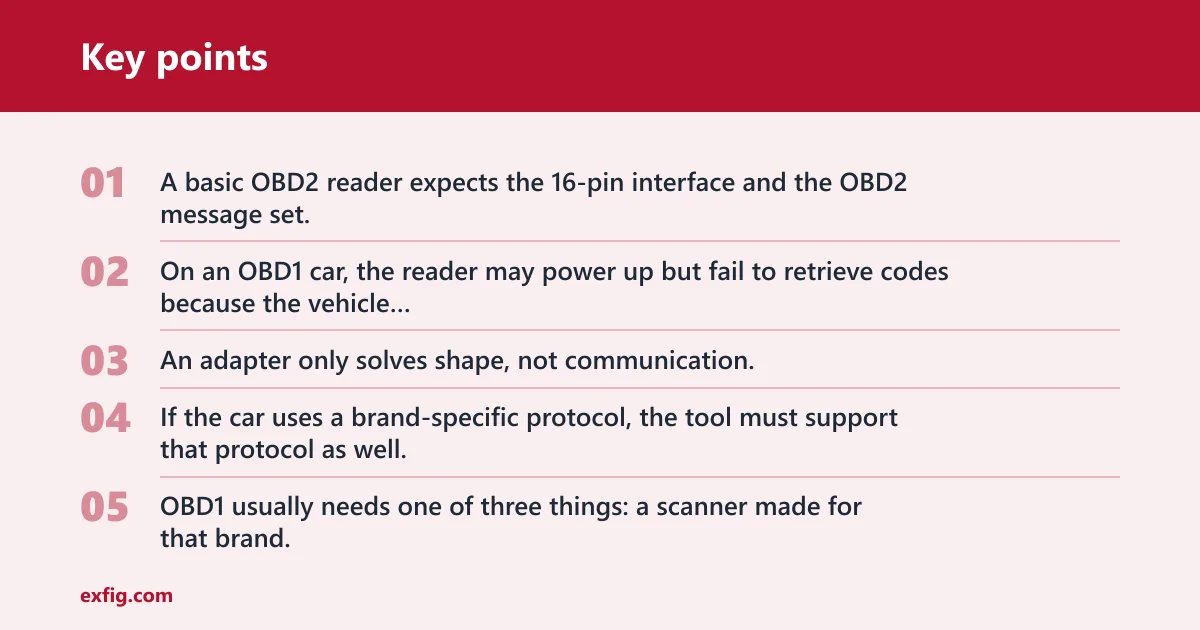
A basic OBD2 reader expects the 16-pin interface and the OBD2 message set. On an OBD1 car, the reader may power up but fail to retrieve codes because the vehicle speaks a different language at the diagnostic port.
When an adapter still is not enough
An adapter only solves shape, not communication. If the car uses a brand-specific protocol, the tool must support that protocol as well, or you will get a connector that fits and data that does not.
What tool type OBD1 usually needs
OBD1 usually needs one of three things: a scanner made for that brand, an adapter paired with a supported tool, or a simple jumper-wire code check where the dash flashes the fault code. That last method is common on older systems and is one reason some enthusiasts still keep OBD1 tools around.
Say your 1994 sedan has a diagnostic plug under the hood, but the scanner you bought is a basic OBD2 code reader. The plug may not match, and if you force an adapter into the equation without protocol support, you can end up with no readable codes at all.
How do you tell which system your car has?
Start with the model year, then verify the connector and the market. A 1996-and-newer U.S. gasoline passenger vehicle is usually OBD2, but transition-year models and non-U.S. cars deserve a closer check before you buy a scanner.
Check model year first
Model year gives you the quickest first pass. In the U.S. context, 1996 is the key cutoff for gasoline passenger vehicles, but it is a practical baseline, not a global rule.
Look at the connector and pin count
Count the pins and note the shape. A 16-pin trapezoid connector points toward OBD2, while older systems often use a different brand-specific connector with different spacing and pin use.
Confirm protocol and market before buying a scanner
Scanner listings should match the vehicle’s protocol support, not only its connector. For a borderline car, confirm the make, model year, engine type, and market, because the same model can differ across regions.
- Check the sticker on the door jamb or paperwork for the model year.
- Find the diagnostic port and note whether it is a 16-pin SAE J1962 connector.
- Confirm whether the vehicle is U.S.-market gasoline, diesel, or a non-U.S. version.
- Look up the exact protocol support before buying a scanner or adapter.
- If the vehicle sits on the cutoff, choose a tool with brand-specific coverage, not only generic OBD2 support.
What OBD2 standardized
OBD2 did more than change the plug. It standardized the trouble code format, added emissions-focused data, and created a common way for scan tools to talk to compliant vehicles. It did not make every vehicle module generic, but it did create a shared diagnostic layer.
DTC format and generic P0 codes
OBD2 diagnostic trouble codes use a letter plus numbers, with P for powertrain. Generic OBD2 codes use P0, while manufacturer-specific extensions use P1 and higher, so the same basic format can carry both common and brand-specific faults.
Freeze-frame data and readiness monitors
OBD2 can store freeze-frame data, which is a snapshot captured when a fault is recorded. It also tracks readiness monitors, which matter in emissions testing because they show whether the vehicle has completed certain self-checks.
Live data and emissions-focused diagnostics
OBD2 provides real-time data streaming, which helps a scanner show sensor values instead of only code numbers. That still sits mainly on the emissions-related diagnostic layer, so buyers should not assume a generic OBD2 reader can see every control module on every vehicle.
Protocol support, including CAN on U.S. vehicles since 2008
OBD2 uses standardized communication protocols, but the exact protocol still matters. Since model year 2008, U.S. vehicles have been required to use CAN, which means a scanner should support CAN if the vehicle falls in that range.
Are OBD1 and OBD2 compatible?
They are only partly compatible, and the difference matters. A physical adapter can sometimes bridge the connector, but protocol compatibility determines whether the scanner can actually read codes, stream data, or report readiness information from a vehicle.
Physical fit versus data access
Physical fit answers one question, data access answers another. A scanner can connect to the port and still fail if the tool does not understand the vehicle’s message format or code set.
Brand-specific exceptions and adapters
Some vehicles sit close to the cutoff and use hybrid arrangements, especially in transition years. In those cases, the right scanner may be one with both generic OBD2 support and brand-specific coverage, plus the correct adapter if the connector differs.
Why vehicle year alone can mislead you
Year alone can point you in the wrong direction on a border case. A 1995 model sold in one market can behave differently from a 1995 model sold elsewhere, and some makers changed diagnostic hardware before or after the common U.S. cutoff.
Suppose a 1996 model has the 16-pin port under the dash, but a cheap reader shows only basic emissions codes and nothing else. That is not a mystery failure. It usually means the tool understands the generic layer, but not the extra manufacturer data on that specific car.
Choose OBD1 if…
Choose OBD1 if you are working on a pre-1996 vehicle with a brand-specific diagnostic setup, or if the car depends on blink-code checks and original hardware. It is also the safer pick when originality matters more than scan depth, as long as you have the right brand-specific tool or procedure.
Choose OBD2 if…
Choose OBD2 if the vehicle is a 1996-and-newer U.S. gasoline passenger car or light truck, or if you need a scanner that can read emissions-related codes, freeze-frame data, readiness monitors, and live data. For borderline cars, choose OBD2 only after confirming the connector and protocol support.
Frequently asked questions
Obd1 vs obd2 difference
OBD1 is manufacturer-specific, with different connectors, codes, and procedures by brand. OBD2 standardizes the 16-pin SAE J1962 connector, uses shared trouble-code formatting, and adds live data, freeze-frame data, and readiness monitors on compliant vehicles.
Is obd1 better than obd2?
Not in general, but it can be better for a narrow use case. OBD1 can fit a classic-car goal, a simple blink-code check, or an original harness that you do not want to modify. OBD2 is the stronger choice for scanner compatibility and broader data.
What is the main difference between obd1 and obd2?
The main difference is standardization. OBD1 varies by manufacturer, while OBD2 gives you a common connector, shared code format, and standardized communication rules, which makes scanner buying much easier on compliant vehicles.
What year did cars switch from obd1 to obd2?
For U.S. gasoline passenger vehicles, the practical cutoff is 1996. That said, transition-year exceptions exist, and non-U.S. markets can follow different rules. The year is a strong clue, not the only check a buyer should make.
How do I know if my car is obd1 or obd2?
Start with the model year, then inspect the diagnostic connector and confirm the market. A 16-pin SAE J1962 plug points to OBD2, but a vehicle near the cutoff may still need protocol verification before you buy a scanner.
What changed from obd1 to obd2 for scanner compatibility?
Scanner compatibility became far less guesswork-heavy. OBD2 standardized the connector, the code format, and the emissions-related diagnostic layer, so buyers can match a tool to a known protocol instead of chasing brand-specific cables and procedures.