HID vs LED Headlights: Which Should You Buy?

Choose HID if your headlight housing was built for xenon projectors or OEM HID parts; choose LED headlights if the housing is designed for LED retrofits or full LED assemblies. Put the wrong bulb in the wrong housing and you can get glare, weak cutoff control, failed inspections, or less useful light on the road. This guide compares HID and LED by housing type, commute, weather, and street-legal fit so you can buy the right upgrade.
| Decision factor | HID | LED headlights | Winner |
|---|---|---|---|
| Factory projector housing | Usually a strong match for xenon projectors and cutoff control | Can work well in LED-designed projectors, but retrofit results vary | HID |
| Factory reflector housing | Fitment-sensitive and often poor as a retrofit bulb swap | Also fitment-sensitive; glare risk rises if the emitter is not matched to the optic | Tie |
| Startup behavior | Needs a short warm-up period before peak output | Reaches full brightness instantly | LED headlights |
| Installation complexity | Requires a ballast and ignition hardware | Needs a driver and cooling hardware, often simpler than HID but still not trivial | LED headlights |
| Long-term failure risk | Ballast can fail independently of the bulb | Driver and cooling parts can fail independently of the LED chip | Tie |
| Wet, foggy, snowy use | Often better when paired with a proper projector and moderate color temperature | Can be excellent in the right optic, but very cool color temperatures can hurt practical visibility | HID |
HID vs LED headlights at a glance
The real choice is not which spec sheet number looks bigger. It is which light source fits the housing, the beam pattern, and the roads you actually drive. HID uses a xenon gas arc and needs a ballast; LED headlights use semiconductor chips and need driver electronics plus cooling.
In a correct housing, both can beat halogen. In a mismatched housing, both can throw glare or waste light above the cutoff. That is why the optic matters more than the brochure number.
Why housing type changes the result
Projector housings are often said to control cutoff and aim better than reflectors, so they usually accept a purpose-built HID or LED setup more cleanly. Reflector housings shape light with broader optics, which makes them more sensitive to bulb position and emitter geometry. A bulb swap cannot fix a bad optical match.
Where raw brightness stops mattering
Lumens are a raw output measure. They do not tell you how much light lands on the lane, the shoulder, or the sign line. If the beam is scattered by the housing, more lumens can mean more glare and less useful road light.
How HID headlights work
HID headlights ignite xenon gas between two electrodes. The ballast steps up voltage for ignition, then regulates the arc while the lamp reaches peak output. That ignition system is why HID is more complex than a simple bulb swap.
Xenon arc and ballast basics
The ballast is required for HID operation. It adds installation complexity and can fail on its own, even if the bulb is still serviceable. That means a no-light complaint is not always a dead bulb; sometimes it is the control hardware.
Warm-up time and color temperature
HIDs need a short warm-up period before peak output. Many systems are sold in common color temperature ranges that look white to slightly blue, but Kelvin is a color measure, not a brightness score. Higher Kelvin can look whiter or bluer, yet it can reduce practical visibility in rain, fog, and snow.
Why projectors usually suit HID better
Projector optics are built to control cutoff tightly, which helps contain the HID arc and its glare. In many factory systems, that optical design is the reason HID performs well. Put the same bulb in a reflector built for halogen and the beam can become messy fast.
How LED headlights work
LED headlights use semiconductor chips to produce light. They reach full brightness instantly, which helps with repeated on-off use and quick flashes. They also depend on a driver circuit, and the light source must stay cool to keep output stable.
Cooling hardware and driver electronics
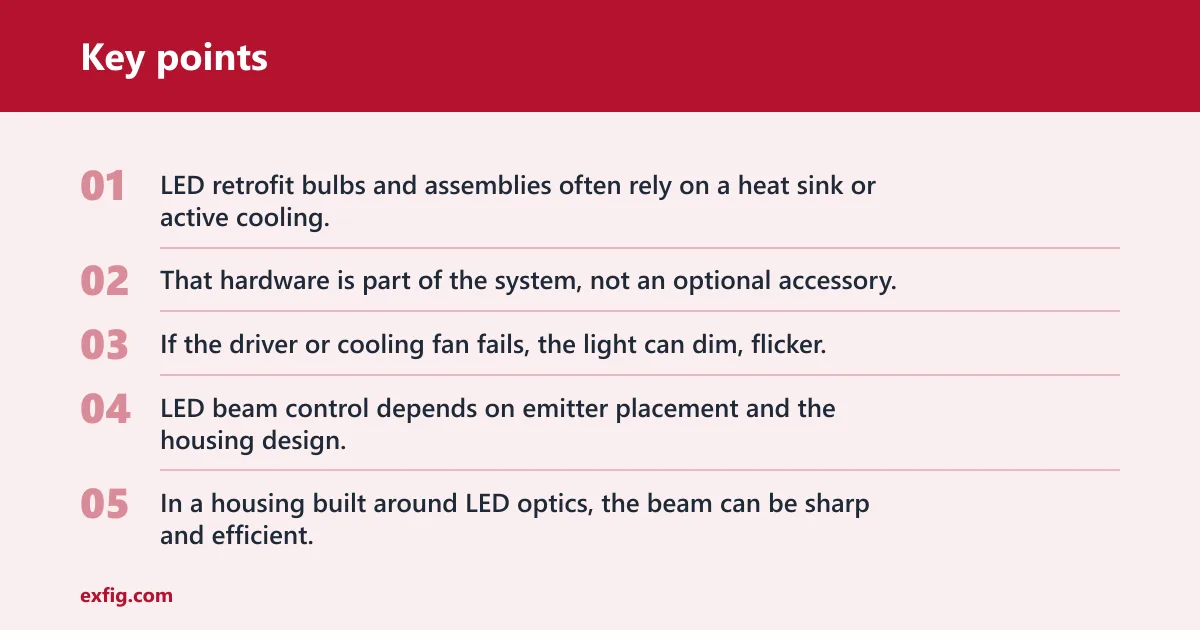
LED retrofit bulbs and assemblies often rely on a heat sink or active cooling. That hardware is part of the system, not an optional accessory. If the driver or cooling fan fails, the light can dim, flicker, or shut down even if the emitters themselves are fine.
Beam control in real housings
LED beam control depends on emitter placement and the housing design. In a housing built around LED optics, the beam can be sharp and efficient. In a reflector not meant for that emitter shape, output can spread where it should not, especially above the cutoff.
Suppose a sedan has a factory projector and sees 40 minutes of night driving every day. HID can be the cleaner retrofit if it was part of the original optical design, because the projector helps contain the arc and its cutoff. Swap the same kit into a reflector and the beam may look brighter on a wall while getting worse on the road.
Which is brighter and which throws farther?
Neither technology wins on brightness alone in every setup. HID can produce strong raw output in some systems, while LED headlights can look very bright at first switch-on. The real question is how the housing uses that light, because cutoff, aim, and emitter position shape what reaches the road.
Lumens versus useful road light
More lumens do not guarantee better visibility. A headlamp can have a high lumen claim and still light up tree tops, signs, and oncoming drivers instead of the lane. Usable road light depends on beam shape and where the optic sends the beam.
Distance, cutoff, and glare
A proper cutoff keeps light below the eyes of other drivers while preserving reach. Projector housings usually do this better than reflectors. If the bulb is wrong for the housing, the beam can lose distance even if the number on the box looks stronger.
Why the same bulb can look different in two housings
A common first-timer mistake is to judge a bulb on garage-door light alone. Say your friend’s LED retrofit looks crisp in a projector but scattered in a reflector. The bulb did not change; the optic did. That is the whole buying problem in one example.
Headlight decision matrix
| Vehicle setup | Best choice | Why |
|---|---|---|
| Factory projector | HID | Projectors usually control HID cutoff well and match xenon arc behavior better than generic reflector optics. |
| Factory reflector | LED headlights | Only if the reflector is designed for an LED retrofit or full LED assembly; otherwise either option can create glare, so verify fitment carefully. |
| Daily commuter | LED headlights | Instant full brightness helps with short trips, stop-and-go use, and frequent engine restarts. |
| Highway-heavy driver | HID | In a proper projector, HID can give strong sustained reach once warmed up, which suits long night drives. |
| Cold-climate driver | LED headlights | Instant output is useful for frequent cold starts, though cooling hardware must still be reliable. |
| Legality-sensitive driver | Factory-matched HID or LED headlights | Complete headlamp assemblies are the safer path under FMVSS No. 108; bulb-only retrofits can create compliance risk. |
HID vs LED headlights checklist
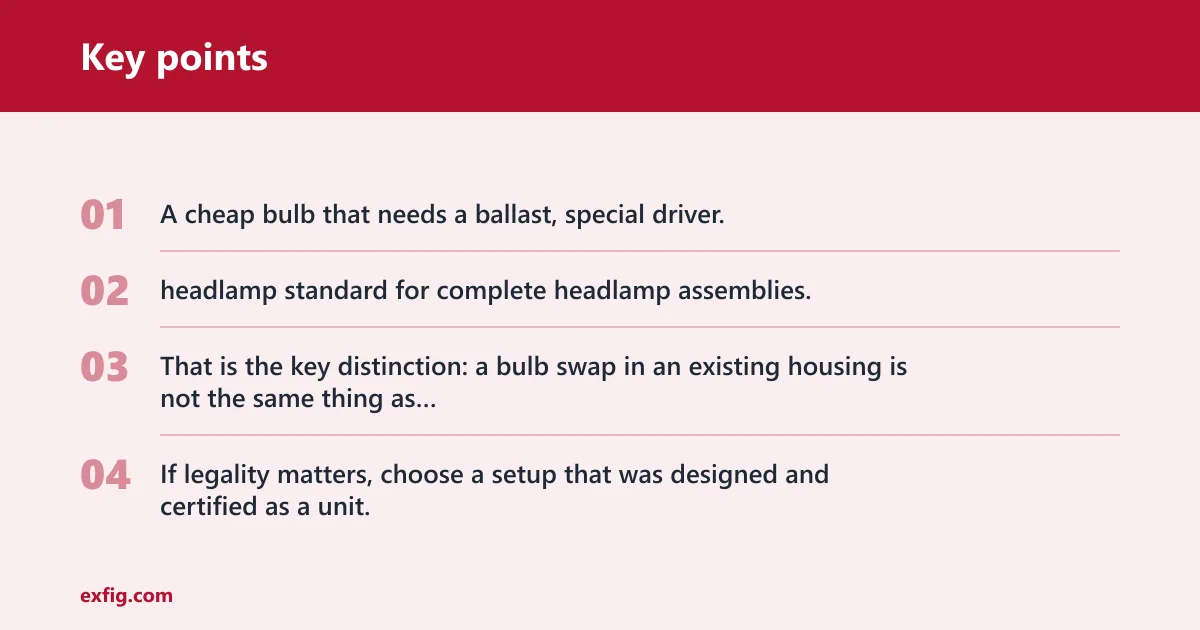
Buy on total cost, not bulb price alone. A cheap bulb that needs a ballast, special driver, or early replacement can cost more over time than a pricier complete assembly.
| Cost item | HID | LED headlights |
|---|---|---|
| Bulb or light source | Xenon HID capsule | LED module or retrofit bulb |
| Required extra hardware | Ballast and ignition parts | Driver and cooling hardware |
| Likely failure point | Ballast can fail independently | Driver or cooling parts can fail independently |
| Expected replacement interval | Depends on the capsule and ballast quality; age and warm-up cycling matter | Depends on driver heat management; long life claims still depend on cooling |
Street-use legality notes
FMVSS No. 108 is commonly cited as the U.S. headlamp standard for complete headlamp assemblies. That is the key distinction: a bulb swap in an existing housing is not the same thing as a compliant assembly. If legality matters, choose a setup that was designed and certified as a unit.
Which should you buy for your driving pattern?
Your commute should decide the purchase more than the sales copy does. Daily stop-and-go driving favors quick output. Long nighttime interstate runs favor a well-controlled beam with enough reach. Winter driving adds another layer, because color and beam control matter in rain, fog, and snow.
Daily commuter
Choose LED headlights if your housing is meant for them or you can buy a complete LED assembly. Instant full brightness is useful for short trips, quick starts, and frequent cycling. If the car came with projectors built around HID, though, a good HID replacement can still be the cleaner fit.
Highway-heavy driver
Choose HID if the vehicle has factory projectors designed for xenon. That pairing often gives strong forward reach and controlled cutoff on dark roads. If you drive long distances at night, a mismatched LED bulb in a reflector is a poor trade.
Cold-climate driver
Choose LED headlights when cold starts matter and the housing is designed for them. Full brightness on first switch-on helps in short winter daylight windows and repeated restarts. For snow, rain, and fog, avoid very high Kelvin colors that look blue and can wash out contrast.
Choose HID if… / Choose LED headlights if…
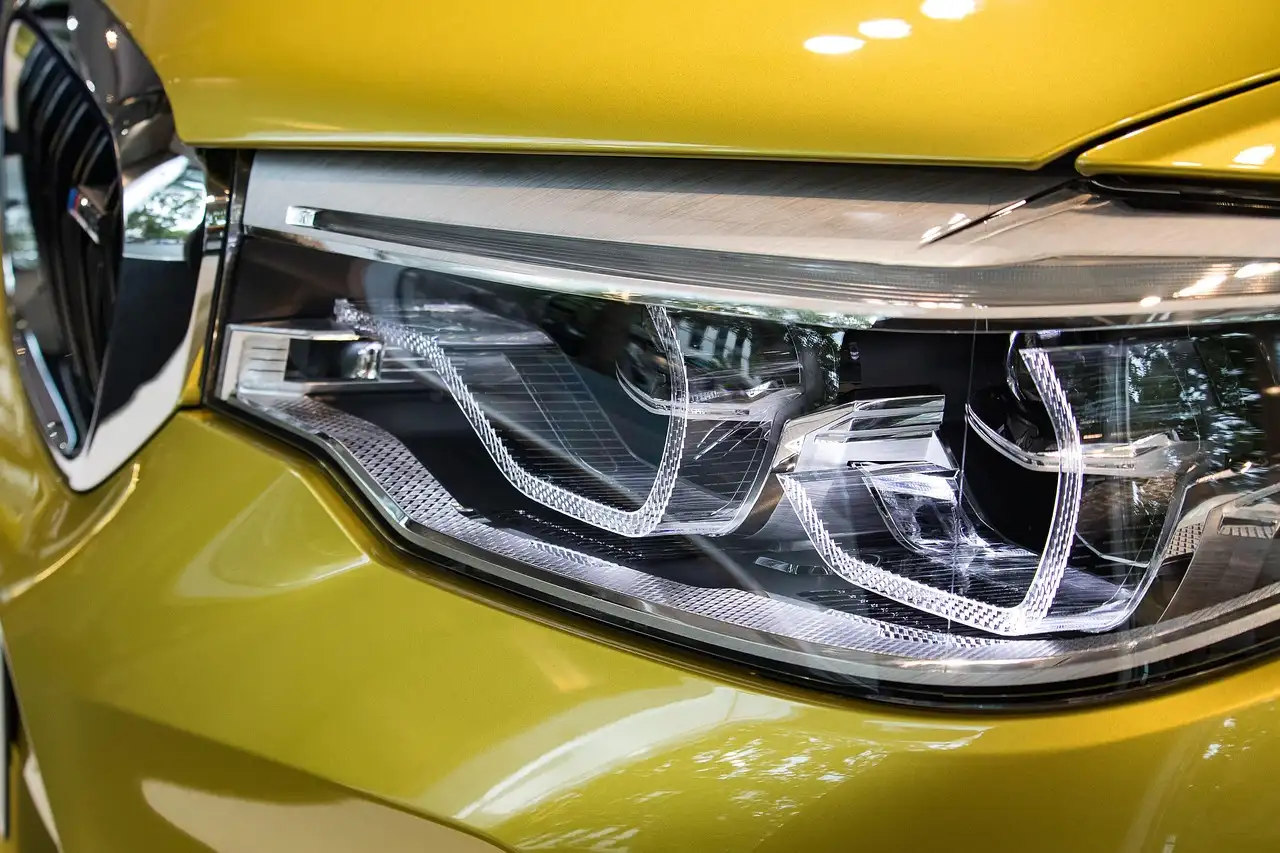
Choose HID if your car came with xenon projectors, if you want a strong projector cutoff with a known HID fit, or if the existing headlamp system already uses HID hardware. Choose LED headlights if the vehicle is built for LED optics, if instant output matters more than warm-up behavior, or if you are buying a full assembly rather than a risky bulb swap.
Choose HID if you are upgrading a factory projector and want the closest match to the original optical design. Choose LED headlights if you need cold-start speed, lower startup complexity at the lamp, or a modern assembly that was engineered around LED beam control.
Choose neither as a casual bulb swap if the vehicle uses a reflector housing that was not designed for the new emitter. In that case, the safer answer is the correct complete assembly, not the brightest-looking capsule.
Frequently asked questions
Hid vs led headlights which is brighter
Brightness depends on the housing, not only the bulb. HID can have stronger raw output in some projector setups, while LED headlights can look brighter at switch-on because they reach full brightness instantly. The real test is road light below the cutoff, not a lumen claim on the package.
Hid vs led headlight bulbs
HID headlight bulbs are xenon arc capsules that need a ballast to ignite and regulate them. LED headlight bulbs use semiconductor chips, plus driver electronics and cooling hardware. That means the bulb type is only part of the system; fitment and optics decide whether the swap works well.
Led vs hid vs halogen headlights
Halogen is the baseline and is usually dimmer than both HID and LED headlights. HID can offer strong output in the right projector, and LED can provide instant light with low startup delay. But a poor retrofit of either can underperform a well-designed halogen headlamp.
Which is better hid or led?
Neither is universally better. HID is often the better fit for factory projector systems built around xenon behavior, while LED headlights are often better for instant-on use and modern LED-designed assemblies. The better choice is the one matched to the housing and the legal path you are using.
What’s better hid or led
For wet, foggy, or snowy roads, the better option is usually the one with the cleaner beam and sensible color temperature, not the one with the biggest number. HID in a proper projector can be very strong. LED headlights can be excellent too, if the optic is designed for them.
What’s the difference between hid and led
HID headlights ignite xenon gas between two electrodes and need a ballast plus warm-up time. LED headlights use semiconductor chips, reach full brightness instantly, and rely on driver electronics and cooling hardware. The practical difference is how each source behaves in a given housing.
Hid vs led lights
HID lights often suit projector optics and can work well in factory xenon systems. LED lights are a better fit when the housing is made for them or when a full LED assembly is available. For street use, the safest choice is the one that controls glare, matches the housing, and meets the legal path for the vehicle.