
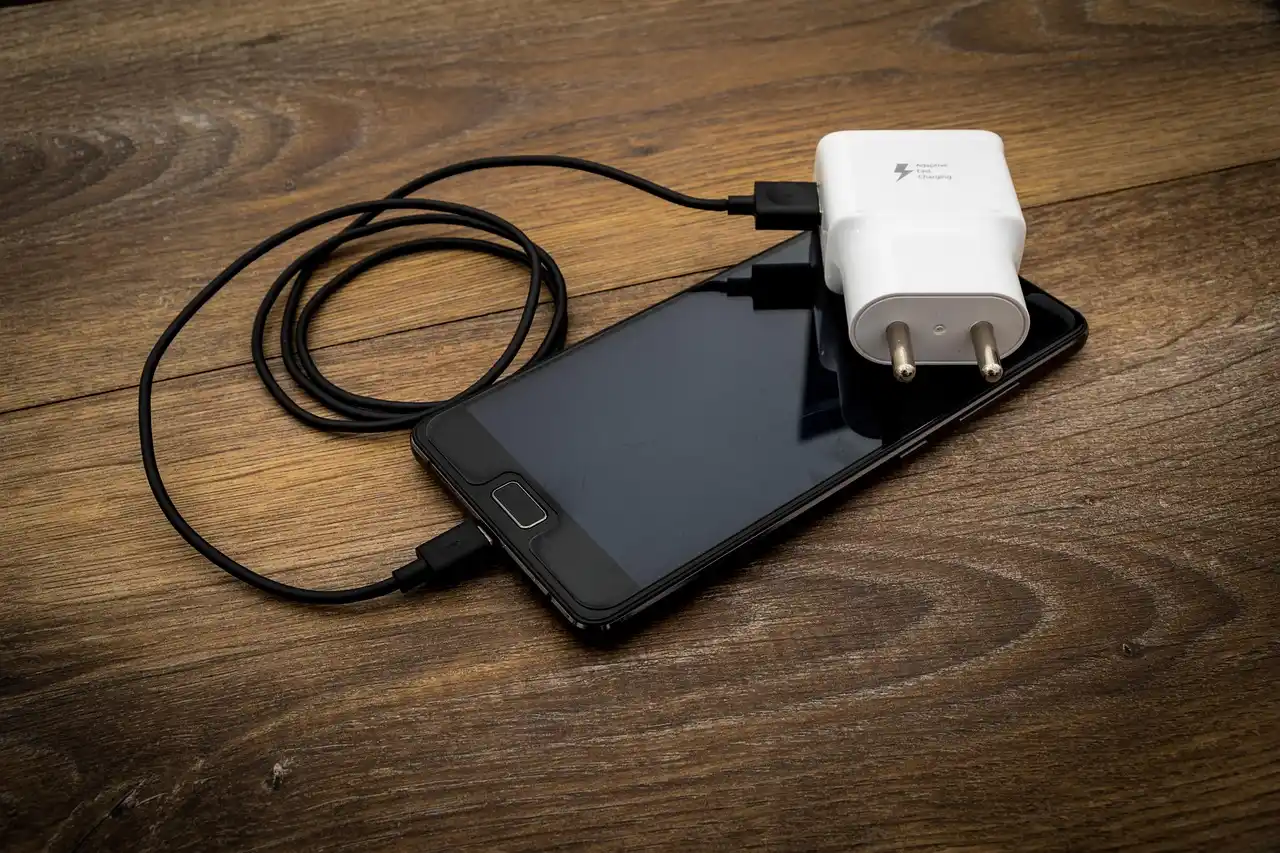
Why Does My Car Charger Say Charging but Not Charge?

If the charger says it is charging but the battery level does not rise after 10 to 15 minutes, one common cause is no real current flow: bad socket power, a blown fuse, a loose plug, or a failed charger. Ignore it, and you can end up with a dead phone or a battery that never recovers. This guide shows how to isolate the charger, lighter port, fuse, cable, and battery before you replace anything.
What that charging light really means
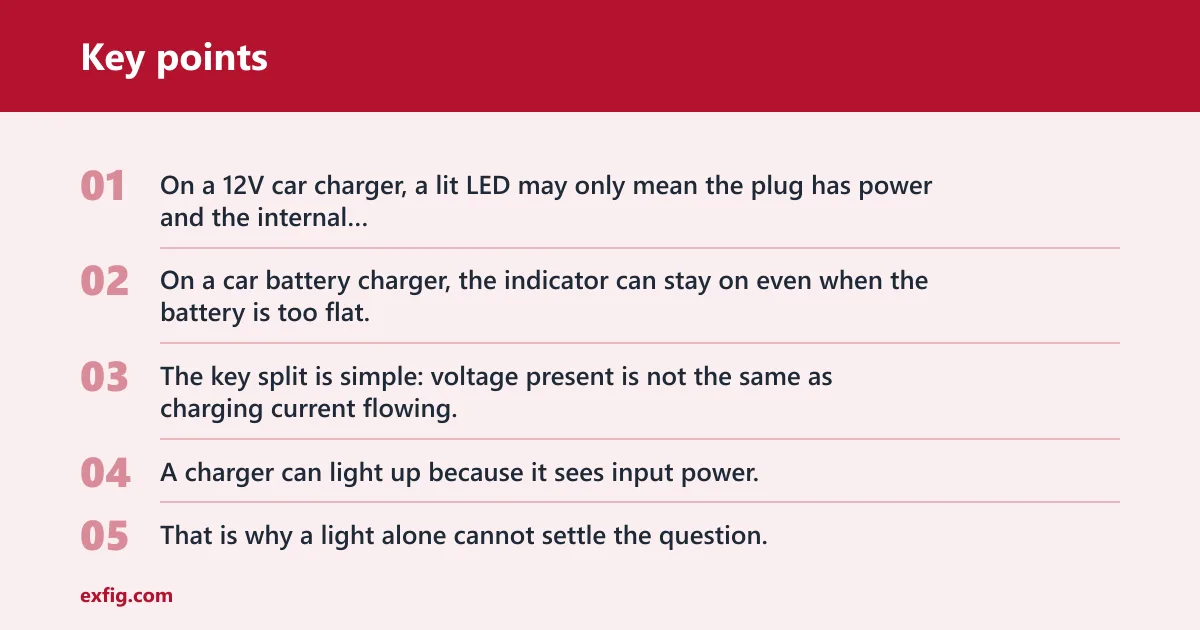
A charging light proves status, not success. On a 12V car charger, a lit LED may only mean the plug has power and the internal circuit is awake. On a car battery charger, the indicator can stay on even when the battery is too flat, too degraded, or too poorly connected to accept useful current.
Status light vs actual current flow
The key split is simple: voltage present is not the same as charging current flowing. A charger can light up because it sees input power, while the battery side still gets nothing useful from a weak socket, a poor ground, a bad cable, or a protection circuit that has stopped the output path.
That is why a light alone cannot settle the question. It may be enough to tell you the charger has power. It does not prove that the vehicle socket, cable, plug fuse, or battery is carrying load.
When a charger can look live but still fail
Common false positives include a plug that is half-seated, a lighter socket with worn side contacts, a fuse that protects the circuit but leaves the indicator lit on one side of the device, and a battery that looks like it is taking charge but immediately falls back once the charger stops.
Suppose a USB adapter lights up in the front 12V socket but the phone never gains battery percentage. If the same adapter works in the rear socket, the charger is not the first suspect. The front socket, its fuse, or its ignition-controlled circuit is more likely at fault.
Car charger decision table
| Symptom | Fastest test | Likely failed part |
|---|---|---|
| Charger light on, no current | Try a known-good charger in the same socket, then check voltage with a multimeter | Vehicle socket, fuse, or charger internal fault |
| Intermittent charging | Wiggle the plug gently and watch for dropouts | Loose connector, worn socket contacts, or damaged cable |
| Charger only works in one socket | Move the charger to another 12V accessory socket | One socket circuit, fuse, or grounding issue |
| Blown fuse | Inspect the fuse in the plug and the vehicle accessory fuse | Fuse in charger plug or vehicle circuit fuse |
| Loose connector | Check whether the plug stays firm without springing back | Worn lighter port, bent plug tip, or weak contact pressure |
| Dead battery | Measure battery voltage and check whether the charger starts a normal cycle | Battery state of charge |
| Degraded battery | Charge fully, then see whether it falls flat again after a short rest | Battery internal wear or loss of capacity |
| Ignition-dependent socket behavior | Turn the ignition to the correct accessory position and retry | Socket circuit that is inactive with ignition off |
| Light on, but charger only warms slightly and does not move the battery state | Swap in a charger that already works in another vehicle, then try another cable or adapter in the same socket | Charging cable / adapter damage |
Why is my car charger not working on the lighter port?
Most lighter-port failures come down to fit, contact pressure, or a dead socket circuit. A 12V car charger needs correct voltage and solid electrical contact. If the plug sits loosely, the socket is dirty or worn, or the port is ignition-switched and inactive, the charger can look powered while delivering little or nothing.
Loose fit in the 12V socket
The 12V accessory socket, also called the lighter port, is a vehicle power outlet used for chargers. It can have a blown fuse or poor connection, and it may not supply power if the ignition state or circuit is inactive. A charger that rocks in the socket often fails because the side contacts are not pressing hard enough.
Check for debris first. Then inspect the plug tip and the socket walls for heat marks, bent contacts, or looseness. If another charger behaves the same way in that socket, the fault points to the vehicle electrical system, not the charger.
Debris, wear, or damaged contacts
Dust, coins, and corrosion can prevent proper contact. So can spring contacts that have opened up after repeated use. A charger may light up as soon as the tip touches power, then cut out the moment vibration shifts it a fraction of a millimeter.
A common first-timer mistake is assuming the indicator light proves everything is fine. Picture a plug that lights in the front socket but fails every time the car hits a bump. That points to contact pressure, not charger speed.
Why one socket works and another does not
If the rear socket works and the front one does not, the charger is usually innocent. The failed socket may be on a different fuse, an ignition-controlled circuit, or a separate wire run with a poor connection. Use the working socket as your comparison point before buying parts.
- Test the charger in another socket.
- Test a different charger in the same socket.
- Check whether the socket only works with the ignition on or in accessory mode.
- Inspect the socket fuse and the plug fuse.
- Use a multimeter to confirm voltage at the socket.
How do you check the fuse and power circuit?
Check both fuses before replacing the charger. A 12V car charger can fail if the fuse in the plug has opened, and the vehicle socket can lose power if its own fuse has blown. Either fault can leave the LED on or create a false sense that the charger is alive.
Fuse in the charger plug
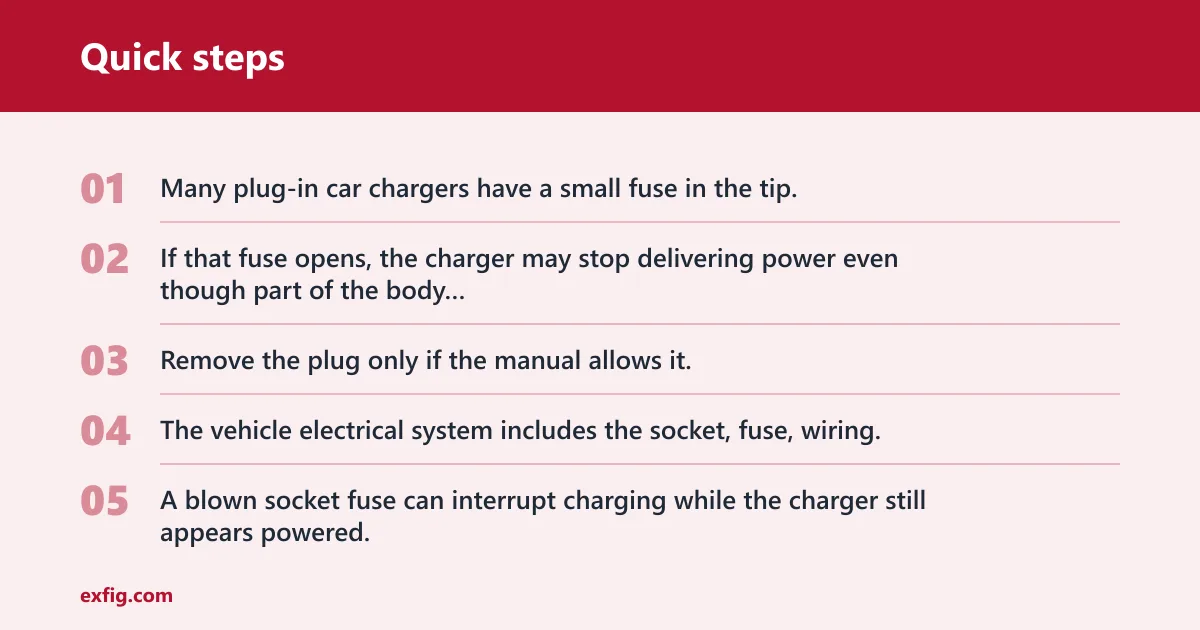
Many plug-in car chargers have a small fuse in the tip. If that fuse opens, the charger may stop delivering power even though part of the body still looks normal. Remove the plug only if the manual allows it, and replace the fuse only with the same type and rating listed by the manufacturer.
Vehicle fuse for the accessory socket
The vehicle electrical system includes the socket, fuse, wiring, and ignition-controlled circuits. A blown socket fuse can interrupt charging while the charger still appears powered. The owner’s manual or fuse card should identify the accessory socket fuse location.
Because fuse layouts vary by model, confirm the label in the manual before you pull anything. A socket that is dead on one side of the car but alive on another often points straight to the circuit layout, not the charger itself.
Ignition-controlled sockets and dead outlets
Some sockets only work with the ignition on or in accessory mode. That behavior is normal on many vehicles. If the socket appears dead with the key off, that does not always mean the fuse has failed.
Use the multimeter only after you know the socket should be live. If the socket wakes up with the ignition but the charger still does not move current, the next suspects are poor contact, plug damage, or a failing charger.
What does a multimeter tell you here?
A multimeter separates voltage presence from effective charging. That matters because a charger can show a light, yet still deliver too little usable power to the socket or battery. Used on the socket, it tells you whether the circuit is alive. Used on the charger output, it helps you separate power-source failure from charger failure.
Testing voltage at the socket
Set the meter to the correct DC voltage range for a 12V circuit. Check the socket with the vehicle in the state it is meant to power the outlet. A healthy reading shows the outlet has power, but it does not prove the charger can pass current under load.
Testing the charger output under load
A charger that measures voltage with no load may still fail when asked to work against a real device or battery. That is why a charger light can be misleading. If the meter shows power at the socket but the charger output collapses when connected, the cable, plug, or charger electronics may be failing.
Car charger with cable and LED activated when devices are connected to connectors is a reminder of the basic design: the LED often reacts to connection state, not to proven charging performance. In practice, you need the meter and a known-good load to separate the two.
Why voltage present still may not mean charging
Current needs a complete path. A socket can have voltage while the charger cannot draw enough because of a weak ground, dirt on the contacts, a loose adapter, or a battery that has gone flat enough to resist normal charging. Voltage tells you the circuit is awake. It does not tell you the battery is accepting energy.
Is the battery the real problem?
Sometimes yes. A dead battery can mimic charger failure, and a degraded battery can make a good charger look useless. If the battery is too low, internally worn, or unable to hold a charge, the charger may indicate activity without producing a meaningful recovery.
Dead battery versus degraded battery
A dead battery may be too low to wake the system normally, while a degraded battery may take some charge and then fall flat again. The distinction matters because the charger can be fine in both cases. A separate test or multimeter reading is needed to confirm battery state of charge.
A battery that accepts charge then falls flat
Suppose the battery appears to charge for an hour, then drops back quickly after the engine is off. That pattern often points to a worn battery rather than a bad charger. The charger may be doing its job; the battery may simply be unable to retain the energy.
On some car battery chargers, the indicator can stay in a charging state even when the battery is not accepting current in a normal way. That is why a status light is only one clue. A bad battery can still look like a charger problem until you separate the tests.
Can a charger be too powerful for my car or battery?
Yes, if the output, socket, or charging method does not match the vehicle or battery setup. A purpose-made home charger can deliver up to four times the power of a three-pin plug, and a domestic socket/adaptor can place a significant load on a standard domestic socket. Electrifying states a home charger can charge at up to 7.2kW, while a 13A three-pin plug and an AC 7kW wall box are different connection types with different limits and use cases.
Matching the charger to the socket or battery
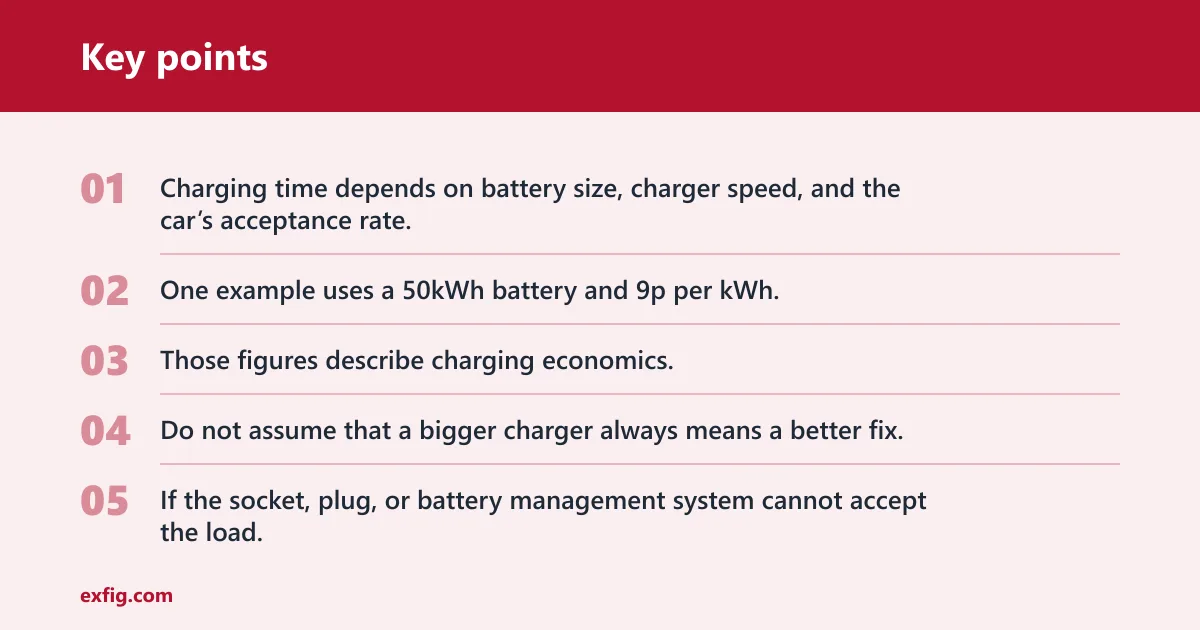
Charging time depends on battery size, charger speed, and the car’s acceptance rate. One example uses a 50kWh battery and 9p per kWh, and gives a recharge cost from empty to full of about £4.50. Those figures describe charging economics, not a universal fit for every outlet or battery.
Do not assume that a bigger charger always means a better fix. If the socket, plug, or battery management system cannot accept the load, the charger may report activity without delivering the result you expect.
When the vehicle circuit limits output
Those details show why power delivery depends on the circuit design, not only the charger label. Check the manufacturer’s listing for your model if you are unsure which circuit or outlet is intended for charging.
What to verify in the manual
Follow the vehicle/product manual, never work under a vehicle held only by a jack, never exceed the vehicle’s rated roof/hitch/tow limit, keep items out of airbag zones and the driver’s view, and check local laws. For charging equipment, confirm the intended socket, fuse rating, voltage range, and whether the outlet is ignition-controlled.
Frequently asked questions
Why isn’t my charger charging?
The usual cause is a broken chain somewhere between power and load: the socket has no supply, the fuse is open, the plug is loose, the cable is damaged, or the battery will not accept charge. Start with a known-good outlet and a multimeter so you can prove where the failure sits before replacing parts.
Why is my battery charger not charging?
A battery charger may appear active while the battery is too depleted, too worn, or connected too poorly to accept current. Check the clamps or leads, confirm the charger output with a meter, and then verify battery state of charge separately. A light alone is not enough to prove charging.
Why does my car charger say charging but not charge?
The indicator often shows power or status, not guaranteed current flow. That can happen with a loose 12V plug, a socket with poor contact pressure, an ignition-switched outlet that is not live, or a charger whose cable or internal circuitry has failed. Use a known-good charger and a multimeter to separate those cases.
How do I know if the charger, port, or battery is the problem?
A common way to narrow it down is to test in this order: same charger in another socket, different charger in the same socket, then a multimeter at the socket. If the socket has power and another charger works, the first charger is suspect. If no charger works there, the port or fuse is the likely fault. If the battery still will not hold charge, the battery itself may be worn.
How long do chargers last before they fail?
There is no single lifespan that fits every charger. Heat, bent connectors, repeated plugging, and cable strain at the ends shorten life. If the charger works only when the cable is held at a certain angle, or if the indicator flickers with vibration, the hardware is already telling you it is near failure.