LED Interior Lights vs Halogen Bulbs: What Changes?

LED interior bulbs usually make cabin lighting brighter, whiter, and cooler, but the biggest change is how the light spreads, not the wattage on the box. Bad LED swaps can create glare, hot spots, flicker, or warning-light issues in some cars. This guide covers what changes in dome, map, and vanity lights, plus heat, power draw, and fitment problems to watch for.
| Decision factor | LED interior lights | halogen bulbs | Winner |
|---|---|---|---|
| Brightness impression | Often looks brighter on first glance because light is more concentrated and usually whiter. | Usually looks softer and warmer, with less apparent punch. | LED interior lights |
| Beam spread | Can be uneven if the package does not send light in a wide pattern. | Usually spreads light more evenly from a filament in many interior housings. | halogen bulbs |
| Heat at the lens | Lower lens heat in most cases, but the bulb still needs thermal control. | Runs hot and can warm the lens and nearby trim. | LED interior lights |
| Power draw | Usually lower; LED lighting products can be up to 90% more efficient than incandescent light bulbs. | Higher, because the filament turns much of the energy into heat. | LED interior lights |
| Lifetime and failure pattern | Brightness declines over time as lumen depreciation; lifetime is commonly tied to 30% light output loss. | Often fails suddenly when the filament opens. | LED interior lights |
| Compatibility risk | More likely to show polarity issues, flicker, delayed shutoff quirks, or dimmer mismatch. | Usually behaves as the vehicle wiring expects. | halogen bulbs |
Brightness, spread and cabin light quality
The trade-off is simple: halogen bulbs give a broad, warm, even glow from a filament. LED interior lights send light in a set direction, so they can look brighter while still leaving uneven patches if the bulb is not built for 360-degree spread. In a cabin, that difference shows up as glare, shadows, or a cleaner but harsher look.
LED lighting can be up to 90% more efficient than incandescent light bulbs, and many replacements draw less power than halogen bulbs too. The result still depends on bulb design, housing shape, and whether the car’s wiring expects the same electrical load. (Energystar)
Brightness impression
LED interior lights often seem brighter because they emit light in a specific direction and frequently use a whiter color. That does not mean the whole cabin gets more useful light. A low-cost LED can put a bright spot on the lens while leaving the footwell or rear seat dim.
Halogen bulbs usually look softer because the filament sends light broadly in many directions. That broad fill can feel calmer at night, especially in a dome light that sits close to passengers’ eyes.
Beam spread
Direction matters more than raw wattage in an interior lamp. LEDs are directional light sources, unlike incandescent and CFL bulbs, so the replacement has to be engineered for 360-degree spread if the original housing expected a filament in the center.
Picture a festoon dome light aimed through a frosted lens. A narrow LED board may make the center hot and the edges dull, while a multi-emitter or wraparound design can keep the cabin more even.
Heat, power, and lifespan
Halogen bulbs use a tungsten filament and are commonly reported to release most of their energy as heat. That heat reaches the lens and nearby trim, which is why some interior lamps feel warm after a long drive.
LED products use heat sinks to absorb heat and prevent overheating, and thermal management is described as the single most important factor in LED performance. Higher operating temperature shortens LED useful life, so a cheap bulb with poor heat sinking can fade early even if it never burns out suddenly.
LED lifetime is defined by light output dropping 30 percent, not by sudden burn-out. That means the bulb usually dims slowly over time instead of going dark all at once. A halogen bulb is the opposite: it may stay stable, then fail abruptly.
Can you swap them directly?
You can often replace halogen interior bulbs with LED bulbs directly if the base size matches, but direct does not always mean trouble-free. Polarity is a common issue because many LED bulbs work only one way. If the bulb does not light after installation, flipping it may solve the problem.
CANbus systems, bulb-check circuits, delayed shutoff, and some dimmers can also change the result. A vehicle may see the lower current draw as a fault, or the bulb may glow faintly when it should be off. That is why a simple plug-in swap can still behave poorly.
A common first-timer mistake is buying the right bulb shape but the wrong width or length. In a vanity light, even a very small mismatch can keep the lens from closing cleanly, or push the emitters too close to the diffuser and create bright dots.
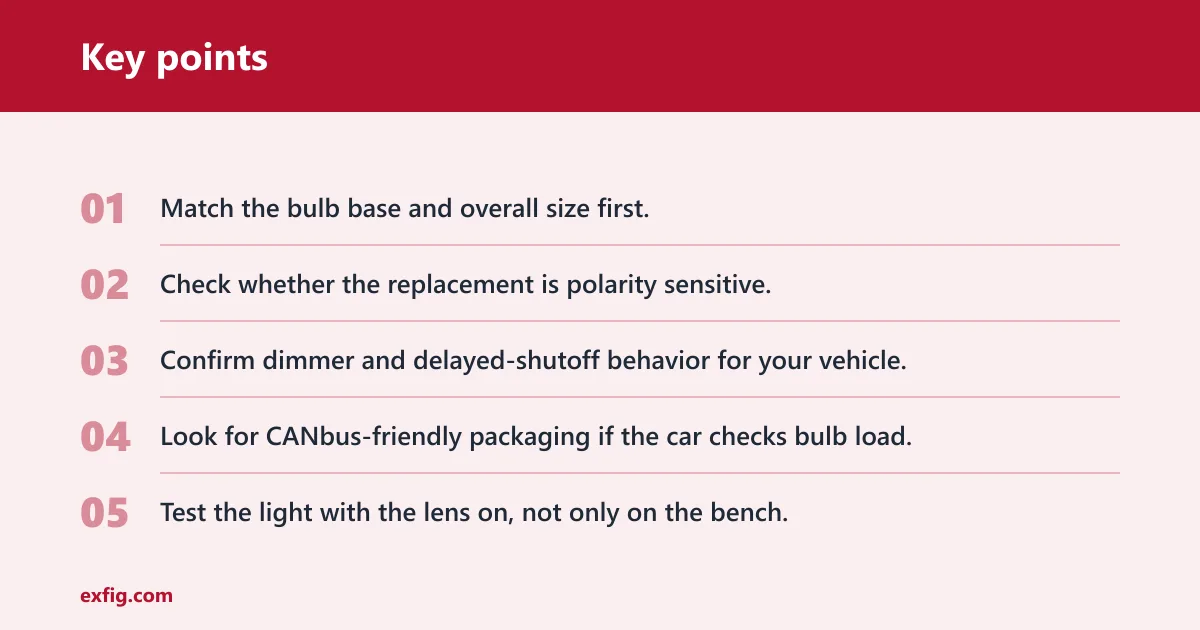
- Match the bulb base and overall size first.
- Check whether the replacement is polarity sensitive.
- Confirm dimmer and delayed-shutoff behavior for your vehicle.
- Look for CANbus-friendly packaging if the car checks bulb load.
- Test the light with the lens on, not only on the bench.
What color temperature should you choose?
Warm white is usually the safest choice for cabin comfort at night. It stays closer to the softer tone of halogen bulbs and is less likely to feel harsh after dark.
Cool white can make the cabin look cleaner and more modern, but it can also make glare stand out more on glossy trim and windshields. White light in LEDs is commonly produced with phosphor, and colored LEDs can be made in amber, red, green, or blue when a specific look is desired.
For reading a map or finding a dropped item, a neutral white LED often works well. For a vanity light, a very cool bulb can be unforgiving in mirrors and may look brighter than it feels.
📊 LED lifetime is defined by light output dropping 30 percent, not by sudden burn-out. Source: Learn About LED Lighting.
Interior bulb comparison table
| Use case | halogen bulbs | LED interior lights | Best for |
|---|---|---|---|
| Dome lights | Even, warm fill with less glare | Can be brighter, but may hotspot without wide spread | halogen bulbs for calm fill; LED interior lights for brighter cabins with a good diffuser |
| Map lights | Soft light that is easy on the eyes | Good if the beam is aimed and the bulb is polarity-safe | LED interior lights when you want a sharper reading beam |
| Vanity lights | Warm and forgiving on skin tones | Can look crisp, but may reveal glare or color shifts | halogen bulbs for softer mirror lighting; LED interior lights only if the beam is even |
How beam spread changes
The main in-car difference is coverage. A halogen filament radiates broadly, so many factory housings were built around that shape of light. A directional LED can feel intense in one spot and weak in another unless the bulb uses emitters on multiple sides.
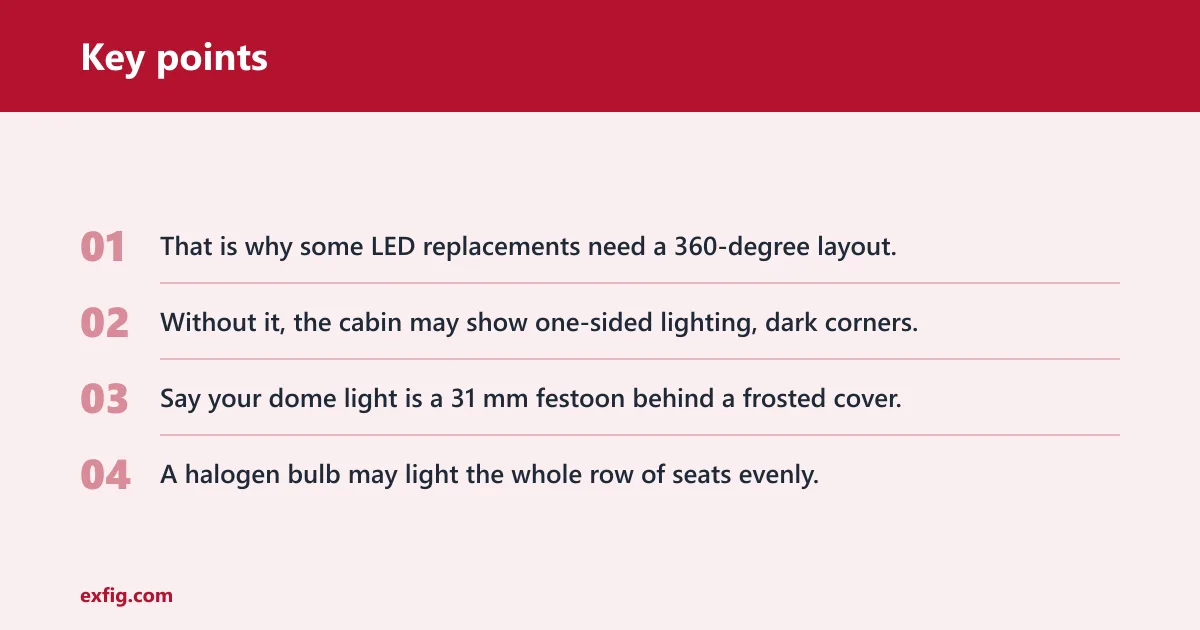
That is why some LED replacements need a 360-degree layout. Without it, the cabin may show one-sided lighting, dark corners, or a bright line across the lens instead of a smooth fill.
Say your dome light is a 31 mm festoon behind a frosted cover. A halogen bulb may light the whole row of seats evenly, while a narrow LED board can leave the rear edge dark and put a hot spot near the center.
Will LED interior bulbs be brighter than halogen bulbs?
Often yes, but brightness is not the same as useful cabin light. LED interior bulbs can appear brighter because they concentrate output and usually use whiter light, yet a poor beam pattern can make the cabin less comfortable than a dimmer halogen bulb with better spread.
For a map light, that extra punch can be useful. For a dome light near passengers’ faces, too much concentrated output can cause glare and make the lens look uneven.
Do LED interior bulbs use less power than halogen bulbs?
Yes, in most cases they do. LED lighting products can be up to 90% more efficient than incandescent light bulbs, and many LED replacements use more than 50% less electricity than traditional counterparts. In a cabin, the practical gain is lower electrical load and less waste heat.
That said, a lower draw does not guarantee better behavior. Some vehicles watch bulb current closely, so a low-draw LED can trigger bulb-check warnings or odd dimming if the car expects a higher load.
Will LED interior lights last longer than halogen bulbs?
Usually yes, but the meaning of “last longer” is different. LED lifetime is defined by light output dropping 30 percent, so the bulb may fade gradually instead of dying suddenly. Halogen bulbs tend to have shorter life and can fail at once when the filament breaks.
A common comparison article puts a halogen bulb at about 2,000 hours of life, while LED lighting lifespan ranges from 20,000 to 50,000 hours. In real interior use, heat control matters because high operating temperature shortens LED useful life.
Do LED bulbs need heat management inside a car?
Yes. Even though they usually run cooler at the lens than halogen bulbs, LED bulbs still need heat management inside the bulb body. Heat sinks absorb that heat, and poor thermal control can shorten useful life or cause output loss over time.
This matters more in a closed dome housing or a small vanity lamp where airflow is limited. If the LED driver and heat sink are undersized, brightness can sag after a few minutes instead of staying steady.
Choose LED interior lights if… / Choose halogen bulbs if…
Choose LED interior lights if you want a whiter cabin, lower power draw, and a sharper map-light beam; if the bulb is the right size; and if your vehicle tolerates polarity, dimming, and bulb-check behavior. LED also fits well when the housing has a diffuser that can spread directional light cleanly.
Choose halogen bulbs if you want the most even glow with the least fuss; if the dome or vanity light is sensitive to glare; or if the car already uses delayed shutoff, dimming, or load monitoring that an LED may upset. Halogen is still the safer pick when beam spread matters more than output.
Frequently asked questions
What changes when you replace halogen interior bulbs with LED bulbs in a car?
The first changes are color, spread, and glare. LED interior bulbs usually look whiter and can seem brighter, but they may create hot spots or dark edges if the housing was built around a halogen filament. Heat at the lens usually drops, while compatibility issues can appear.
Why do some LED interior bulbs flicker or look uneven compared with halogen?
Flicker often comes from polarity, dimmer compatibility, or a bulb-check circuit that does not like the lower load. Uneven lighting usually comes from directional output and poor emitter placement. If the replacement does not mimic a filament’s spread, the cabin can look patchy through the lens.
What color temperature should I choose for LED interior lights?
For most cabins, warm white is the easiest choice at night because it is closer to halogen bulbs and feels softer on the eyes. Cool white works if you want a cleaner look and do not mind stronger contrast. Very blue light is more likely to feel harsh.
Can I replace halogen interior bulbs with LED bulbs directly?
Often yes, but only if the base, size, and depth match. Direct fit does not guarantee good results because polarity, dimmer behavior, delayed shutoff, and bulb-check systems can still cause problems. Check the bulb after installation with the lens fitted, not just outside the housing.