Are OBD2 Scanners Compatible with All Cars?

OBD2 scanners generally work only when the car’s port, protocol, and regional requirements match the tool. The common 16-pin socket is necessary, but it is not enough. A scanner may read check-engine codes on one car and fail on another with the same-looking connector.
What compatibility really means beyond the plug
Why a scanner can fit the port but still fail to talk to the car
OBD2 compatibility is a software-and-hardware match, not a plug-shape check. The vehicle needs to support the relevant emissions-diagnostics standard for its market, and the scanner must speak the same protocol family. A powered-up scanner can still show “no communication” if the car uses a protocol the tool does not support.
That is why the first question is not “does it plug in?” It is “does this car use a supported standard, in this market, for this model year?”
What “compatible” means for basic codes versus advanced diagnostics
Most basic OBD2 readers can read and clear check-engine codes, and many show live data or freeze-frame data. That is the emissions-diagnostics layer. Full-system diagnostics are different. Airbags, ABS, body modules, and manufacturer-specific functions may need a more capable scan tool, even on a car with a valid OBD2 port.
That split matters. A cheap reader can be the right tool for an emissions light. It may be the wrong tool for transmission data, service resets, or brand-specific menus.
📊 A linked 2026 update discusses tested scanners. Source: Best OBD-II Scanners for 2026, Tested.
What makes a car OBD2 compatible?
A car is OBD2 compatible when it has the right connector and the right protocol support for its market and model year. The 16-pin D-shaped diagnostic connector is the visible clue. It is not the whole answer. The vehicle still has to accept standard OBD2 queries and return data in a format the scanner can understand.
The 16-pin connector is necessary, but not sufficient
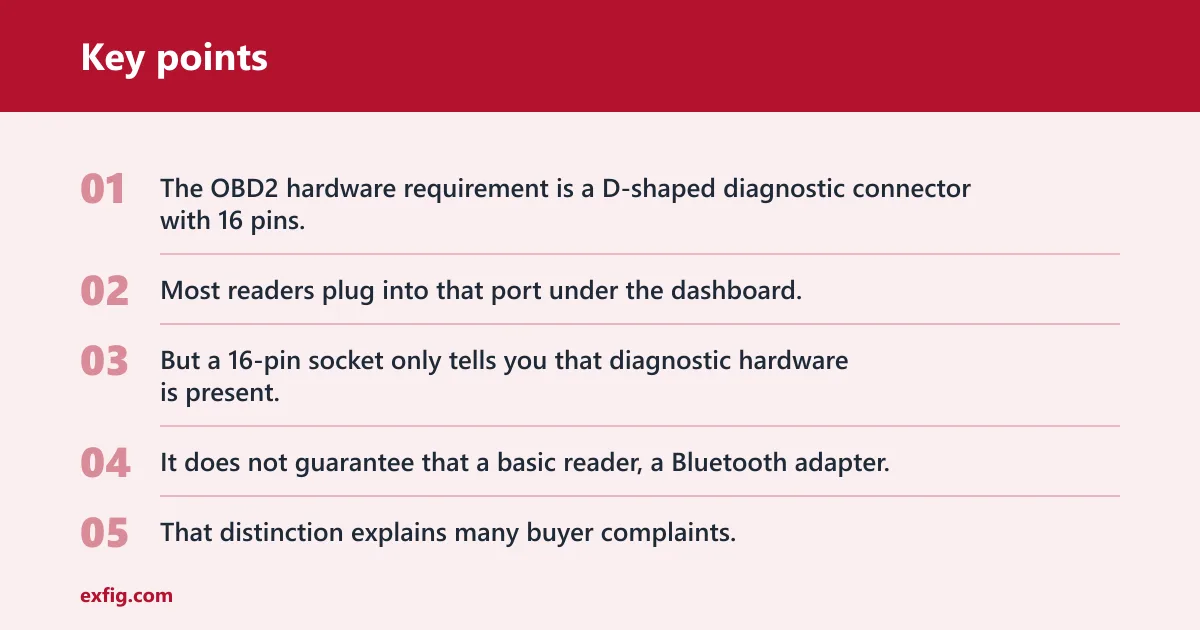
The OBD2 hardware requirement is a D-shaped diagnostic connector with 16 pins. Most readers plug into that port under the dashboard. But a 16-pin socket only tells you that diagnostic hardware is present. It does not guarantee that a basic reader, a Bluetooth adapter, or a handheld scan tool can speak to every module.
That distinction explains many buyer complaints. The tool powers up. The app sees voltage. Then communication stops.
Which protocol families a scanner must support?
Passenger-car OBD2 compatibility depends on protocol support. The main families to know are SAE J1850 VPW, SAE J1850 PWM, ISO 9141-2, ISO 14230-4 KWP, and ISO 15765-4 CAN. Some app-based adapters, such as Car Scanner, list support for SAE J1850 VPW and ISO 15765-4 CAN, which shows why protocol matching matters.
Do not treat SAE J1939 as a normal passenger-car OBD2 protocol. It is mainly a heavy-duty standard, so it is not the answer for most light-duty cars. That is a common source of confusion when people search for a “universal” scanner.
Why market rules matter more than a global rule
Model year alone is not global. OBD2 adoption depends on market rules. The U.S. made OBD2 mandatory for all cars since 1996. EU gasoline cars got mandatory OBD2 starting in 2001, and EU diesel vehicles were phased into mandatory OBD2 requirements around 2003 for some approvals and broadly by the general 2004 cutoff. China made the standard mandatory in 2008 for many vehicles, depending on class and implementation phase.
That means a 2000 car in Europe may not behave like a 2000 car in the U.S. A scanner buyer has to match the tool to the vehicle’s market first, then to the model year, then to the job.
OBD2 compatibility matrix
The table below separates connector presence, protocol support, and likely outcome. It also shows the scanner type that fits each case.
| Region or market | Model-year threshold | OBD2 port presence | Standard-protocol support | Likely scanner result | Recommended scanner type |
|---|---|---|---|---|---|
| U.S. | 1996 and newer | Usually present on light-duty vehicles | Usually one of the standard OBD2 protocol families | Basic reader usually reads and clears emissions codes | Basic code reader or app adapter for standard codes |
| EU gasoline | 2001 and newer | Usually present on covered vehicles | Standard OBD2 protocol support is expected on compliant cars | Standard diagnostics usually work if the scanner supports the protocol | Basic reader for codes; handheld tool if you need more data |
| EU diesel | 2003 and newer | Usually present on covered vehicles | Standard OBD2 protocol support is expected on compliant cars | Should work for standard emissions queries when the tool matches the protocol | Basic reader, then step up for system-specific work |
| China | 2008 and newer | Often present on compliant vehicles | Depends on the vehicle and software support | Common scanners may work for basic codes; enhanced functions vary | Protocol-aware reader or a better handheld scan tool |
| Japan-market RHD imports | No single global cutoff | May have a 16-pin port, or may need an adapter | May not support OBDII in the same way as domestic-market cars | Common failure point: tool powers up but cannot communicate | Scanner with the right protocol support, or a brand-specific adapter |
| Pre-1996 vehicles | Before U.S. OBD2 adoption | Often no true OBD2 port | May use older or manufacturer-specific diagnostics | Basic OBD2 readers often fail to connect | Brand-specific adapter or older diagnostic tool |
What scanner type fits each row of the matrix
Use the matrix as a buying filter. If the vehicle is a straightforward 1996+ U.S. car, a basic code reader or app adapter is often enough for check-engine work. If it is an import, a diesel, a swap, or an older vehicle, start by checking protocol support and connector type before choosing the tool.
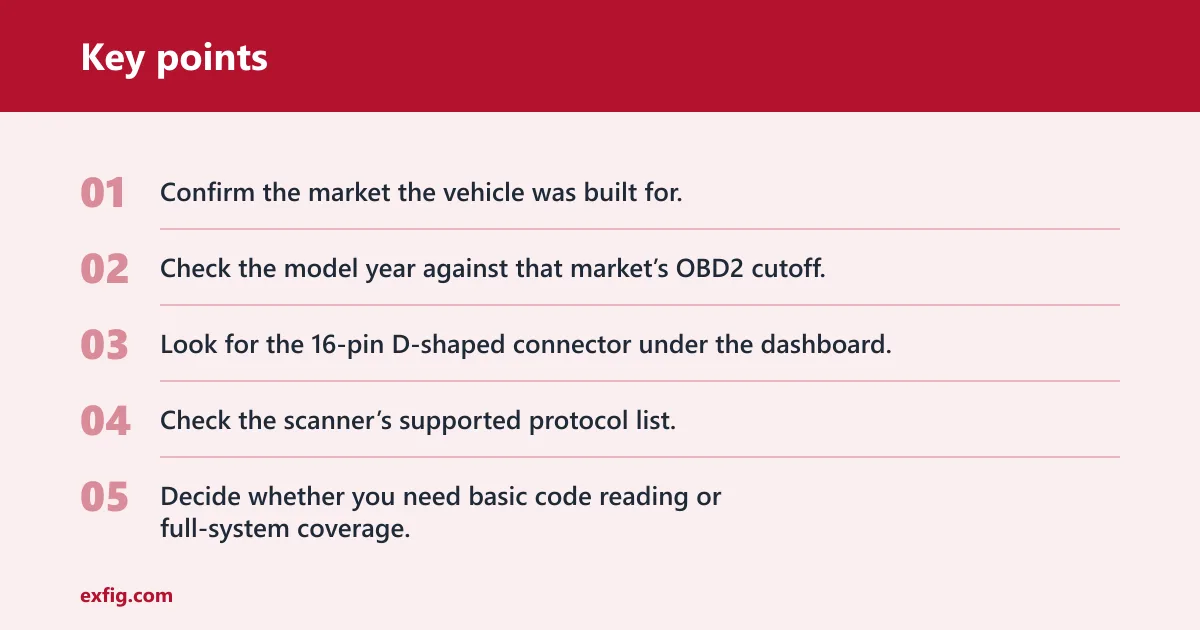
- Confirm the market the vehicle was built for.
- Check the model year against that market’s OBD2 cutoff.
- Look for the 16-pin D-shaped connector under the dashboard.
- Check the scanner’s supported protocol list.
- Decide whether you need basic code reading or full-system coverage.
Why does my car have an OBD2 port but the scanner won’t connect?
The port can be present even when communication fails. The most common reasons are protocol mismatch, incomplete standard support, missing power on the diagnostic pins, or a vehicle that only exposes limited emissions data through the port. In other words, the connector can exist while the command set still does not match the scanner.
Protocol mismatch versus connector-only presence
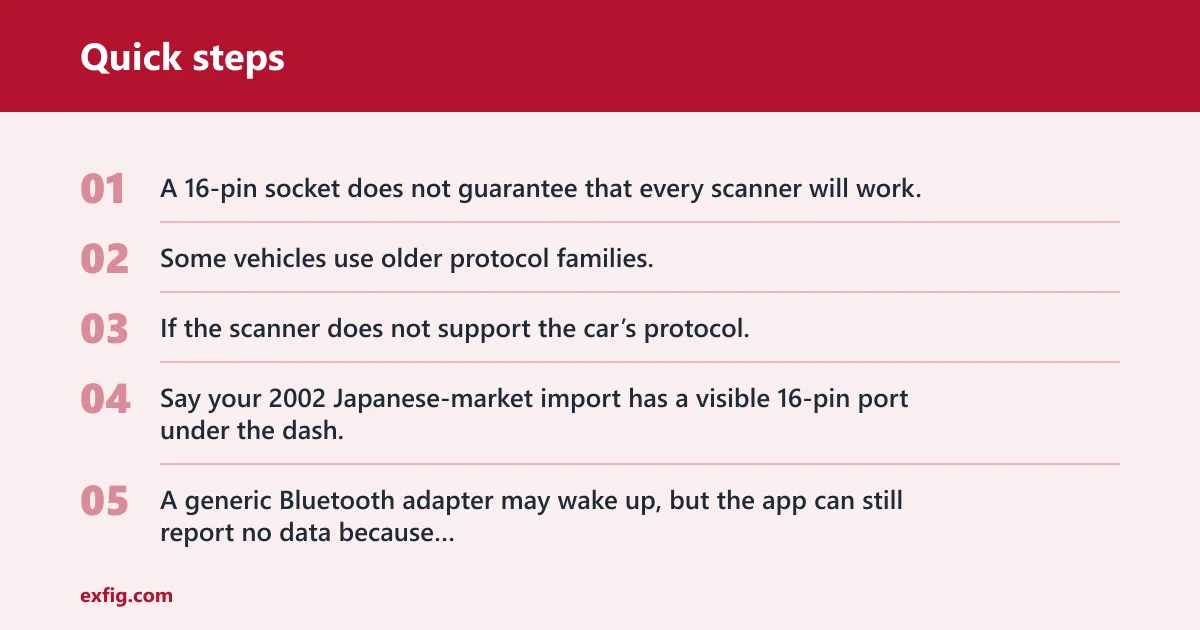
A 16-pin socket does not guarantee that every scanner will work. Some vehicles use older protocol families, and some imports do not support standard OBDII the way U.S.-market cars do. If the scanner does not support the car’s protocol, it may never get past the connection screen.
Say your 2002 Japanese-market import has a visible 16-pin port under the dash. A generic Bluetooth adapter may wake up, but the app can still report no data because the vehicle does not speak the protocol the adapter expects.
Power and pinout problems at the port
Sometimes the issue is physical, not software. The port may be damaged, the fuse may be blown, or the vehicle may not be providing power where the scanner expects it. On a standard OBD2 connector, that usually means pin 16 for power and pins 4 and 5 for ground. In that case, the tool may not turn on at all, or it may power up but fail as soon as it tries to query the car.
Emissions data works, but enhanced modules do not
A scanner can succeed on generic emissions data and still fail on manufacturer-specific functions. That is because basic OBD2 queries are standardized, while deeper module access is not. Suppose the check-engine light is on in a 2010 sedan. A basic reader may show the P-code, yet it may not access ABS or body-control modules even though the car has a working port.
Which scanner type should you buy for your car?
Match the scanner to the job. If you only need to read and clear check-engine codes on a compliant car, a basic code reader is enough. If you want live data on a phone, choose a Bluetooth or Wi-Fi adapter that supports the vehicle’s protocol. If you need broader coverage, step up to a handheld scan tool with more functions.
Basic code reader
This is the simplest option. It is for standard OBD2 code reading and clearing, and it usually suits drivers who want a quick check on an emissions fault. It is the first choice for many standard U.S. vehicles from 1996 onward and for similar compliant cars in other markets.
Bluetooth or Wi-Fi adapter with an app
An ELM327 adapter is a common choice for OBD2 apps. It can work with many standard OBD2 protocols, so it is useful for generic code reading and live data. It does not guarantee manufacturer-specific diagnostics, advanced coding, or every enhanced function the app advertises.
That is the key limitation. The adapter may be fine for standard P-codes, but not enough for all car systems.
Handheld scan tool
A handheld tool is the safer choice when you want a larger feature set and a screen that is not tied to a phone. It is often the better pick for users who need more than code reading, especially when the vehicle is older, imported, or known to use a less common protocol family.
When manufacturer-specific coverage matters
If the goal is module access beyond standard emissions data, check the manufacturer-specific coverage before you buy. That is especially important for gray-market imports, Japan-market RHD vehicles, and some pre-1996 cars. A basic OBD2 device may still be the wrong tool even though the connector looks right.
Do OBD2 scanners work on all cars?
No. They work on cars that meet the standard and speak a supported protocol, but not on every vehicle with a similar plug. The strongest odds are on covered U.S., EU, and China-market vehicles from the relevant cutoff years onward. Outside that group, compatibility becomes a case-by-case check.
Pre-1996 vehicles
Many pre-1996 vehicles are not a good fit for standard OBD2 scanners. They may use older diagnostic systems, special adapters, or brand-specific tools. If a car predates the cutoff, do not assume a generic reader will work just because the dashboard has a diagnostic socket.
Gray-market or Japan-market imports
Japan-market cars are a special case. Car Scanner notes that Japan-market cars often do not support OBDII. That means a buyer may need a protocol-specific scanner, a brand-specific adapter, or a tool designed for non-U.S. import diagnostics rather than a generic reader.
Diesel, swap, and nonstandard cases
Diesels, engine swaps, and modified vehicles can produce mixed results. Some communicate normally; others expose only part of the data; some have been rewired enough that the port looks standard while the communication path is not. In those cases, the right tool depends on the vehicle’s actual electronics, not the badge on the hood.
A common first-timer mistake is buying the cheapest adapter because the socket is 16-pin. That works only when the rest of the compatibility chain also lines up.
Frequently asked questions
Are OBD2 scanners compatible with all cars?
No. They are compatible only with vehicles that have a supported OBD2 or EOBD setup, the correct 16-pin connector, and a matching protocol. Market rules matter. A scanner can work on one car and fail on another that looks similar from the outside.
Are OBD2 scanners universal?
No. “Universal” is too broad. Many scanners are broadly compatible with standard emissions diagnostics, but they are not universal for every make, model, protocol, or module. The safe view is that they are universal only within the supported standard and vehicle list.
Will any OBD2 scanner work on my car?
No. You need a scanner that matches the car’s market, model year, and protocol family. A basic reader may be enough for standard code reading, but a car with an older or nonstandard setup may need a more capable tool or a specific adapter.
Are all OBD2 scanners the same?
No. Basic code readers, Bluetooth adapters, Wi-Fi adapters, and handheld scan tools do different jobs. Some only read and clear codes. Others show live data. A few offer broader system access, but manufacturer-specific functions still vary by tool and by vehicle.
Can I use an OBD2 scanner on a pre-1996 car?
Sometimes, but not usually with a standard OBD2 reader. Pre-1996 vehicles often use older systems or special adapters. Check the car’s diagnostic standard first. If it is not OBD2-compliant, a different tool may be required.