

Are Vent Phone Mounts Safe for Heavy Phones and Rough Roads?

Vent phone mounts are generally only a reasonable choice for heavier phones on rough roads if the clip is stiff, the vent blades are metal or reinforced, and the phone is not so heavy that sag, slip, or drop risk becomes more likely. A poor mount can block controls, trap heat around the phone, or let it fall into the footwell during braking or a pothole hit. This guide explains how phone mass, vent geometry, clip fatigue, and cabin heat determine whether a vent mount is a safe choice.
How vent clips handle weight and vibration
A vent phone mount clips to air vent slats, not the dashboard. That position keeps the phone close to eye level, but it also puts the full load on thin plastic fins or metal blades that were built to move air, not necessarily to hold a swinging mass over bumps.
Rough-road vibration adds side load and twisting force. Potholes, speed bumps, gravel, and washboard pavement do not only shake the phone; they also try to pry the clip open and rotate the mount downward.
How the mount carries the load
The mount acts like a small lever. A heavier phone increases torque on the clip, and a thick case moves that weight farther from the vent face. The farther the mass sits from the slat, the more likely the mount is to creep downward after repeated bumps.
That is why short-trip fit can mislead you. A mount may feel fine for five minutes in city traffic and still loosen after repeated vibration, especially if the clip already sits on a thin or flexible vent blade.
Are vent phone mounts safe for heavy phones on bumpy roads?
They can be safe, but only in a narrow set of conditions: a stiff clip, a strong vent structure, and a phone that is not too heavy for the mount’s lever arm. Once the phone moves into the large-phone class, rough roads expose wobble, rotational drift, and clip fatigue much faster than smooth commutes do.
Where large phones start to stress the clip
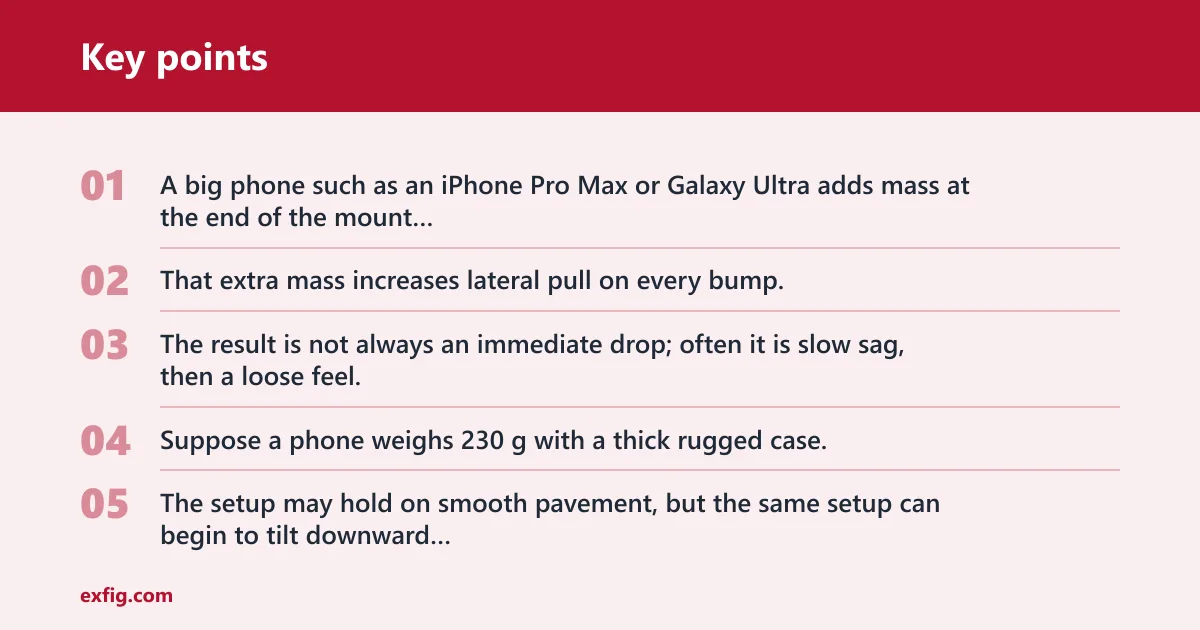
A big phone such as an iPhone Pro Max or Galaxy Ultra adds mass at the end of the mount arm. That extra mass increases lateral pull on every bump, and the effect grows if the phone sits in portrait mode with a tall case. The result is not always an immediate drop; often it is slow sag, then a loose feel, then a failure on a sharp hit.
Suppose a phone weighs 230 g with a thick rugged case, and the mount grips a thin horizontal vent blade. The setup may hold on smooth pavement, but the same setup can begin to tilt downward after repeated potholes because the clip has to resist both downward weight and repeated rotational shock.
How thick cases add torque and wobble
Thick cases matter because they extend the center of mass farther from the vent face. That makes the mount wobble more on bumps and puts extra strain on the clip jaws. Cases with hard edges can also make magnetic alignment less forgiving, which increases the chance of a small shift that grows over time.
A common first-timer mistake is treating “fits the phone” as the same as “safe on rough roads.” Fit only means the jaws or cradle can close around the device. It does not mean the vent blade can carry that load safely for weeks of vibration.
Magnetic vs gravity mounts
Magnetic mounts rely on neodymium magnets, and some older phones or Android devices may need a thin metal plate for attachment. They are quick to place, but rough pavement can let the phone shift slightly if the contact patch is small or the plate sits off-center. Gravity mounts use spring-loaded arms that close under the phone’s weight, and that design can be steadier on some mounts and vent setups, depending on the vent design and the phone size.
Magnetic mounts and shift risk on bumps
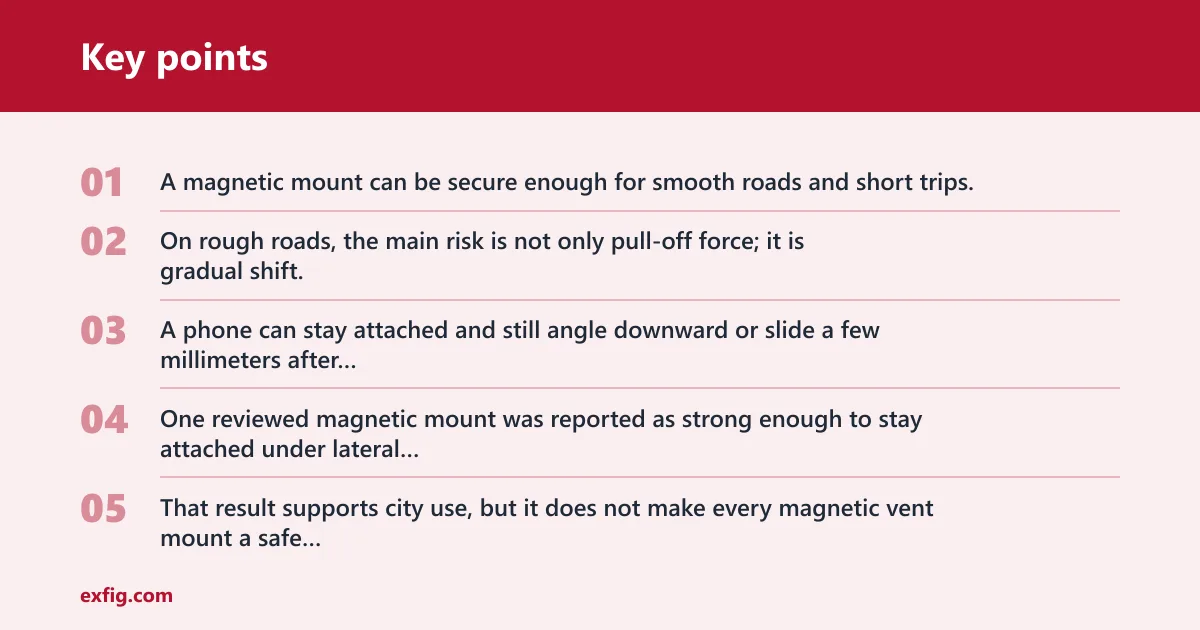
A magnetic mount can be secure enough for smooth roads and short trips, especially with a compatible phone and a well-centered ring. On rough roads, the main risk is not only pull-off force; it is gradual shift. A phone can stay attached and still angle downward or slide a few millimeters after repeated shocks.
One reviewed magnetic mount was reported as strong enough to stay attached under lateral force in testing, and a strong magnetic mount did not drop a phone during several weeks of city driving. That result supports city use, but it does not make every magnetic vent mount a safe choice for washboard roads or repeated potholes.
Gravity arms and their stability trade-off
Gravity mounts can be a good choice for some rough-road setups because the spring-loaded arms keep the phone seated with mechanical support. The trade-off is size: gravity mounts are usually bulkier and may take two hands to seat the phone.
That extra bulk can also place more load on the vent slat if the arm assembly hangs far from the grille. So the stability advantage depends on the mount design, the vent design, and the phone size.
When metal plates or MagSafe rings matter
Metal plates and MagSafe-style rings matter because they change how securely the phone couples to the mount. A centered ring usually performs better than a loose plate because it resists side shift. If the plate is small, off-center, or hidden under a thick case, rough-road movement can grow even when the mount feels strong at first.
Vent geometry safety guide
Vent shape decides a lot of the failure risk. Horizontal slats usually give a more predictable grip point than vertical slats, but thin slats, loose slats, and brittle older plastic fail first. Round vents are especially awkward because many clips cannot sit flat or lock into them cleanly.
Horizontal versus vertical slats
Horizontal slats often give the clip a longer surface to bite on, which can help with centering and resistance to twist. Vertical slats can work, but they often offer less support against side-to-side rotation, so the mount may rock more on bumps. The problem is worse if the clip design assumes a flat rail and the vent surface does not provide one.
Thin slats, thick slats, and brittle plastic
Thin slats are the weakest point because they bend and twist before the clip fully settles. Thick slats can be better if the material is rigid, but some thick-looking vents are made of brittle plastic that snaps if the clip is tightened too hard. Vent clips can snap plastic vent fins if tightened too hard.
Older vents often fail sooner because the plastic has aged and become less flexible. Newer vents are not automatically safe; what matters is rigidity at the point where the clip grabs and how much movement the slat has before it flexes.
Older vents versus newer vents
Older vehicles may have softer or more brittle vent fins, while newer ones may have tighter styling with narrower slats that leave less purchase for the clip. A mount that feels secure on a thick, rigid fin can be a poor match for a thin, glossy blade that flexes under load.
Heavy-phone safety matrix
This matrix turns the failure modes into a go/no-go choice. Use the phone weight, case thickness, slat type, road severity, and clip style together. If two or more columns fall into the caution range, treat the setup as unsafe for rough roads.
| Phone weight | Case thickness | Vent slat type | Road severity | Clip style | Safety score | Recommendation |
|---|---|---|---|---|---|---|
| Under 200 g | Thin or none | Rigid horizontal or reinforced metal | Mostly smooth city roads | Metal-hook anchor or strong gravity arm | Low risk | Go |
| 200–225 g | Moderate case | Rigid horizontal | Mixed city and suburban rough patches | Metal-hook anchor preferred | Moderate risk | Go only if inspected often |
| 225–250 g | Thick rugged case | Rigid, wide slat only | Frequent bumps or gravel | Gravity mount or metal-hook style | High risk | Caution |
| Over 250 g | Any thick case | Any thin or flexible slat | Rough roads or washboard pavement | Shallow spring clip | Very high risk | No-go |
A practical rule of thumb is that a well-built vent mount can work if the vent is stiff and the road surface is moderate. Above that, the risk rises quickly, especially with a thick case and a shallow spring clip. At that point, a dash mount is usually the safer option.
- Check the phone weight with the case installed.
- Inspect the vent slat for flex, cracks, or play.
- Identify the clip style: metal-hook, spring clip, or gravity arm.
- Choose the mount only if the vent blade feels rigid.
- Reject any setup that shows new slippage or droop after use.
- Replace the mount if the clip no longer closes firmly.
Will it block airflow or overheat the phone?
Yes, it can. Vent mounts can block cabin airflow, and the effect is more noticeable on a center vent than on many side vents because the center vent often handles more of the main heating and cooling flow. In summer, blocked airflow can trap heat around the phone; in winter, it can reduce warm air where you want it most.
Center vent versus side vent placement
A center vent gives the cleanest sight line, but it also makes airflow blockage more obvious. A side vent may disturb the cabin less, yet it can be a worse mounting point if the slats are weaker or set at an odd angle. The better choice is the vent that combines rigid slats with acceptable airflow trade-offs.
Hot air, cold air, and cabin comfort
Heat exposure matters because the phone sits directly in the airstream. If the vent is blasting hot air in winter, the phone can warm quickly, which may be a problem if the device is already running navigation and charging. If the vent is set to cold air in summer, the mount may still block enough flow to make the cabin less comfortable for the driver.
Heat and airflow trade-offs can become obvious after repeated use. That kind of timing is typical for wear-and-tear issues: the mount can seem acceptable at first, then show slow drift or heat-related discomfort only after repeated use.
When to replace a vent mount
Replace a vent mount as soon as the clip loses its bite, the phone starts to settle lower after bumps, or the vent fins show stress marks. Clip fatigue does not announce itself all at once. It usually appears as a small amount of movement that becomes more noticeable over days or weeks.
Clip fatigue and loosening signs
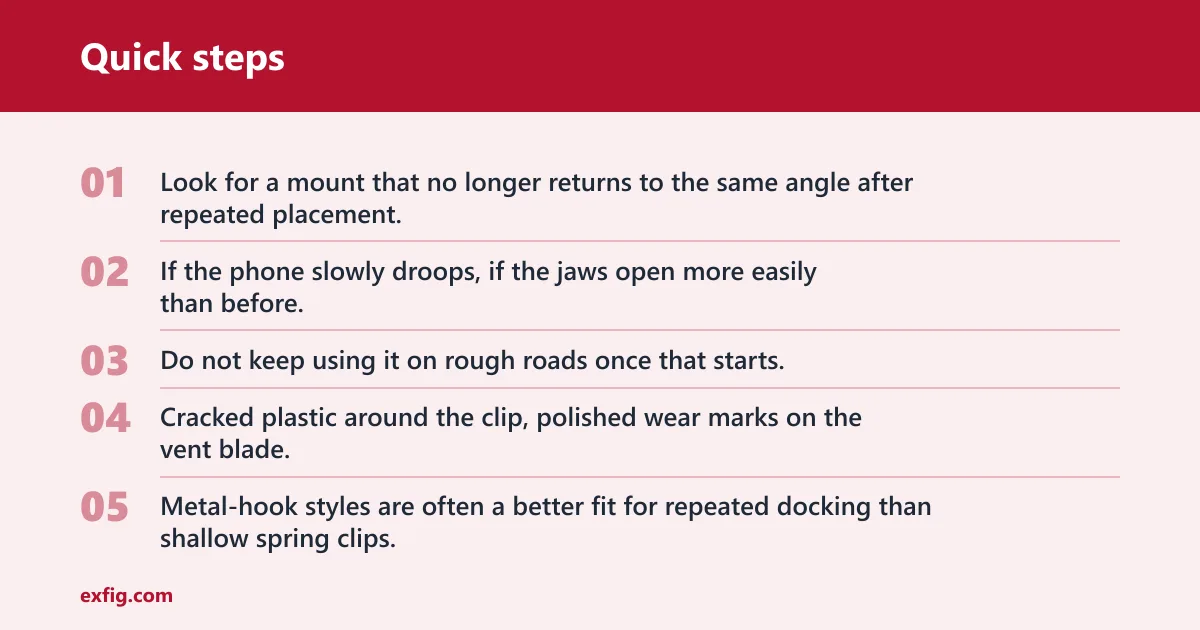
Look for a mount that no longer returns to the same angle after repeated placement. If the phone slowly droops, if the jaws open more easily than before, or if the mount needs extra force to stay fixed, the clip has likely lost some of its grip. Do not keep using it on rough roads once that starts.
Cracks, slippage, and vent-fin damage
Cracked plastic around the clip, polished wear marks on the vent blade, and visible slippage are all replacement triggers. Metal-hook styles are often a better fit for repeated docking than shallow spring clips, so a failing spring clip is a good reason to step up to a stronger mount or change the mounting location.
When a dash mount is the better choice
Use a dash mount instead of a vent mount when the phone is over the safe weight range, the vent slats flex easily, or the vehicle has brittle fins that could snap. A dash mount also makes more sense when you need steady airflow from the vents during long drives in hot or cold weather.
Say your phone is a large model in a thick case and the vent slats are narrow and vertical. That combination is a poor match for rough pavement, even if the mount feels secure in the driveway. A dash mount avoids the vent-failure path entirely and gives you a better chance of keeping the phone stable over bumps.
Frequently asked questions
Will a vent phone mount stay put on rough roads?
Some will, but the answer depends on the clip and the vent. A strong mount may hold on mixed city roads and mild bumps, while washboard pavement or repeated potholes can cause downward angle creep. Metal-hook styles can hold position better than shallow spring clips over time.
Can a vent mount hold a big phone like an iPhone Pro Max or Galaxy Ultra?
Yes, if the vent is stiff and the mount is built for it, but that is the upper edge of safe use for rough roads. A big phone with a thick case raises torque fast, so the mount needs a secure clip and a vent blade that does not flex under load.
Do vent mounts loosen or break over time?
They can. Repeated vibration wears the clip, and heat plus airflow changes can make the mount drift after several weeks. The warning signs are slippage, a looser grip, cracked plastic, and a phone that no longer sits at the same angle after bumps.
Are metal-hook vent mounts better than spring clips?
Usually yes for rough-road use. Metal-hook styles generally resist repeated docking and vibration better than shallow spring clips, which can fatigue faster and slip on thin or brittle slats. The trade-off is that the hook still needs a rigid vent to anchor against.
Does a vent mount block AC or heat from reaching the cabin?
Yes. Vent mounts sit directly in the airflow path, so they can block cabin heating or cooling. The effect is often more noticeable on center vents because those vents usually carry the main airflow, while side vents may be easier to live with if the slats are strong enough.
Can a vent mount damage the air vent slats?
Yes, especially if the clip is overtightened or the slats are thin, loose, or brittle. Vent clips can snap plastic vent fins if tightened too hard. If the vent shows cracks, bends, or permanent play after mounting, stop using that setup.
Should I use a vent mount or a dash mount for rough roads?
Use a dash mount if the road is rough often, the phone is heavy, or the vent slats are weak. Use a vent mount only when the vent is rigid, the phone is moderate in weight, and you can accept airflow blockage. For frequent gravel or potholes, dash mounting is the safer choice.