How Fast Does a Fast Car Charger Charge a Phone?

A good 20–30W car charger can usually add about 10–20% in 15 minutes, about 20–35% in 30 minutes, and about 30–50% in an hour, though results vary by device and conditions. That assumes a compatible phone, a solid cable, and normal in-car use. Miss the match, and you leave with less charge than the label suggests.
What fast charging means in a car
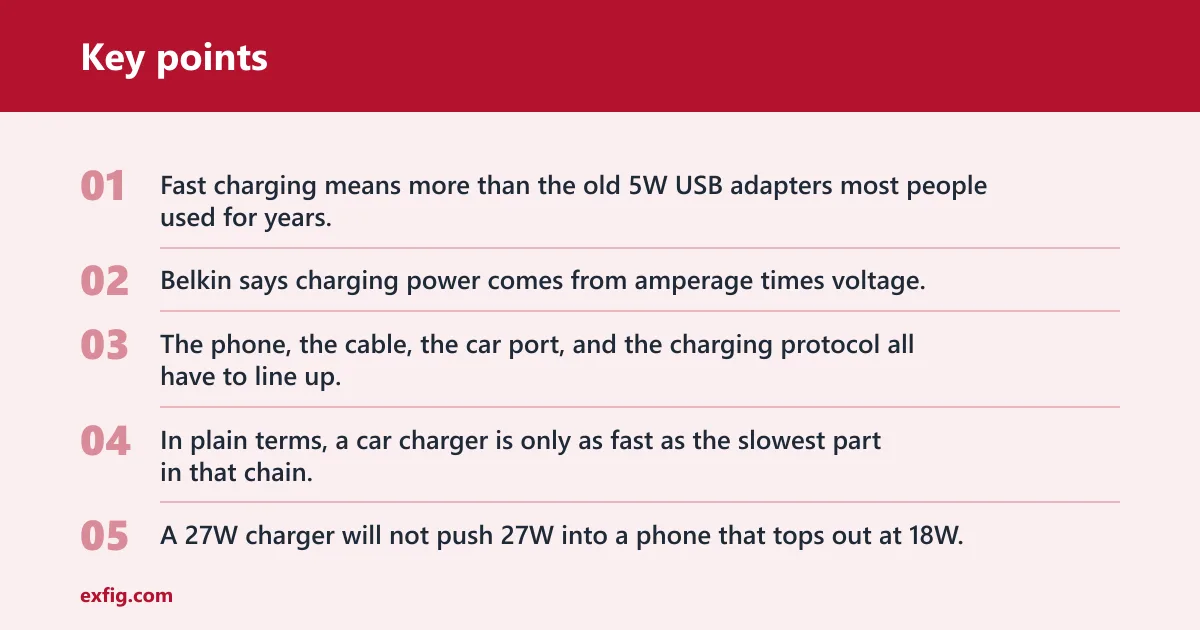
Fast charging means more than the old 5W USB adapters most people used for years. Belkin says charging power comes from amperage times voltage, so wattage alone does not tell the full story. The phone, the cable, the car port, and the charging protocol all have to line up.
In plain terms, a car charger is only as fast as the slowest part in that chain. A 27W charger will not push 27W into a phone that tops out at 18W. Belkin says the phone still draws only its own maximum speed.
That matters in a vehicle because many drivers expect a plugged-in phone to refill as quickly as a wall charger. Car charging often feels slower because the phone is also working. Screen brightness, GPS, music, Bluetooth, and background apps all use power at the same time.
Why 5W feels slow
Traditional chargers often sit in the 5 to 10 watt range, while fast chargers can deliver 15 to over 100 watts. A 5W car adapter may hold battery level during light use, but it usually will not add charge quickly if navigation is on and the screen stays awake.
How fast can a fast car charger charge a phone?
For most phones, a good 20–30W car charger can add roughly 10–20% in 15 minutes, about 20–35% in 30 minutes, and around 30–50% in an hour. The first part of the charge is fastest. As the battery fills, the phone slows the current to manage heat and battery health.
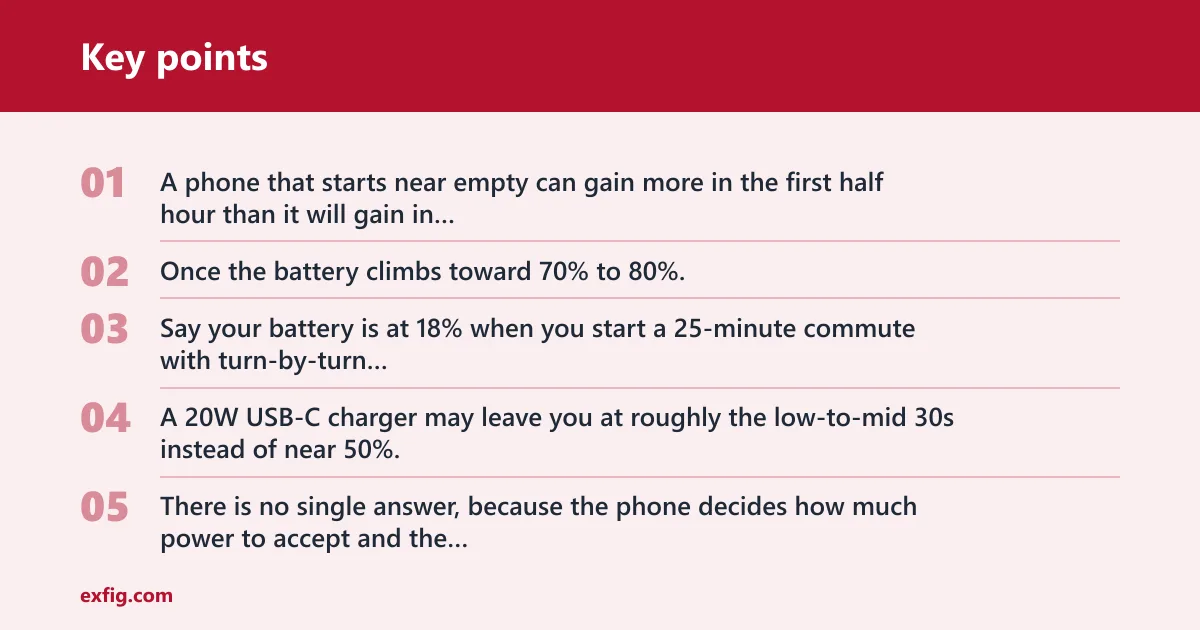
That range is practical, not theoretical. A phone that starts near empty can gain more in the first half hour than it will gain in the last half hour of the same drive. Once the battery climbs toward 70% to 80%, the charging curve matters more than the printed wattage.
Say your battery is at 18% when you start a 25-minute commute with turn-by-turn navigation running. A 20W USB-C charger may leave you at roughly the low-to-mid 30s instead of near 50%, because GPS, screen use, and the phone’s own charging curve all reduce the result.
How long does a fast charger take to charge a phone?
There is no single answer, because the phone decides how much power to accept and the charging curve changes as the battery rises. CNET says iPhones can recharge from zero to 50% in half an hour, and can reach up to 80% in roughly an hour with compatible Power Delivery charging. After that, charging slows further.
For a commute, the better question is how much battery a drive can add, not whether it can fill the phone from empty. If you only need enough charge for the rest of the day, 15 to 30 minutes can be enough with the right phone, cable, and charger.
Commute charging estimator
Use this table as a realistic starting point. The figures assume a healthy phone battery, a compatible cable, and a charger that can supply the stated wattage without splitting output across other ports.
| Phone type | Charger wattage | Expected battery gain after 15/30/60 minutes of driving | Notes for GPS, use-cases, and cable requirements |
|---|---|---|---|
| iPhone 8 and later | 20W USB-PD | About 10–15% / 20–35% / 35–50% | Needs a USB-C to Lightning cable for fast charging. GPS use can cut the gain, especially if the screen stays bright. |
| Recent USB-C Android phone | 25–30W USB-PD | About 12–18% / 25–40% / 40–60% | Good match for commuting and maps. Speed is strongest below about 70% battery, then tapers. |
| Older Samsung or LG phone with Quick Charge | 18–27W Quick Charge or TurboPower-type support | About 10–15% / 20–35% / 35–50% | Works only if the phone and charger share the same standard. Older cables or mismatched ports can cap speed. |
| Entry-level phone with 10W cap | 20W charger | About 6–10% / 12–20% / 20–35% | The phone limits the speed, not the charger. A higher-watt charger does not force more power into a low-cap phone. |
| Phone in a multi-port car charger | Shared output from 30W+ unit | About 8–12% / 15–30% / 25–45% | Two devices may split output, so one phone may charge much slower than the label suggests. |
To read the table, start with the phone type, not the charger label. Then check the cable and the port. A charger rated at 30W can still behave like a much slower unit if the vehicle socket is weak or the cable is poor quality.
Which charging standard does your phone use?
USB Power Delivery, often called USB PD, is the main wired fast-charging standard for modern phones. Belkin says it uses USB-C connectors and supports negotiated wattage, meaning the charger and phone agree on a safe power level. USB Power Delivery support is commonly cited as reaching higher wattages in the standard, depending on the source and implementation.
Qualcomm Quick Charge is an older fast-charging standard that still appears in some phones and car chargers. Belkin says many older Samsung, LG, and other devices support Quick Charge. It may also appear under rebranded names such as TurboPower.
For iPhone 8 and later, Belkin says USB-PD fast charging is supported. The same source says iPhone 12 or later supports at least 20-watt Power Delivery charging. In practice, that makes a 20W USB-C car charger the common starting point for fast iPhone charging.
Wired charging versus Qi wireless charging
Qi wireless charging is convenient, but it is usually slower and warmer than wired charging. That makes it a tradeoff, not the fastest route. If you want the most battery added during a commute, wired charging through a compatible cable usually wins.
Will a higher-watt charger make it faster?
Only up to the phone’s limit. Belkin says if a charger exceeds the phone’s max, the phone still draws only its own maximum speed. That means a 45W or 65W charger will not charge an 18W-limited phone any faster than an 18W-capable setup can.
Multi-port chargers add another limit. Some share power across ports, so the number printed on the box may apply only when one port is used. Plug in a second device, and the per-port output can drop enough to change the charging result during a short drive.
Picture a 24V van charger with a 30W rating feeding two phones at once. One phone may get enough power to maintain battery level with maps open, while the other falls back to a slower rate because the charger is dividing output. The label alone does not tell you that.
How wattage turns into real charging speed
Watts are the practical number, but they only work when amperage and voltage match the phone’s negotiation. A charger can advertise a high number and still underperform if the phone, cable, or vehicle socket cannot support the protocol cleanly.
Why charging slows near full
Most phones charge in two stages, then enter trickle charging near the top. HyperchargeHQ describes this as two stages followed by trickle charging. The battery fills quickly at first, then the phone tapers the power as it approaches full, often around 70% to 80% and beyond.
That slowdown is normal. It helps control heat and battery stress. It also means the last 20% often takes far longer than the first 20%, which is why a short commute can make a battery feel much healthier even if it does not reach 100%.
Heat matters here. A hot cabin, a sunlit dashboard, or heavy navigation use can make the phone reduce charge speed sooner. When that happens, the charger may still be working correctly, but the phone is limiting itself to stay within a safer temperature range.
Do you need a special cable?
Yes, sometimes. Belkin says a charger and cable must match the same fast-charging standard as the device. For iPhone fast charging, that means a USB-C to Lightning cable. For many Android phones, it means a USB-C cable that is rated for the standard and in good condition.
A low-quality cable can cap speed even when the charger and phone support faster charging. A worn connector, a loose fit, or a cable that is not built for the negotiated wattage can turn a fast setup into an ordinary one.
- Check the phone’s charging port and standard.
- Match the charger to that standard.
- Use a cable rated for the same fast-charging mode.
- Make sure the vehicle port is providing stable power.
- Watch for heat, because heat can slow the charge.
Is fast car charging safe?
Fast charging is generally safe with proper accessories. The phone controls the draw, so it does not keep pulling more power than it can handle. The bigger risks are poor cables, weak adapters, and heat buildup, which can reduce speed and create unreliable charging behavior.
That is why reputable chargers and cables matter. A good setup keeps the negotiation clean and the voltage stable. A bad setup may still charge, but it can do so slowly, intermittently, or with extra heat.
If speed is your priority, wired charging is usually the better choice. Qi wireless charging is fine for convenience, but it commonly runs warmer and slower, which makes it less useful when you need a large battery gain during a short drive.
Frequently asked questions
How fast can a car charger charge a phone?
A typical 20–30W car charger can add about 10–20% in 15 minutes, 20–35% in 30 minutes, and 30–50% in an hour, assuming the phone supports the standard and the cable is proper. Actual speed depends on the phone’s limit, the charging curve, and in-use drain from maps or music.
Will a fast car charger charge my phone at maximum speed?
Not automatically. Belkin says the phone only draws up to its maximum supported speed, even if the charger can supply more. The cable and charging standard also have to match. If any part of the chain falls short, the phone charges at the slower limit instead.
Why does my phone charge slower in the car than at home?
Car charging often has more limits than wall charging. The vehicle socket may be weaker, the charger may split output across ports, and the phone may be running GPS, music, and screen brightness at the same time. Heat inside the cabin can also make the phone slow the charge sooner.
What wattage car charger do I need for fast charging?
For many iPhones, 20W is the common fast-charging starting point. For many Android phones, 25W to 30W covers a useful range. If the phone maxes out lower, a larger charger will not force extra speed. The right wattage is the one that matches the phone’s supported standard and cap.
Do I need a special cable for fast charging in the car?
Yes, if you want full speed. iPhone fast charging needs a USB-C to Lightning cable. USB-C phones need a cable that supports the negotiated standard. A weak or low-quality cable can cap the charge even when the charger itself is fast enough.
Is fast charging safe for my phone battery?
Yes, when you use proper accessories and the phone manages the heat. The phone controls how much power it accepts, and the charge rate slows near full to protect the battery. The main problems are excess heat, bad cables, and chargers that do not match the device properly.
Why does charging slow down after 80%?
Because the phone changes how it charges as the battery fills. The same source describes a two-stage process followed by trickle charging. Near 80% and above, the phone lowers the charge rate to manage heat and battery wear, so the last part always takes longer than the first part.