What Size Speakers Are in My Car?

Factory speakers usually carry a size label, but fit depends on the opening, depth, mounting pattern, and clearance in your exact car. Miss one of those, and the speaker may not bolt in, may sit too deep, or may strike the window, grille, or dash trim. This guide shows how to identify front door, rear door, dash, and rear deck sizes without guessing.
How to check speaker fitment by location
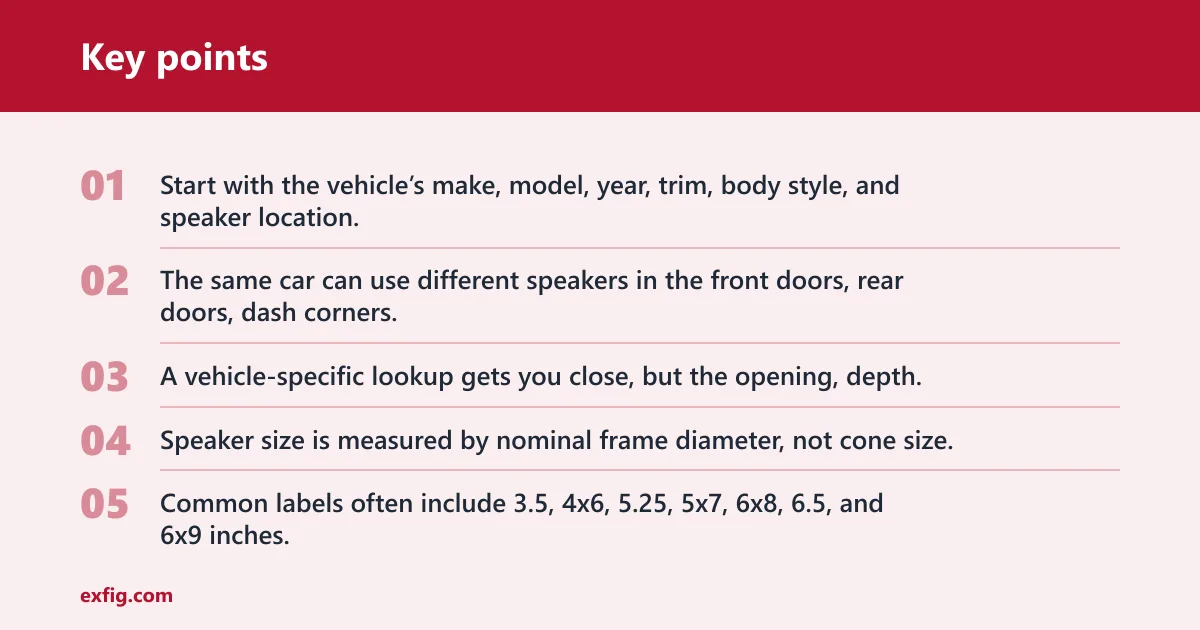
Start with the vehicle’s make, model, year, trim, body style, and speaker location. The same car can use different speakers in the front doors, rear doors, dash corners, and rear deck. A vehicle-specific lookup gets you close, but the opening, depth, and bracket pattern still decide the final fit.
Speaker size is measured by nominal frame diameter, not cone size. Common labels often include 3.5, 4×6, 5.25, 5×7, 6×8, 6.5, and 6×9 inches. A 6.5-inch label does not guarantee identical cutout dimensions across brands, so the label is the starting point, not the whole answer.
Check the speaker location before the size
Front doors, rear doors, dash corners, A-pillars, side panels, and rear decks often use different fitments in the same vehicle. Factory audio systems can change that layout again by trim. Premium systems may add tweeters, separate midrange units, or subwoofers, which changes both the part count and the wiring path.
For a quick sense of where common sizes usually land, a 6.5-inch speaker is commonly used in front and rear doors in many vehicles. A 5.25-inch speaker is often found in compact-car doors and rear decks. Dash corners commonly use 3.5-inch speakers or smaller 2.75-inch units. Rear decks and some truck doors often use 6×9-inch speakers.
Which speaker size fits each location?
Use the location first, then confirm the opening. Front and rear door speakers are often the easiest to mix up because the same car may use different diameters or adapters from front to back. Dash corners and rear decks are more likely to use size-specific brackets or shallow baskets that block a generic replacement.
Here are a few fit patterns that show up often enough to use as a first check, not a final one. Ford F-150 models from 2015 to 2020 use 6×9-inch front doors. Toyota Tacoma models from 2005 to 2015 use 6×9-inch front doors. The 2025 Toyota Tacoma is listed with 6.75-inch front-door fitment.
Some Chevrolet Silverado and GMC Sierra regular cab models are reported to use about 6.5-inch fronts and 4×6-inch rear pillars. Those listed sizes are fit sizes, not necessarily the original factory speaker dimensions. That matters because the original speaker may sit in a molded basket or on an adapter that hides the real opening size.
How do you measure speaker fit?
Measure speaker fit in layers: nominal size, cutout diameter, mounting depth, and bracket pattern. Do not rely on the old factory speaker alone, because adapters and molded baskets can distort the real opening. A speaker can match the hole and still fail because of depth or clearance issues.
Measure nominal size and cutout diameter
Nominal size is the label on the replacement speaker. Cutout diameter is the actual hole in the door, dash, or rear deck. Oval and irregular openings are common, especially in factory doors and rear pillars, so a round speaker label may not reflect the true opening shape.
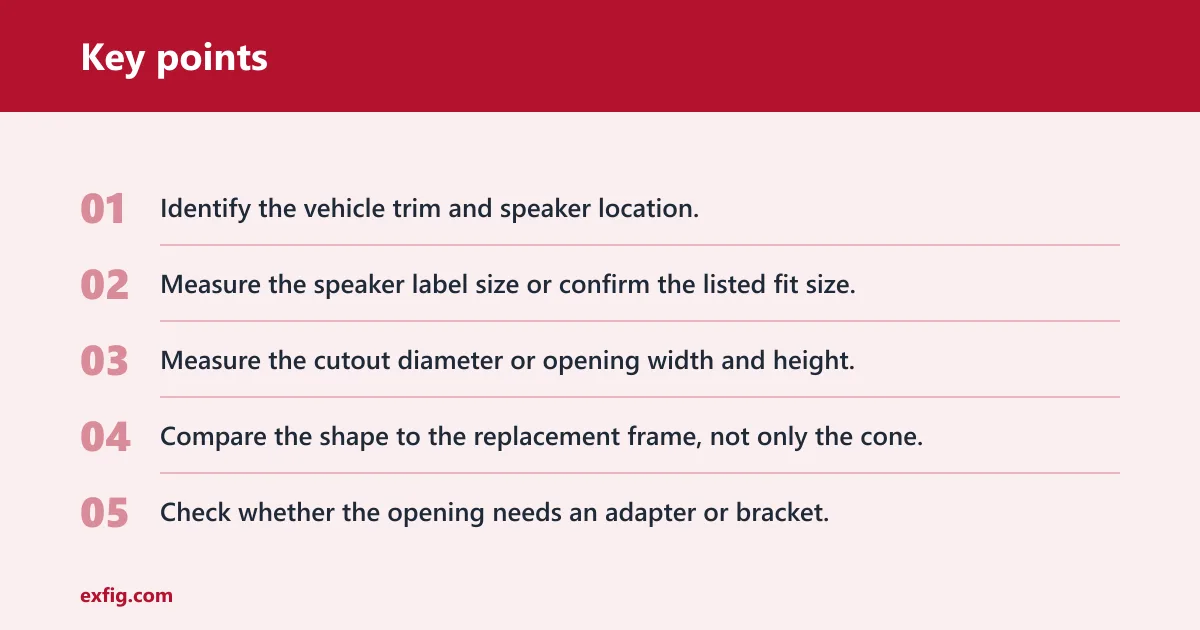
- Identify the vehicle trim and speaker location.
- Measure the speaker label size or confirm the listed fit size.
- Measure the cutout diameter or opening width and height.
- Compare the shape to the replacement frame, not only the cone.
- Check whether the opening needs an adapter or bracket.
Check mounting depth and magnet clearance
Mounting depth is the space from the mounting surface to the back of the speaker basket and magnet. It often limits fit more than diameter does. Check mounting depth with the window fully down, because the glass path and regulator can sit close behind the opening.
A door may be labeled for a 6.5-inch speaker but still not fit if the magnet touches the glass track when the window drops. The size matched, yet the depth failed. In that case, a shallow-mount speaker or a vehicle-specific bracket may solve the problem better than a larger adapter ring.
Verify bracket pattern and adapter needs
Factory brackets and bolt patterns can force a separate fit check even when the diameter matches. The fitment record separates opening, mounting pattern, mounting depth, and connector as distinct checks. If the factory speaker bolts to a molded ring, the new speaker may need an adapter bracket to sit correctly.
That is why the old part is not a perfect template. A factory bracket can make the speaker look larger or smaller than the opening beneath it. The new speaker must match the pattern, the depth, and the connector location, or it may need an adapter and a wiring change.
Speaker fitment checklist
Use this checklist before you buy. A pass in one column does not override a fail in another. If any item fails, the next action tells you what to verify before ordering.
| Measured input | Pass or fail | What to check | Next action if it fails |
|---|---|---|---|
| Nominal size | Pass if the label matches the confirmed fit size | Speaker label, vehicle location, and trim-specific listing | Look up the exact make, model, year, trim, body style, and location |
| Cutout diameter | Pass if the opening matches the frame or adapter spec | Door, dash, rear deck, or pillar opening size and shape | Measure the opening directly and compare it to the replacement frame |
| Mounting depth | Pass if basket and magnet clear the glass path | Depth behind the mounting surface with the window fully down | Choose a shallower speaker or a thinner adapter |
| Bracket or bolt pattern | Pass if the speaker or adapter lines up with the factory points | Factory bracket, screw spacing, and connector location | Use a vehicle-specific adapter bracket or a different fit size |
| Window-clearance result | Pass if the glass and regulator clear the speaker at full travel | Window fully lowered, glass path, and door card clearance | Do not install until the interference point is solved |
Why trims and audio packages change fit
Trim level can change more than the speaker label. Factory audio systems may use different speaker counts, extra tweeters, subwoofers, or separate amplifier paths. That can change impedance, wiring, and even the speaker location, so a base model fit chart may not apply to a premium system.
Factory audio systems and extra speaker locations
Premium systems often add speakers in places the base system does not use, especially A-pillars, dash corners, and rear side panels. Some trucks and SUVs also place different units in the rear doors or rear deck depending on audio package. The result is a separate fitment case, not a simple swap from one trim to another.
Suppose a base trim lists 6.5-inch front doors, but a premium trim adds a separate tweeter in the A-pillar. The door speaker may still be 6.5-inch by label, yet the wiring, crossover, and bracket stack become different. In that case, the size match is only one part of the job.
Why premium systems need separate verification
Factory wiring and impedance can affect replacement choice. Some premium systems expect a specific load or use a multi-speaker assembly that is not interchangeable with the base trim piece. If the vehicle has a branded audio package, verify the exact system code before buying speakers or adapters.
What if the size matches but the speaker still will not fit?
If the size matches but the speaker still will not fit, check clearance in this order: glass path, regulator travel, door card depth, then bracket pattern. The most common failure is a label match that collides with the window or a molded factory basket that changes the real mounting position.
Window glass and regulator interference
Check mounting depth with the window fully lowered, then move the glass through its full path. The speaker basket and magnet may clear at the top and still strike the glass track on the way down. That can damage the speaker, scratch the glass, or stop the window from moving freely.
Door card, dash, and rear deck obstructions
Door cards can leave very little extra room around the speaker grille. Dash corners can block deeper frames with trim ribs or ducting. Rear decks can fail on depth, grille height, or parcel shelf shape even when the opening looks correct from above. Measure the obstacle, not only the hole.
A common first-timer mistake is to compare only the old speaker frame and buy the same label size. That misses the adapter ring underneath it. If the factory speaker used a molded basket, the replacement may need a different spacer or a shallower mounting profile to fit cleanly.
What to do when the factory bracket differs
If the factory bracket differs, stop and match the bracket or bolt pattern before buying the speaker. Many vehicles need a vehicle-specific adapter even when the nominal size is correct. Confirm the connector style, screw spacing, and bracket depth together so the new part sits in the same plane as the original.
Frequently asked questions
What size speakers are in my car?
The exact size depends on the make, model, year, trim, body style, and speaker location. Start with the confirmed fit listing for your vehicle, then verify the opening, depth, and bracket pattern. Front and rear locations can use different sizes in the same car.
What size speakers are in my car doors?
Door speakers are often 6.5-inch, but that is a common fit size, not a universal answer. Some compact cars use 5.25-inch speakers, and some trucks use 6×9-inch fronts or different rear-door sizes. Check the door opening, adapter, and glass clearance before ordering.
What size rear speakers are in my car?
Rear speakers may be in rear doors, rear decks, side panels, or rear pillars, and each location can use a different fit. Common rear fit sizes include 5.25-inch, 6.5-inch, and 6×9-inch depending on the vehicle. Verify the exact rear location, not just the rear label.
What size speakers fit in my car?
The size that fits is the one that matches the opening, depth, mounting pattern, and clearance in your exact vehicle. A vehicle-specific fitment lookup gives the starting point, but the final check is physical. Use make, model, year, trim, body style, and location together.
How to know what size speakers are in my car
Look up the vehicle by make, model, year, trim, body style, and speaker location, then confirm the opening and depth. Check whether the car has a base or premium audio system, because that can change the layout and wiring. A direct measurement is still the final check.
What size speakers does my car have?
Your car may have one size in the front doors and another in the rear doors, dash, or rear deck. The safest answer comes from a location-specific fit listing and a direct measurement of the opening. Do not rely on the old factory speaker alone if adapters are present.
What size speakers are in my car by reg?
A registration-based lookup can help identify the exact vehicle, but it does not replace fit verification. Use the registration details to confirm make, model, year, trim, and body style, then check the speaker location and factory audio package. The final fit still depends on the opening and clearance.