
Why Is Only One Side Speaker Not Working in My Car?

If one car speaker is silent, the fault is usually in the balance or fader setting, source output, wiring, amplifier channel, or the speaker itself; check settings first, because one bad setting can mimic a dead speaker. Skip that order, and you can replace a good part while missing a broken wire or failed amp channel. This guide walks you through a channel-by-channel diagnosis from settings to speaker tests.
How to tell where the audio fault
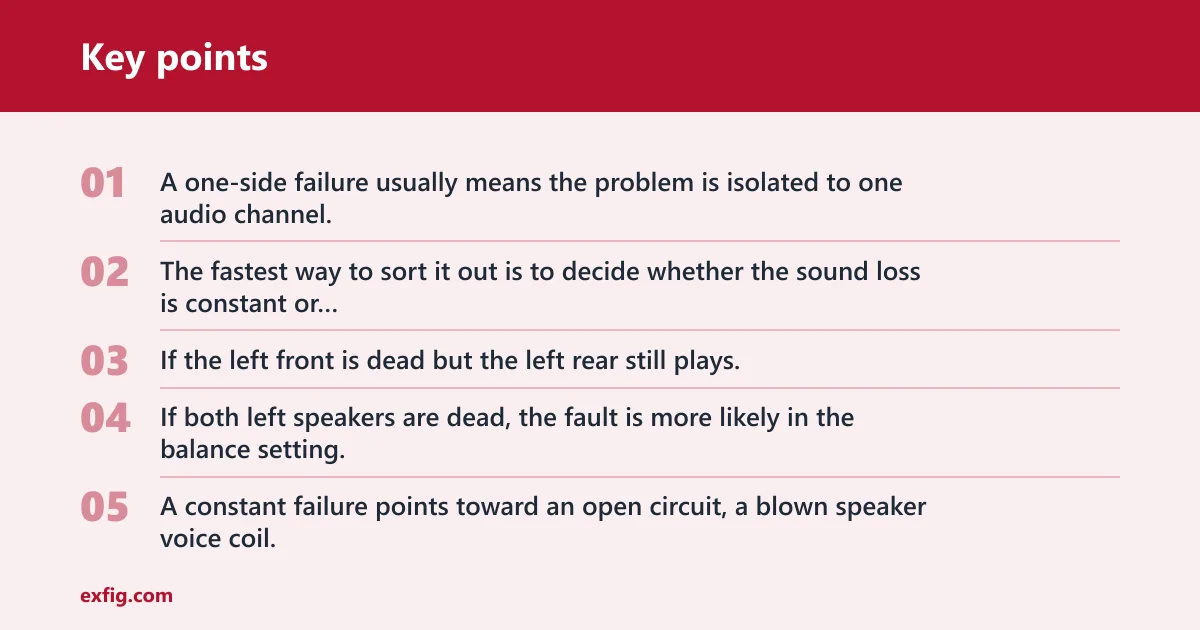
A one-side failure usually means the problem is isolated to one audio channel, one speaker circuit, or one local speaker assembly rather than the whole system. The fastest way to sort it out is to decide whether the sound loss is constant or intermittent, and whether it follows the side, the door, or the source input.
What a one-side failure usually means
If the left front is dead but the left rear still plays, the problem may be at the front speaker, its door wire path, or the head unit’s front-left output path. If both left speakers are dead, the fault is more likely in the balance setting, a shared amp channel, or a head unit output issue.
Constant loss versus intermittent loss
A constant failure points toward an open circuit, a blown speaker voice coil, a dead amplifier channel, or an unplugged connector. An intermittent failure often points toward a loose connector, broken wire at the door jamb, vibration-related contact loss, or moisture intrusion in a car door speaker.
Say your front-left speaker cuts out only when the driver’s door is opened fully. That pattern points first to the door wire flex point, not the speaker cone itself. A dead speaker usually stays dead.
Check balance and fader first
Set the balance to center and the front/rear fader to the middle before touching hardware. A user-setting error can make one side seem dead even when the head unit, amplifier, wiring, and speaker are all working.
Set balance to center
Move the left/right balance control back to center. Then listen again with a steady source, such as FM radio or a known-good USB file. If both sides return, the fault was a setting, not a part failure.
Set the fader to the middle
Move the front/rear fader to the middle. A fader set fully forward or fully rearward can hide one speaker or one whole pair, especially in cars with front-only or rear-only output trim.
Confirm the fault is not a settings issue
If the sound follows the control position, you are still dealing with a settings issue or a head unit source issue. If the same physical side stays dead across settings, move on to channel isolation and wiring checks.
- Set balance to center.
- Set fader to the middle.
- Switch to another source.
- Listen for the same side to stay dead.
- Only then open trim panels or touch wiring.
Is the head unit the source?
The head unit is worth checking early because it creates the audio output channels that feed the rest of the system. If the fault follows the input, the radio or source device may be the problem. If the fault stays on one side across sources, the issue is farther down the chain.
Switch sources and inputs
Test FM, USB, Bluetooth, and any auxiliary input the car has. If one source sounds normal and another loses one side, the source path or the head unit may be at fault. If every source loses the same side, the fault is less likely to be the media file or app.
Test left and right output behavior
Use the balance control to send sound hard left, then hard right. A healthy stereo system should move output cleanly from one side to the other. If the left output is weak, distorted, or silent across every source, the head unit’s left channel may be failing.
When the radio itself is the problem
A radio problem is more likely when both speakers on one side fail together, or when the fault appears right at the head unit and stays there after source changes. A damaged internal audio output channel can mimic a bad speaker, but it will affect the circuit before the door wire path.
Suppose the left front and left rear both go quiet, but the right side plays normally. If the balance and fader are centered and the fault stays on the left with every source, the head unit or factory amplifier is a stronger suspect than either speaker.
Speaker wiring and connector faults
Speaker wiring is a common cause of one-sided silence because the car door speaker lives in a moving, vibrating area with a connector and wire path that flex every time the door opens. A loose connector, broken wire, short circuit, or reversed polarity can all disturb output without damaging the speaker itself.
Loose connector at the speaker
Pull the door panel only after the settings and source checks are done. A loose connector at the speaker can make the sound cut in and out, or disappear completely when the door is moved or the panel vibrates.
Broken wire in the door harness
Door-wire flexing is a classic failure point. The wire can break inside the insulation near the hinge area, so the break may not be visible. If the speaker works with the door partly open but fails when closed, suspect the wire path first.
Short circuit and polarity checks
A short circuit can trip protection in the head unit or amplifier, mute one channel, or create very low output. Polarity errors usually do not make a speaker fully silent, but they can weaken bass and create phase problems if a recent repair reversed the leads.
How to use a multimeter
A multimeter helps separate a speaker problem from a wiring problem. Use continuity test mode on the wire path and resistance measurement across the speaker terminals. A reading that jumps around, stays open, or reads far from the expected speaker impedance can point to the fault path.
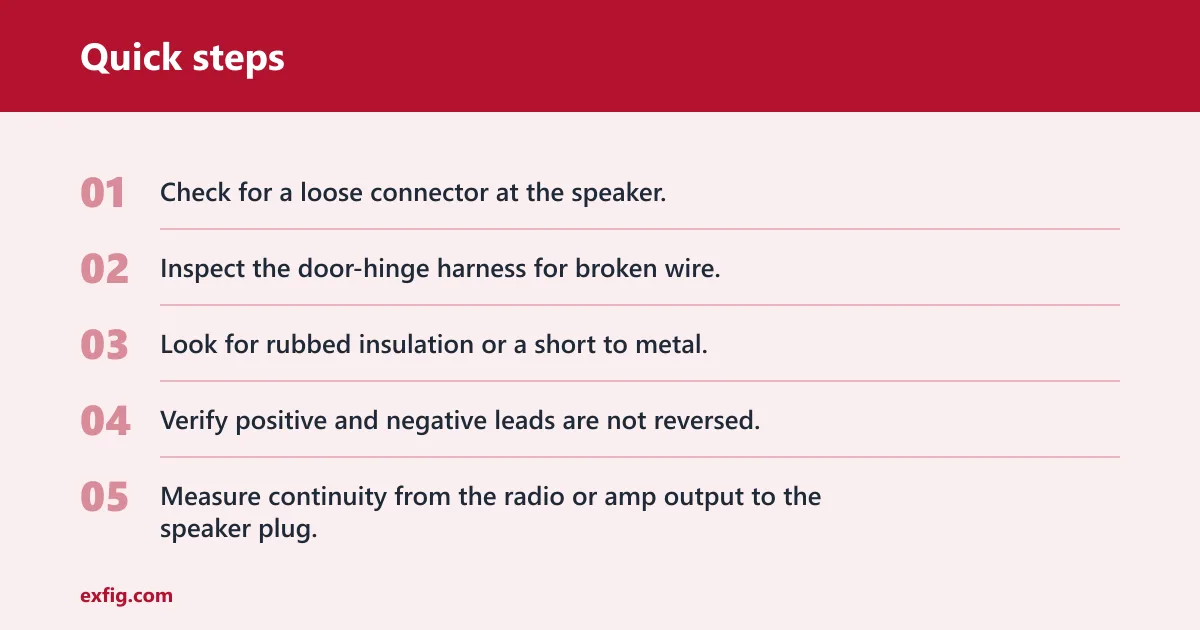
- Check for a loose connector at the speaker.
- Inspect the door-hinge harness for broken wire.
- Look for rubbed insulation or a short to metal.
- Verify positive and negative leads are not reversed.
- Measure continuity from the radio or amp output to the speaker plug.
Can a blown fuse make one speaker stop working?
A blown fuse can matter, but it is not the first explanation for one dead speaker. Audio circuit protection usually affects a broader part of the system, such as the head unit or amplifier feed. It is more likely to kill multiple outputs than only one local speaker.
Which fuse to inspect?
Check the fuse labeled for audio, radio, ACC, or amplifier power in the cabin fuse panel and the under-hood box if the car uses an external amp. The exact inspection location depends on the vehicle, so use the fuse map on the cover or in the owner’s manual.
What a blown audio fuse usually affects
A blown fuse often takes out the whole radio, the amplifier, or a bank of channels. If the display is dead, the unit will not power up, or multiple speakers fail together, a fuse becomes more plausible. One silent door speaker by itself is less typical.
When a fuse is and is not the cause
If the system powers on normally and only one side is quiet, keep the fuse check in the list but do not stop there. A fuse rarely explains a single door speaker fault unless that speaker is on a protected amp channel that has opened for another reason.
When does the amplifier cause one speaker to stop working?
The amplifier becomes a prime suspect when the fault stays with one output channel after the head unit and wiring checks pass. This is especially important on cars with a factory amp or an aftermarket amp, because one failed channel can mute only one speaker or one side of the cabin.
Factory amp versus aftermarket amp
A factory amp may sit between the head unit and the speakers, so a bad amp channel can look like a bad speaker. An aftermarket amp can do the same thing, especially if one output pair is damaged, a protection circuit has tripped, or a remote turn-on issue is present.
One-channel-only symptoms
One-channel failure usually means one speaker or one side stays silent no matter which source you choose, while the other channels continue to play. If the same channel is dead at the amplifier output and at the speaker plug, the amp is likely bad before the speaker ever sees signal.
When the amp is before the speaker in the fault path
If the wiring checks out and the speaker measures normally, the amp sits earlier in the fault path. That matters because replacing a good speaker will not restore output from a dead amp channel. A meter check at the amp output can save time and cost.
Speaker fault decision table
This table helps separate a dead channel from a dead speaker before you buy parts. Start with the symptom, then use the quickest test to narrow the fault. Repair complexity is estimated relative to a normal trim-panel access job, not a quoted price.
| Symptom | Likely cause | Quickest test | Next action | Repair complexity |
|---|---|---|---|---|
| Constant failure on one side | Head unit output, amplifier channel, open wire, or dead speaker | Center balance and fader, then switch sources | Trace the signal from head unit to amp to speaker | Moderate if wiring; higher if amp replacement is needed |
| Intermittent failure on one side | Loose connector, broken door-wire, vibration issue, moisture intrusion | Move the door and watch for sound cutout | Inspect connectors, hinge-area wiring, and speaker terminals | Low to moderate, depending on wire access |
| One-door failure only | Door speaker fault, local wiring fault, or water intrusion in the door panel | Swap the speaker with a known-good unit or measure resistance | Test the speaker, then inspect the door panel and wire path | Low if speaker only; moderate if door wiring is damaged |
| One-channel-only failure | Failed amp channel or head unit channel | Check output at the amp, then at the speaker plug | Replace or repair the bad channel source, not the speaker first | Moderate to high if the amplifier is integrated |
How to read the table
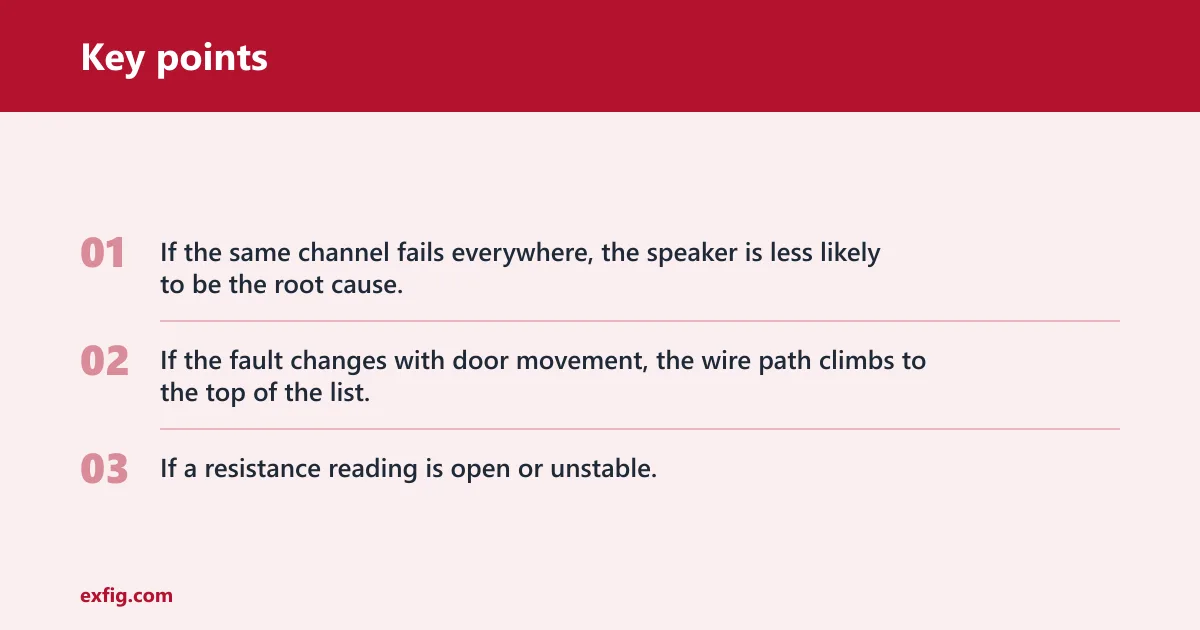
If the same channel fails everywhere, the speaker is less likely to be the root cause. If the fault changes with door movement, the wire path climbs to the top of the list. If a resistance reading is open or unstable, the speaker or its local wiring deserves closer attention.
What should you check before replacing the speaker?
Before replacing a car speaker, confirm the fault is truly at the speaker itself. That means checking balance and fader, source output, connector fit, wire continuity, amplifier behavior, and the speaker’s resistance. This order keeps you from buying a new woofer, tweeter, coaxial, or component set to solve a wiring problem.
Check speaker type and fitment
Make sure the replacement matches the vehicle’s size and impedance requirements. A car speaker can be a woofer, tweeter, coaxial, or component unit, and component systems often split the woofer and tweeter into separate pieces. Fitment errors create install problems even when the channel fault is real.
Inspect for water intrusion
Door speakers sit in a wet environment by design, but water intrusion from a failed barrier or clogged drain can corrode terminals and damage the cone, surround, or voice coil. If the door panel shows moisture marks or rust at the connector, address that before fitting another speaker.
Use a resistance check
A resistance measurement across the speaker terminals helps confirm whether the coil is open or shorted. If the reading is wildly off, the speaker may be damaged. If the reading is normal, the fault is more likely in the wire path, amp, or head unit.
A common first-timer mistake is replacing a 6.5-inch door speaker because the left front is silent, then finding the real fault was a broken wire in the door jamb. The new speaker will not help if the circuit cannot reach it.
Frequently asked questions
Why is only one side speaker not working in my car?
Only one side usually means a single channel problem, not a full system failure. Start with balance and fader, then check source output, wiring, amplifier channel, and the speaker itself. A dead side that stays dead across sources points away from user settings and toward hardware.
Why does my car speaker only work sometimes?
Intermittent sound usually points to a loose connector, broken wire in the door wire path, vibration-related contact loss, or moisture intrusion in the door panel. If the sound changes when the door moves, the wiring path is the first place to inspect. The speaker may still be fine.
Is the problem the speaker, wiring, or head unit?
Use isolation in that order. If the problem follows the source input, suspect the head unit. If it stays on one side but changes with door movement, suspect wiring. If the circuit checks good and the speaker resistance is wrong, the speaker itself is the likely fault.
Can a blown fuse make only one speaker stop working?
It can, but it is not the usual cause. Audio fuses more often affect the radio, the amplifier, or several channels at once. If only one speaker is dead and the rest of the system works, keep the fuse check in the process, but do not stop there.
How do I tell if the front left or right speaker is dead?
Use the balance control to isolate left and right output, then listen to each side with the fader centered. If the front left disappears while the front right plays normally, the front-left circuit is the one to trace. Repeat with another source to rule out input-specific faults.