Is My Car OBD2 Compliant?

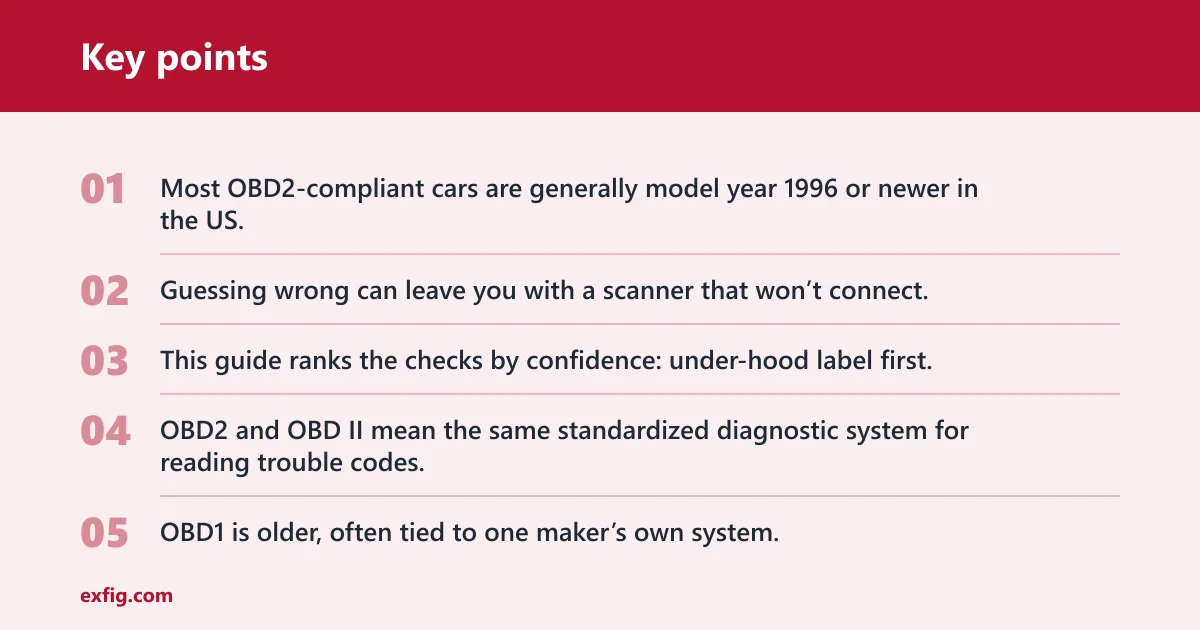
Most OBD2-compliant cars are generally model year 1996 or newer in the US, about 2001 and up for many petrol cars in the EU, and about 2004 and up for many diesel cars, but the label is the best proof. Guessing wrong can leave you with a scanner that won’t connect, can’t read emissions faults, or misses data on an imported vehicle. This guide ranks the checks by confidence: under-hood label first, market and year second, 16-pin port shape third, and scanner communication last.
What OBD2 compliance means
OBD2 versus OBD1
OBD2 and OBD II mean the same standardized diagnostic system for reading trouble codes, live data, and readiness monitors. It is not the same as OBD1. OBD1 is older, often tied to one maker’s own system, and a generic OBD2 code reader will not reliably work on cars that never adopted the later standard.
Why compatibility matters before you buy a scanner
A scanner can fit the port and still fail on the car. Some readers power up from the diagnostic port, then cannot talk to the vehicle, which is where buyers get misled by a lit screen. If the vehicle is not compliant, a generic OBD2 scanner may do little more than turn on.
OBD2 confidence check
This checklist ranks the evidence from strongest to weakest. Start at the top, stop as soon as you have a clear verdict, and use the last step only as a confirmation. A 16-pin socket alone is not enough.
| Step | Yes/No | What to check | Verdict |
|---|---|---|---|
| 1. Market/year rule | Yes / No | US gasoline/light-duty from 1996 model year; EU gasoline from 2001; EU diesel from 2004; imported cars follow their original market rules. | Strongest clue. If yes, likely compliant for that market. |
| 2. 16-pin port present | Yes / No | SAE J1962 connector, trapezoid-shaped, inside the passenger compartment and within reach of the driver. | Helpful, but not proof by itself. |
| 3. Under-hood label mentions OBD II / EOBD | Yes / No | Vehicle Emission Control Information label under the hood may say OBD II Certified or OBD-II Compliant. | Strong backup confirmation. |
| 4. Scanner communication test | Yes / No | Plug in a generic OBD2 scanner and try to read codes and live data, not just power. | Final confirmation if the scanner communicates. |
How to use the checklist on an unknown car
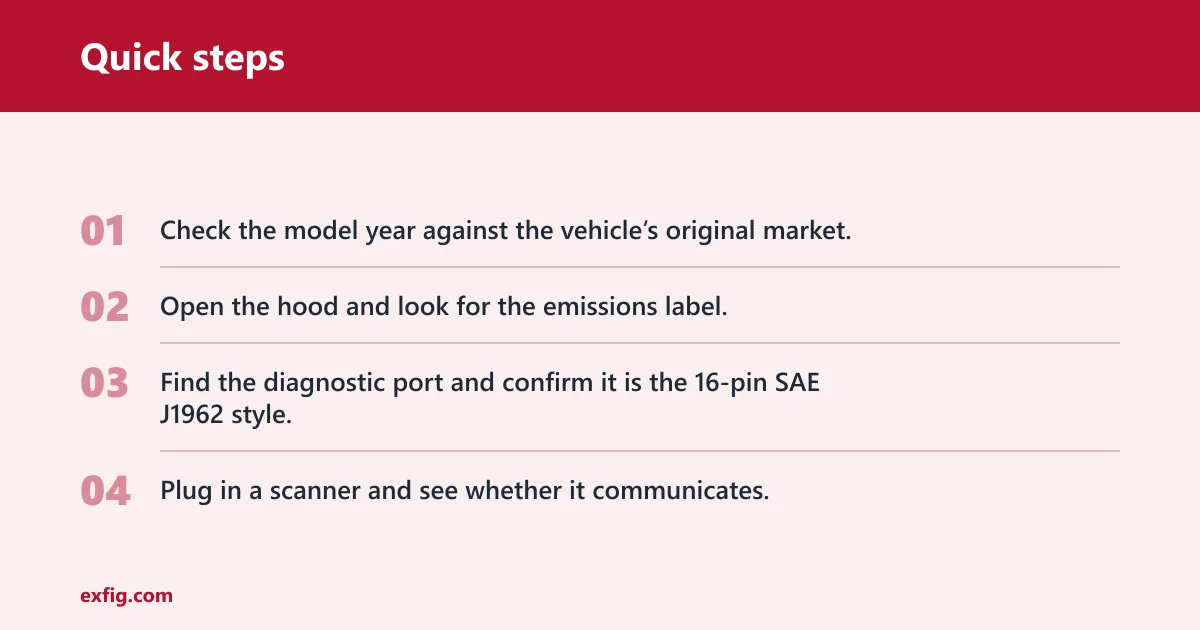
- Check the model year against the vehicle’s original market.
- Open the hood and look for the emissions label.
- Find the diagnostic port and confirm it is the 16-pin SAE J1962 style.
- Plug in a scanner and see whether it communicates.
Say your car is a 1998 US-market gasoline sedan with a 16-pin port under the dash. That combination strongly points to OBD2 compliance, and a basic code reader should usually communicate. If the same port appears on a grey-market import from another region, the label and the scanner response matter much more.
Is my car OBD2 compliant by region?
Yes, but the answer depends on where the car was built for sale, not just where it is parked now. The US, the European Union, and imported vehicles follow different timelines and exceptions, so a year stamp alone is not enough unless you match it to the market.
US-market vehicles
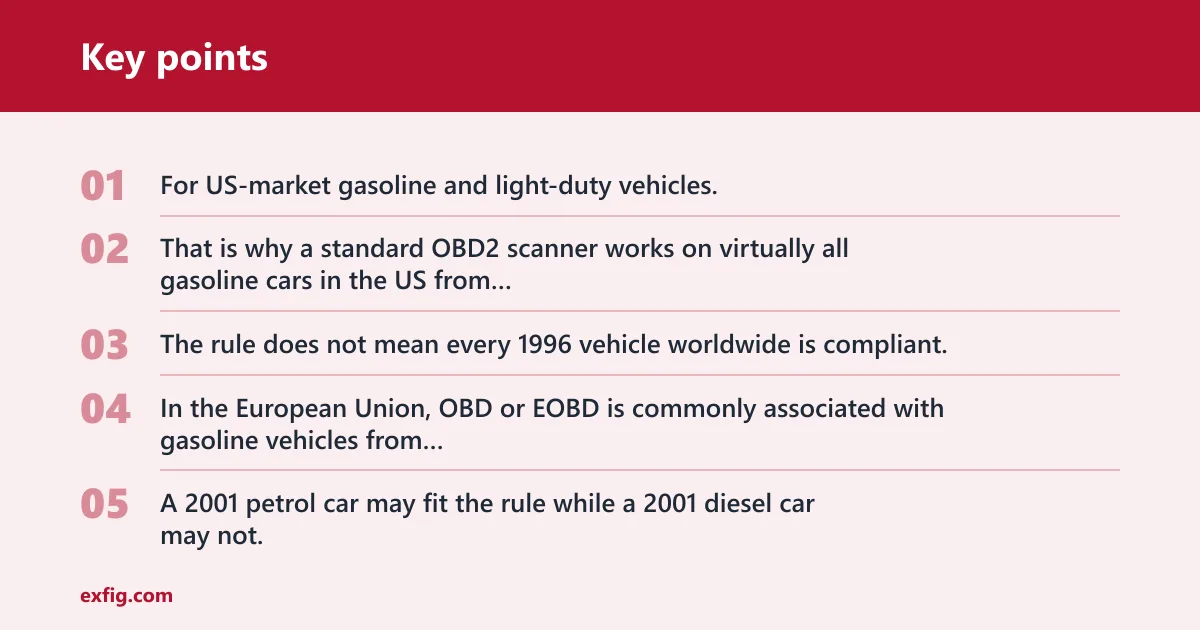
For US-market gasoline and light-duty vehicles, OBD2 is generally considered mandatory starting with the 1996 model year. That is why a standard OBD2 scanner works on virtually all gasoline cars in the US from 1996 onward. The rule does not mean every 1996 vehicle worldwide is compliant.
EU-market vehicles
In the European Union, OBD or EOBD is commonly associated with gasoline vehicles from about 2001 and diesel vehicles from about 2004. That split matters. A 2001 petrol car may fit the rule while a 2001 diesel car may not, depending on the exact market and model line.
Imported and grey-market vehicles
Imported cars can follow the regulations of their original market, which is why country-specific timelines vary. A vehicle brought into another country may have the right connector shape and still not communicate with a generic scanner. Grey-market cars are the ones most likely to need label-based confirmation.
Picture a 2002 compact hatchback imported into the UK from outside the EU. The dashboard port may look standard, but the car could still follow a non-EU emissions setup. In that case, the under-hood label and the scanner communication test carry more weight than the calendar year alone.
How to identify the diagnostic connector
The standard OBD2 connector is the SAE J1962 diagnostic port. It has 16 pins and a trapezoid-shaped, often D-shaped, opening. It is usually inside the passenger compartment, under the dash or within reach of the driver. That shape helps, but it does not prove compliance.
Why port shape alone is not enough
Some cars use a 16-pin connector for other reasons, and some non-compliant vehicles can still carry a socket that looks close enough to fool a quick glance. One source of confusion is simple: a 16-pin connector alone does not guarantee OBD2 compliance. You still need the market/year rule or the emissions label.
Where the port is usually located
Most vehicles place the port under the dashboard, often near the steering column, the lower fuse panel, or the driver’s knee area. The important detail is access from the passenger compartment. If you have to hunt under the hood for the main diagnostic plug, that is a warning sign that the car may not be using the standard OBD2 layout.
How to read the under-hood label
The Vehicle Emission Control Information label under the hood is one of the strongest checks you can use. It may explicitly say OBD II Certified or OBD-II Compliant. If that wording is present, it is strong backup confirmation that the car is meant to work with OBD2 diagnostics.
What counts as backup confirmation
Use the label as support for the market-year rule, not as a replacement for it. If the label, model year, and market all agree, confidence is high. If the label is missing, faded, or unreadable, fall back to the regulatory timeline and then the scanner test.
What to do if the label is missing or unclear
Some labels are buried, worn, or covered by service stickers. If you cannot read it, do not assume the car is non-compliant. Instead, move down the checklist: confirm the original market, check the year, inspect the connector, and only then try a scanner. That order avoids a lot of false confidence.
Can an OBD2 scanner work on an older car?
Sometimes, but not always. Older cars may be OBD1, and OBD1 scanners are made for one maker’s system rather than one universal standard. A generic OBD2 code reader will not reliably read data from a vehicle that never adopted OBD2, even if the car has some kind of diagnostic plug.
Why power is not the same as communication
A reader that powers on only proves that the port can supply electricity. It does not prove the car speaks OBD2. The common failure case is a scanner that lights up, then shows no communication, no codes, or a generic link error. That usually means the vehicle is not compatible with that reader.
What to check before buying a scanner
Check the original market, the model year, and the emissions label before you shop. If the car is a pre-OBD2 vehicle, a generic code reader is the wrong tool. If the car is transitional, choose a scanner only after confirming that the vehicle actually supports OBD2 data and readiness monitors.
What year cars are OBD2 compliant?
For US-market gasoline and light-duty vehicles, the common cutoff is the 1996 model year. In the European Union, many gasoline vehicles follow the 2001 EOBD timeline and many diesel vehicles follow 2004. 1996 can be a transition year, so edge cases deserve extra checking.
Transition-year edge cases
The awkward cases are usually built around the handoff year. A 1996 vehicle may be compliant in one market and not in another, or a single model line may have mixed equipment across trims and engines. If the year is borderline, trust the label before you trust the connector shape.
Gasoline and diesel are not interchangeable
Do not apply a petrol timeline to a diesel car. The EU timeline is different for the two fuel types, and imported cars can sit outside the local rule set entirely. That is why a year-only answer can be misleading when you are checking a used car or a grey-market import.
Is my car OBD2 compliant UK?
In the UK, the answer depends on whether the car was built to EU EOBD rules or imported from elsewhere. Many petrol cars from 2001 onward and many diesel cars from 2004 onward are OBD or EOBD compliant, but imports and transition-year vehicles need the under-hood label and connector check as well.
Frequently asked questions
Is my car OBD2 compliant?
Check in this order: the vehicle’s original market and model year, the under-hood emissions label, the 16-pin connector, and then scanner communication. If the label says OBD II Certified or OBD-II Compliant, that is strong evidence. If the car is pre-OBD2, a generic reader may not work.
Is my car OBD II compliant?
OBD II and OBD2 mean the same standardized diagnostic system in this context. If your car meets the market-specific timeline and carries the proper emissions label, it is likely compliant. If it is an older OBD1 vehicle, generic OBD2 scanners will usually not communicate with it.
Does a 16-pin port mean my car is OBD2?
No. A 16-pin SAE J1962 connector is a strong clue, but it is not proof by itself. Some non-compliant vehicles can still have a similar port shape. You need the market/year rule or the under-hood label to confirm compliance before buying a scanner.
How do I check if my imported car is OBD2 compliant?
Start with the car’s original sales market, not the country where it is now registered. Then check the emissions label under the hood and confirm the connector shape. Imported and grey-market cars often break simple year rules, so scanner communication is the last check, not the first.