Dual Dash Cam vs Single Dash Cam: Which Should You Buy?

Buy a single front dash cam if you only want proof of road events; choose front-rear for parking hits and rear-end disputes; choose front-inside if you need cabin coverage for rideshare or fleet work. Choose the wrong layout and you may miss the angle that proves fault. This guide breaks down front-only, front-rear, and front-inside coverage so you buy the right camera for your use case.
| Decision factor | Dual dash cam | single dash cam | Winner |
|---|---|---|---|
| Incident coverage | Front plus rear or front plus cabin, depending on design | Front-only recording | Dual dash cam |
| Cost and storage load | Higher upfront cost and larger files from two-camera recording | Lower cost entry point and lighter storage use | single dash cam |
| Parking incidents | Captures hit-and-runs from more angles when parking mode is active | Useful for front impact only | Dual dash cam |
| Rideshare and fleet use | Front-inside setups add cabin evidence and driver monitoring | Usually misses the cabin view that matters most | Dual dash cam |
| Budget buyers | Often more than needed if you only want forward crash proof | Gets the core job done for less | single dash cam |
| Rear-end dispute context | Rear camera can show following traffic and impact sequence | No rear evidence | Dual dash cam |
Key differences in coverage, cost, and installation
The main trade-off is plain: dual dash cam models add another angle, while single dash cam models keep cost and storage needs lower. If your likely claim involves only the road ahead, front-only is enough. If you need rear or cabin evidence, the extra camera earns its place.
Coverage
Single dash cam usually means front-only recording. Dual dash cam can mean front and rear or front and inside, so buyers need to check the layout instead of assuming every “dual” model does the same job.
A front and rear dash cam system is the common consumer format for collision evidence. A front and inside dash cam is the better fit when the cabin matters more than the road behind.
Cost and storage
Dual recording costs more because it adds a second camera and writes more video data. That means larger files, faster card fill-up, and shorter overwrite timing if the storage is too small for the recording settings.
Single dash cam is the lower cost entry point. Many models use microSD storage, and some use internal eMMC storage, but the storage burden still stays lighter because there is only one video stream.
Installation and power
Two-camera systems usually mean more cables, more mounting decisions, and more chances for setup mistakes. That is manageable, but it is still more work than a front-only install.
Power choice matters too. Battery-powered models are simpler, while supercapacitor-powered models are generally favored for heat tolerance and reliability in parked vehicles and hot climates.
Best fit by driver type
Dual dash cam fits drivers who need a second angle for disputes, parking damage, or cabin evidence. Single dash cam fits drivers who mainly want proof of forward crashes and insurance disputes without paying for unused coverage.
📊 Consumer Reports says top-rated dash cams range from about $100 to $400. Source: Consumerreports.
Dash cam decision matrix
Use this matrix to match the smallest useful setup to the job. The right answer depends on where the risk comes from, not on how large the spec sheet looks.
| Driving scenario | Minimum camera setup | Why it wins | Skip dual? |
|---|---|---|---|
| Commuting | single dash cam | Most claims start with forward traffic, lane changes, or a front-end impact | Yes, if you only want road evidence |
| Parking protection | Dual dash cam | Rear or cabin angles can help identify a hit-and-run while parked | No, if you want the best chance of capturing the event |
| Highway driving | Dual dash cam | Rear coverage adds context in lane-change and tailgating disputes | Sometimes, if you only care about front collisions |
| Rideshare | Dual dash cam | Front-inside coverage records the cabin, which is the point of the setup | No |
| Fleet use | Dual dash cam | Cabin evidence and driver monitoring matter more than a front-only clip | No |
| Budget buyers | single dash cam | Front-only coverage covers the most common insurance dispute at the lowest cost | Yes |
Commuting
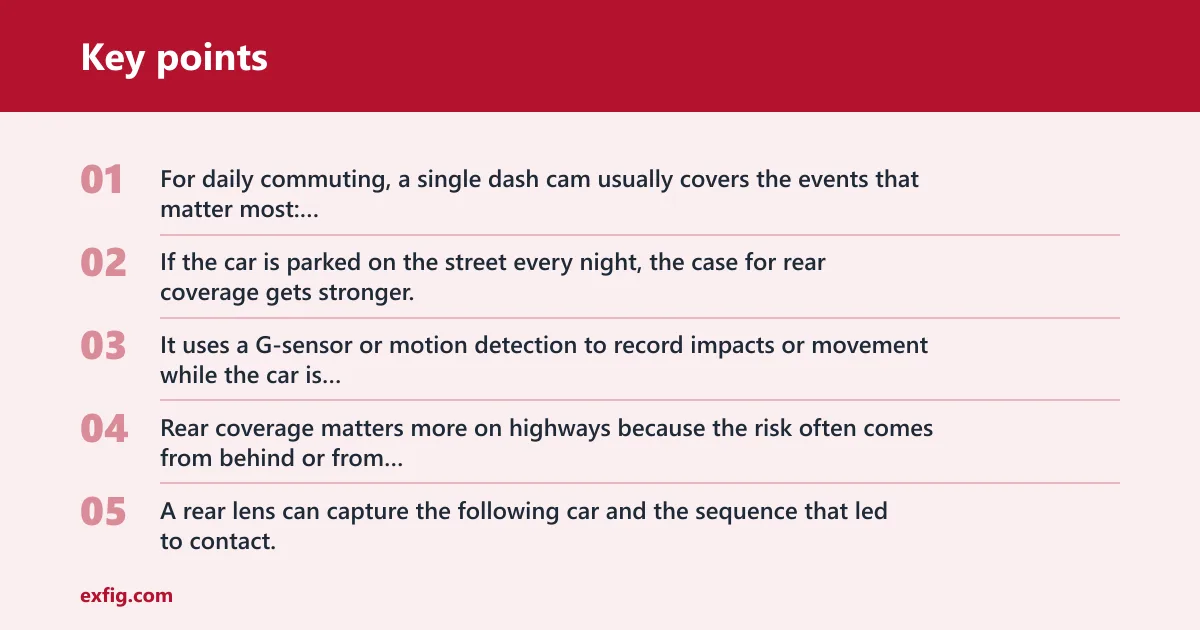
For daily commuting, a single dash cam usually covers the events that matter most: fender-benders, brake-check claims, and traffic disputes ahead of you. If the car is parked on the street every night, the case for rear coverage gets stronger.
Parking protection
Parking mode is standard territory here. It uses a G-sensor or motion detection to record impacts or movement while the car is parked, which makes a front-rear system more useful for hit-and-runs than a front-only camera.
Highway driving
Rear coverage matters more on highways because the risk often comes from behind or from a side lane change. A rear lens can capture the following car and the sequence that led to contact.
Rideshare
Rideshare drivers need cabin evidence, not just road footage. A front and inside dash cam records the vehicle interior, and many cabin-facing units add infrared night vision so passenger activity remains visible after dark.
Fleet use
Fleet managers usually care about incident context, driver conduct, and who was inside the vehicle. A front-inside setup fits that job better than a front-only camera because the cabin is the evidence source.
Budget buyers
Say your only goal is proof after a front-end collision in city traffic. A single dash cam is usually the right purchase, because the extra camera adds cost and storage load without solving your main problem.
A common first-timer mistake is buying rear coverage for a car that spends most of its time on low-risk local errands. If rear incidents are rare in your routine, that money may be better spent on a higher-quality front camera.
When to skip dual
Skip dual when you mainly want forward crash evidence, you have a tight budget, and you do not need cabin coverage. In that case, a front-only camera with decent resolution and parking mode is the cleanest buy.
Do you need a rear camera or front-only is enough?
Front-only is enough when your main concern is a crash, merge dispute, or insurance question that happens ahead of the car. Rear coverage matters when you want context for rear-end impacts, parking damage, or tailgating that front footage cannot show.
When front-only covers the likely incident
If you drive mostly in traffic where problems happen in front of you, a single dash cam often answers the question that matters: what happened before impact. This is the minimum setup for many commuters and budget buyers.
When rear coverage changes the outcome
Rear coverage is worth it when the second angle can identify the other vehicle, its lane position, or the moment it makes contact. It also helps when a parked car is struck from behind and the front camera sees nothing useful.
What does dual dash cam mean?
Dual dash cam does not always mean the same thing from one brand to another. Some models use a front and rear dash cam system, while others use a front and inside dash cam layout for cabin recording.
Front and rear dash cam system
This version records the road ahead and the road behind. It is the common consumer dual-camera format for collision evidence, because it shows more of the event sequence on the street.
Front and inside dash cam
This version records the road and the cabin. It is aimed at rideshare and fleet drivers, where the interior view is the point and the camera may include infrared night vision for low-light cabin recording.
How cabin cameras differ from rear-road cameras
A cabin camera answers a different question than a rear road camera. It shows who was inside, how they behaved, and what happened in the vehicle, while a rear camera shows following traffic and rear impact context.
Resolution, field of view, and storage
Resolution matters, but only within the limits of what the lens sees and how much storage you have. 1080p Full HD is widely offered, higher resolutions can provide clearer detail, and 4K UHD can leave more room for license plates and street signs when conditions cooperate.
1080p, 2K, and 4K
1080p works for basic incident recording, especially close ahead in daylight. Consumer Reports recommends 2K resolution as a baseline for image quality, and 4K can help preserve more detail in the frame when the scene is busy or the vehicle is moving quickly.
For a concrete example, Miofive Dual Dash Cam records front footage in 4K UHD at 3840 x 2160, while its rear camera records in 2K QHD at 2560 x 1440. Its dual setup records both cameras at 30 frames per second.
140-degree versus wider lenses
Field of view shapes what gets into the clip. A moderate viewing angle is a practical middle ground, while wider lenses widen coverage but make license plates smaller in the frame.
That trade-off matters. Wider is not automatically better if the plate becomes too small to read at speed or at night.
microSD cards and internal memory
Many models rely on microSD cards, and those cards need enough capacity for your recording length and resolution. Some cameras use internal eMMC storage instead, which can simplify the storage setup but does not remove the file-size issue.
Dual-camera recording fills storage faster because it writes two video streams. If you keep parking mode on, the storage burden rises again because the camera may keep recording longer while parked.
Why dual files fill storage faster
Two channels mean more data per minute and less time before older clips are overwritten. That matters if you want longer event history, because the card can roll over sooner than the buyer expects.
Suppose a driver switches from a front-only camera to a front-rear setup but keeps the same memory card size. The storage fills sooner, and the camera may overwrite useful clips earlier than before unless the card capacity is increased.
Which dash cam fits your use case?
Match the setup to the event you most want to prove. If the likely claim is forward-facing, the smaller system usually wins. If the second angle changes who gets blamed, dual coverage earns the extra cost.
Commuters and budget buyers
Choose single dash cam if your priority is simple forward evidence and lower cost. That covers the most common insurance dispute without paying for a rear or cabin angle you may never use.
Parking incidents and hit-and-runs
Choose dual dash cam if you park on public streets, live in a dense area, or need the best chance of catching a hit-and-run. Parking mode, G-sensor triggers, and motion detection matter here because the car is unattended.
Ride-share and fleet drivers
Choose front and inside dash cam if the cabin is part of the risk. That setup is built for passenger incidents, driver accountability, and interior evidence, which makes it a stronger fit than front-only recording.
Choose Dual dash cam if…
You need rear or cabin evidence. You park in places where hit-and-runs are a real risk. You drive for rideshare or fleet work and need interior coverage, not just a clip of the road ahead.
Choose single dash cam if…
You mainly want proof of forward incidents. You are buying on a tighter budget. You do not need rear-road footage or cabin video, and you would rather keep storage use, installation, and cost lower.
Frequently asked questions
Is a dual dash cam better than a single dash cam?
Dual dash cam is better when the second angle helps prove fault, such as parking damage, rear-end disputes, or cabin incidents. Single dash cam is better when you only need front-facing evidence and want lower cost, simpler installation, and lighter storage use.
Do I need a rear camera or is front-only enough?
Front-only recording is enough for many commuters and budget buyers, since many claims involve events ahead of the car. A rear camera becomes important if you park on the street, drive highways often, or want evidence for impacts that happen behind you.
What is the difference between a dual dash cam and a front-and-rear dash cam?
A dual dash cam can mean either front and rear or front and inside, so the term is not precise enough by itself. A front-and-rear dash cam always means road coverage both ways, while a front-and-inside setup records the cabin instead of the rear road.
How much more expensive is a dual dash cam than a single dash cam?
The price gap varies by brand and feature set, but dual systems usually cost more because they add hardware and storage demand. Consumer Reports places top-rated dash cams at about $100 to $400, and notes that sub-$100 models do not perform as well.
Which dash cam is better for parking incidents and hit-and-runs?
Dual dash cam is the stronger choice for parking incidents and hit-and-runs because the second camera can catch activity that the front lens misses. Parking mode with a G-sensor or motion detection is especially useful here, since the vehicle is not being driven.
Do dual dash cams record the cabin or the rear road?
They can do either, depending on the design. Some dual dash cams record the front and rear road, while others record the front view and the cabin, which is the setup used for rideshare and fleet monitoring.
What video resolution do I need for license plates?
2K QHD is a practical baseline, and 4K UHD gives more detail when conditions are favorable. Wider field of view can help capture more of the scene, but it also makes plates smaller in the frame, so resolution alone does not solve every visibility problem.
Are dual dash cams worth it for ride-share or fleet drivers?
Yes, because those drivers often need cabin evidence more than rear-road footage. A front and inside dash cam records passenger behavior and driver interactions, and that interior view is the one front-only cameras cannot provide.