How to Choose LED Interior Lights for Your Car

Choose LED interior lights by cabin zone: use dome and map LEDs for broad light, footwell and door LEDs for accent, and keep to the car’s socket type and voltage first; pick plug-in bulbs if you want low risk, or wired kits only if you can handle trimming and splicing. Bad fit, wrong color temperature, or excess current can trigger flicker, glare, hot spots, or a dead fuse. This guide breaks down what to buy by location, power source, and installation risk.
What you’ll need
- Owner’s manual or the old bulb for exact size verification
- Tape measure for strip length and cabin clearance
- Trim tool for panels and lens covers
- Flashlight for socket access and wire routing
- Cleaning cloth for adhesive mounting surfaces
- Optional fuse tap for hardwired installs
- Zip ties for tidy wire management
Which cabin zone are you lighting?
Start with the zone, because product choice changes with location. Footwell and under-dash areas favor strip kits. Dome, map, trunk, and cargo areas usually make more sense with replacement bulbs, especially when you want factory-style lighting or want the car’s original switch behavior to stay the same.
Footwell and under-dash use
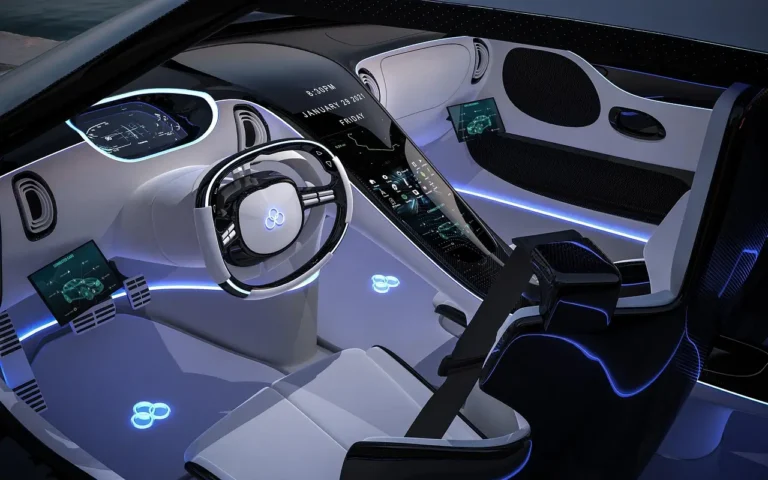
These areas suit LED interior strip kits because they can spread light across a wide surface. A four-strip kit with strips about 12 inches long can fit many smaller cabins, while a 6-strip option is often better for larger cabins. Keep wiring clear of seat rails, pedals, and steering parts.
Dome, map, trunk, and cargo use
These zones usually work better with replacement interior LED bulbs. Festoon and wedge bulbs are common here, and exact size matching matters. One example size is DE3175 for map, dome, and cargo lights. Another example is a 1.7-inch festoon bulb for certain housings.
Strip kits or replacement bulbs?
Choose strip kits for ambient or accent lighting, and choose replacement bulbs when you want an OEM-style upgrade inside existing housings. Strip kits are better for mood lighting in footwells and under-dash areas. Replacement bulbs are better when you want brighter, cleaner light from the dome, map, trunk, or cargo lens.
Choose strip kits for accent lighting
Strip kits often add RGB modes, music sync, and app or remote control. Some kits list 16 million colors, and RGBIC lighting can show several colors along one strip at once. That suits parked use more than driving. Keep bright colors out of the driver eye line.
Choose replacement bulbs for task lighting
Bulb swaps are the cleaner choice when you want brighter white light without visible strips. Match the exact code before buying. Common codes often include DE3175, 578, 6411, and 194. Check the owner’s manual or pull the old bulb before you order, because size-code mismatches are a common failure point.
What power source should you use?
Use the simplest power source that still fits the job. A 12V socket or USB kit is easier to install and easier to remove. Hardwired power is cleaner, but it needs an inline fuse sized for the kit and careful routing. Add battery-drain prevention if the kit does not shut off on its own.
12V socket or USB for simple installs
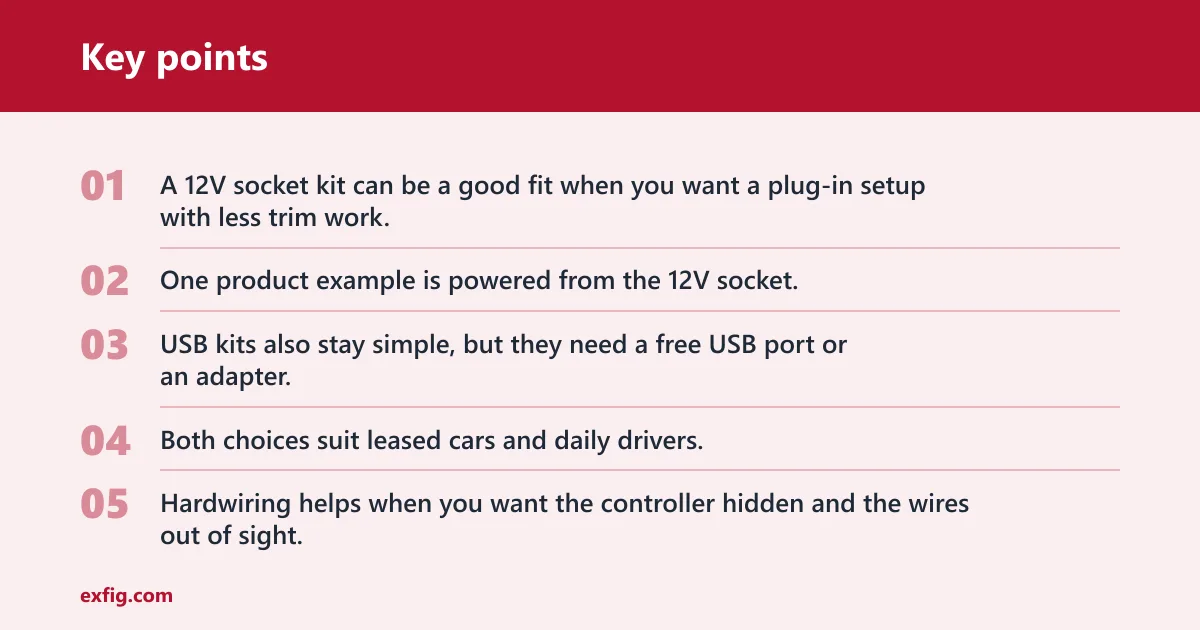
A 12V socket kit can be a good fit when you want a plug-in setup with less trim work. One product example is powered from the 12V socket. USB kits also stay simple, but they need a free USB port or an adapter. Both choices suit leased cars and daily drivers.
Hardwired power for a cleaner setup
Hardwiring helps when you want the controller hidden and the wires out of sight. Use an inline fuse sized for the kit. Route power away from airbags and seat rails, and confirm the kit’s off-state draw or auto-off behavior so the battery does not drain during long parking periods.
What control method fits your use?
Pick the control method based on how often you will change the lighting. App control via Bluetooth works best if you want presets and color changes from your phone. A handheld remote is faster for basic changes. A built-in controller box is fine when you want a fixed setup with less phone dependence.
App control via Bluetooth
App-based kits often offer custom presets, dimming, scene changes, and music-synced effects. Check whether the app needs Bluetooth pairing, whether the controller remembers the last setting, and whether the kit supports separate front and rear zones. Those details matter in larger cabins.
Remote, controller box, or both
A handheld remote is useful if you want a physical control surface. A built-in controller box keeps the setup simple, but it may limit tuning. Some kits bundle both, which gives you a backup if the phone app is awkward or the phone is not in the car.
How do you check fitment and brightness?
Fitment comes first. Match bulb size codes exactly, then measure strip length and count, then check cabin clearance. For task lighting, neutral or cool white is usually better than colored light, and higher color temperature looks bluer. Use dim settings for driving and save colored accents for parked use.
Match bulb size codes exactly
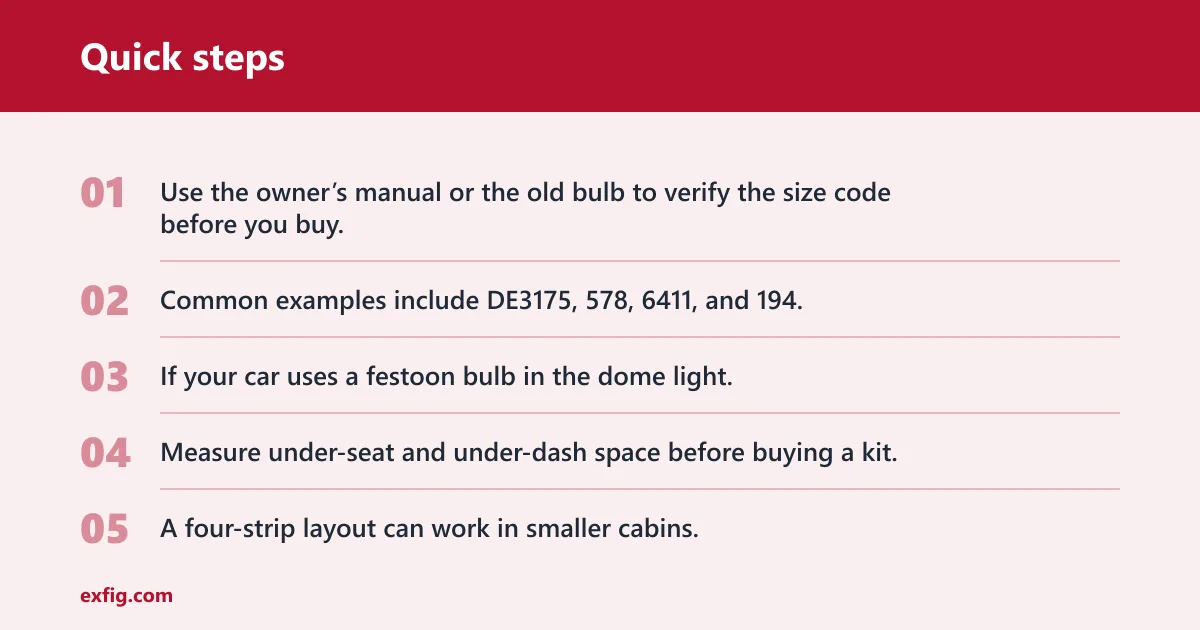
Use the owner’s manual or the old bulb to verify the size code before you buy. Common examples include DE3175, 578, 6411, and 194. Do not treat bulb codes as interchangeable. If your car uses a festoon bulb in the dome light, the wrong length can leave the lens loose or create poor contact.
Measure strip length, strip count, and clearance
Measure under-seat and under-dash space before buying a kit. A four-strip layout can work in smaller cabins, while a 6-strip layout is often better for larger cabins. Leave room for seat travel, pedal movement, and steering column clearance. Plan wire routing so adhesive mounts sit on clean, flat surfaces.
Choose the right brightness and color
Neutral or cool white is the better task-light choice for reading, loading cargo, or finding items. Colored light is more suitable for parked use. If you want a softer cabin look at night, lower the brightness rather than using a high-output color that spills into mirrors or the windshield.
LED interior lights decision matrix
| Cabin zone | Recommended product type | Must-check specs | Install complexity | Common failure mode | Best-for use case |
|---|---|---|---|---|---|
| Footwell | Strip kit | 12V socket or USB, 4-strip or 6-strip layout, adhesive backing, dimming, music sync if wanted | Medium | Wires catch under seat rails or pedals | Ambient lighting and accent glow |
| Under-dash | Strip kit | Controller placement, wire length, mount surface, auto-off behavior | Medium | Visible wiring or loose strips | Accent light in daily drivers |
| Dome | Replacement bulb | Exact bulb code, festoon or wedge type, brightness, flicker compatibility | Low | Wrong size or dashboard warning | Broad cabin light |
| Map | Replacement bulb | DE3175 or exact verified code, switch behavior, dimming | Low | Uneven fit or poor contact | Reading and task lighting |
| Trunk and cargo | Replacement bulb | Exact code, white output, flicker resistance | Low | Light output mismatch | Loading and storage visibility |
Common mistakes
Ignoring the exact bulb code is the fastest way to buy the wrong part. A second mistake is mounting strips where they block pedals or the driver’s sightline. A third is routing wires across seat rails, steering parts, or airbag paths. Bright colors near the driver eye line can also cause glare and reflection issues.
Picture a truck owner choosing a 6-strip kit for a large cab, then mounting one strip across a seat rail. The strip may look fine at first, but the first seat move can tug the wire and peel the adhesive. The better move is to reroute the lead before final stick-down.
Suppose a dome light takes a 578 bulb, but the buyer orders a different festoon length. The light may fit loosely, flicker, or fail to seat against the contacts. Verify the code from the manual or old bulb first, then confirm the lens closes without pressure.
Are LED interior car lights legal?
Interior LED lights are usually easiest to keep legal when they stay inside the cabin and stay out of the driver’s direct view. Problems start when colored light is visible from outside, reflects in the windshield, or mirrors the dashboard too brightly. Check local rules before using visible accent lighting on public roads.
Keep light inside the cabin
Use interior-only lighting that does not face outward. Avoid bright strips near the windshield edge and keep sources away from mirrors. If you want color, reserve it for parked use or for low-intensity ambient settings that do not pull the eye away from the road.
Check local restrictions
Some places may limit visible red, blue, or animated lighting on moving vehicles. That can apply even when the lights are mounted inside. Read local vehicle rules before you buy an RGB kit, especially if the kit includes music sync or chase effects that are obvious from outside the car.
Frequently asked questions
How do I choose LED interior lights for my car?
Start with the cabin zone, then pick the product type, then check the power source and installation risk. Dome and map lights usually need exact bulb sizes. Footwell and under-dash areas usually suit strip kits. Match brightness to the use case, and keep the driver’s sightline clear.
Are interior LED lights bad for your car?
Not if they are matched correctly and installed with care. The main risks are wrong bulb fitment, excess draw, loose wiring, and interference with pedals or airbags. Use the correct size code, a proper fuse for hardwired kits, and an auto-off plan if the kit stays powered.
Should I buy strip lights or replacement bulbs?
Buy strip lights for accent zones such as footwells and under-dash areas. Buy replacement bulbs for dome, map, trunk, and cargo lights when you want factory-style output. If you want the least install risk, choose bulbs; if you want mood lighting, choose strips.
What power source is better for car interior LED lights: 12V, USB, or hardwired?
For simple installs, 12V and USB are easiest. USB needs a free port or adapter, and 12V usually offers an easy plug-in path. Hardwired power is cleaner but needs an inline fuse and careful routing. Choose hardwired only if you can manage the extra install work.
Will LED interior lights drain my car battery?
They can if the kit stays on or the controller keeps drawing power when the car is parked. Check for auto-off behavior and any standby draw before you install. Hardwired kits should use an inline fuse sized for the kit, and plug-in kits should not stay active with the ignition off.
What should I look for in app-controlled car interior lights?
Look for Bluetooth pairing, usable presets, dimming, and memory for the last setting. If you want more than one color at a time, RGBIC lighting can show several colors along one strip at once. Make sure the controller is easy to reach and the app does not force you into bright settings every time.