Fast Charger vs Regular Car Charger: What Is the Difference?

Fast charger vs regular car charger comes down to power. DC fast charging often starts around 50 kW and can add useful range in roughly 20 to 45 minutes. AC home charging is generally slower and often takes several hours. Get this wrong, and you can buy the wrong hardware or expect charging speeds your car cannot deliver. This guide explains the charger, cable, onboard charger, and battery management system limits that decide real charging speed.
How charging speed compares
| Decision factor | Fast charger | regular car charger | Winner |
|---|---|---|---|
| Power delivery | Usually DC, often 50 kW or more, with common public units listed at 60 kW, 120 kW, 150 kW, 250 kW or higher. | Usually AC, with typical slow-charging power around 2.3 kW, 3.3 kW, 7.2 kW, 11 kW, or 22 kW. | Fast charger |
| Where it fits | Public charging stops, highway top-ups, and short dwell times. | Home and overnight charging, apartment parking, and long parked periods. | Regular car charger |
| Vehicle limits | Can still be capped by the battery management system and the battery pack’s charge acceptance rate. | Can still be capped by the onboard charger inside the vehicle. | Tie |
| Battery-health tradeoff | More heat and more stress near the top of the pack, especially after roughly 80% state of charge. | Lower stress because charging is slower and usually happens when the car sits for hours. | Regular car charger |
| Convenience and cost | Fast when time matters, but public sessions usually cost more per use. | Cheaper and easier to live with if you can park and charge at home. | Regular car charger |
Power is the real dividing line
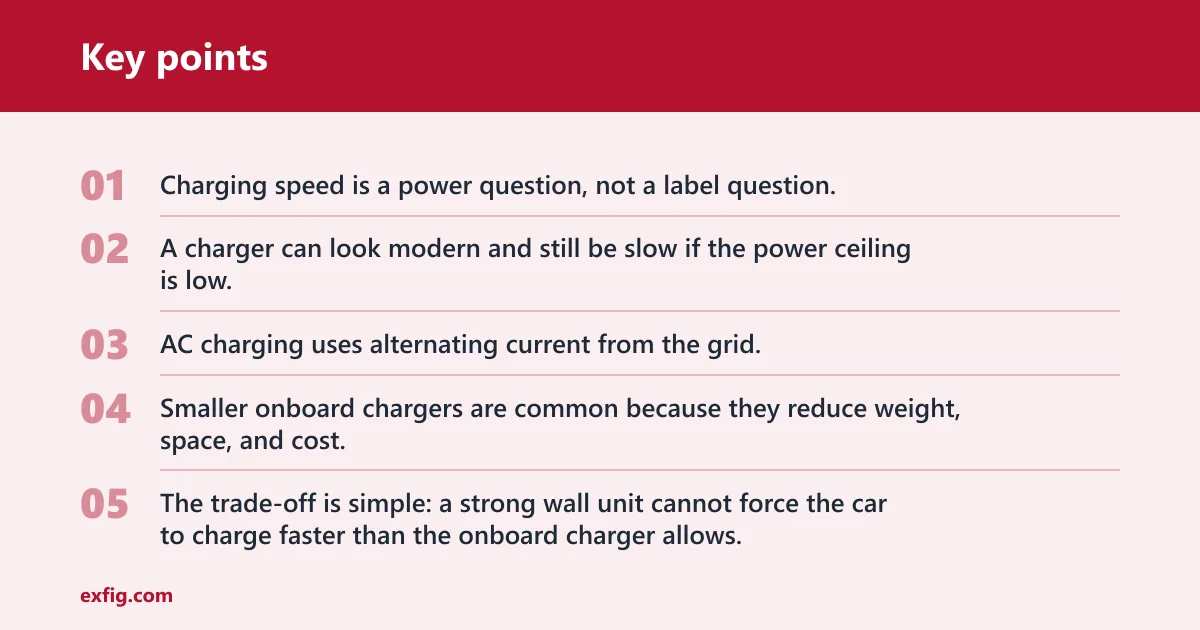
Charging speed is a power question, not a label question. Power is volts × amps, so voltage and current both matter; Fastned says most 50 kW fast chargers can provide a maximum current of 125A, and it also notes most car battery packs today operate at around 400V when fully charged.
That is why “fast” usually means DC charging at 50 kW or more, while “regular” usually means AC charging from the grid. A charger can look modern and still be slow if the power ceiling is low.
AC charging needs the car’s onboard charger
AC charging uses alternating current from the grid. The vehicle’s onboard charger converts that AC into DC for the battery, and that onboard unit sets part of the speed ceiling.
Smaller onboard chargers are common because they reduce weight, space, and cost. The trade-off is simple: a strong wall unit cannot force the car to charge faster than the onboard charger allows.
DC fast charging bypasses that limit
DC fast charging supplies direct current from the charger itself, so it bypasses the onboard charger. That is why public DC stations can charge much faster than AC home units when the car accepts the power.
This is also why two EVs can behave differently at the same station. The charger may offer 150 kW or more, but the car still decides how much it will take.
The battery management system still controls the session
The battery management system, or BMS, regulates charging speed, battery temperature, voltage, and current. It also hides reserve capacity and charge limits from the driver, so the dash percentage is not the whole story.
That control protects the pack. It also means fast charging is not a simple plug-and-go race to maximum power for the entire session.
State of charge changes the speed curve
Charging is fastest at lower battery levels. Speed usually slows after roughly 80%, and the last 20% takes longer than the middle part of the session.
That is why 20% to 80% is a common benchmark. Many modern EVs can reach that window in approximately 20 to 45 minutes on a suitable DC fast charger, but the exact time depends on the vehicle and station.
What makes one charger faster?
The faster charger is the one that can deliver more power to the battery without being limited by the car. In practice, that means the charger’s output, the cable rating, the vehicle’s onboard charger, and the BMS all set separate ceilings. The lowest ceiling wins.
Charging power is measured in kW
Charging power is measured in kilowatts and watts. A 50 kW unit is commonly called fast charging, and common DC fast charging speeds also include 30 kW, 60 kW, 120 kW, 150 kW, and 250 kW or higher.
Typical slow-charging power ranges include 2.3 kW, 3.3 kW, 7.2 kW, 11 kW, and 22 kW. Those numbers are why a home charger can be useful without being quick.
Voltage and current both matter
Power equals volts × amps. A charger can raise current, voltage, or both, but the vehicle and station must match on the electrical side for that power to reach the pack safely.
That is also why a 400V operating point is common in fast charging. High voltage with controlled current is a normal way to move more power without turning the cable into a heating problem.
Is fast charging the same as DC charging?
In everyday EV talk, fast charging is usually DC charging, and regular charging is usually AC charging. The terms are not perfect synonyms in every context, but for most buyers the practical split is this: DC fast charging is the public high-power option, and AC charging is the slower home or destination option.
What AC charging requires
AC charging sends alternating current from the grid into the car. The onboard charger inside the vehicle converts it to DC, which means that onboard unit is part of the speed limit.
That is why an AC wall unit does not automatically mean “fast.” The charger at the wall may be capable, but the car can still cap the rate.
What DC fast charging bypasses
DC fast charging feeds direct current to the battery and bypasses the onboard charger. That removes one bottleneck and is the reason DC stations are much faster than AC stations when the car and cable are compatible.
Public fast-charging stations use this approach because time matters there. A road trip stop should not behave like an overnight parking session.
What actually limits charging speed?
Charging speed is limited by the whole system, not a single label on the pedestal. The charger, cable, onboard charger, battery pack size, chemistry, and BMS all shape the ceiling, and the car can reduce power even when the station is capable of more.
The onboard charger sets the AC ceiling
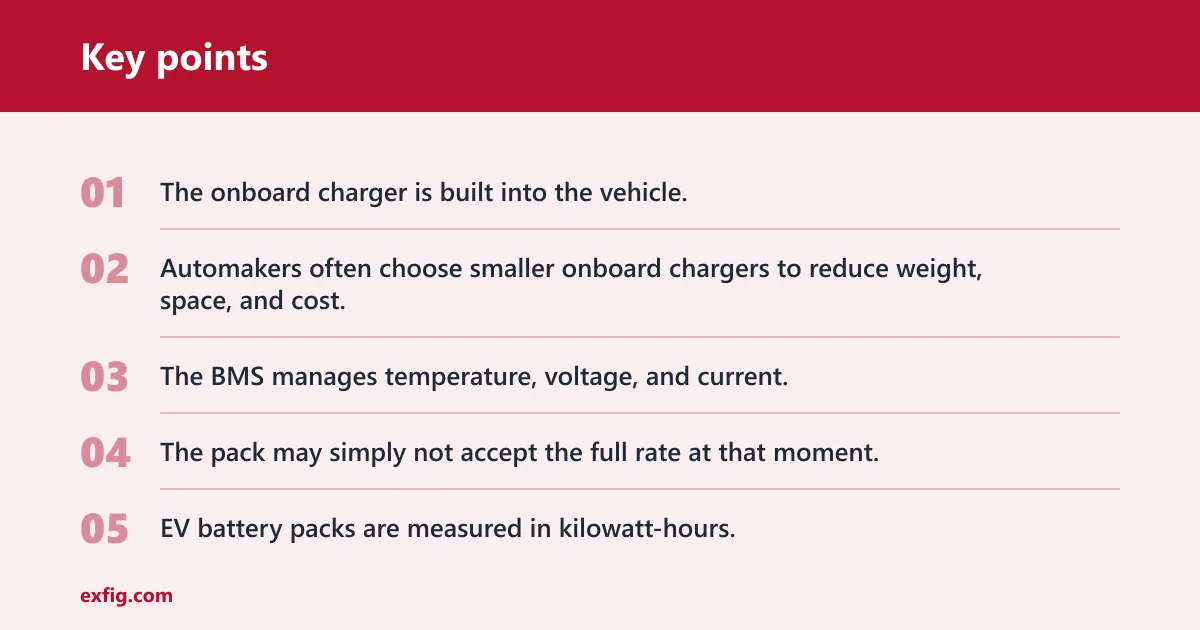
The onboard charger is built into the vehicle. It converts AC to DC, and its size helps determine how fast the car can charge from an AC source.
Automakers often choose smaller onboard chargers to reduce weight, space, and cost. That choice is fine for overnight use, but it keeps AC charging slower than DC fast charging.
The BMS decides what the pack can accept
The BMS manages temperature, voltage, and current. It protects the pack by limiting charging when the battery is cold, hot, or already near full.
That is why a powerful charger can still slow down. The pack may simply not accept the full rate at that moment.
Battery size and chemistry matter
EV battery packs are measured in kilowatt-hours. Usable capacity is lower than total capacity, because manufacturers buffer the pack so the driver does not normally use the full chemical range.
Fastned says the latest generation of EV batteries is set up to maintain a charge level of between 10% and 90%. Charge speed also depends on battery size and chemistry, which is why two vehicles can react differently to the same charger.
For context, Fastned describes the Tesla Model Y Long Range battery pack as 78.1 kWh usable with around 75 kWh usable capacity. It also notes a BMW i3 battery pack has 21.6 kWh capacity and 96 cells, while a Lucid Air battery pack contains 6,600 individual cells.
Say your car is plugged into a 150 kW station. Suppose the station can deliver 150 kW but the car’s BMS tapers hard above 80% state of charge. The first half of the session may be quick, then the rate drops and the last stretch takes much longer. The station did not fail; the pack asked for less.
Can you use fast charging every day?
Yes, frequent fast charging can be acceptable if the car needs it, but AC charging is the better default for daily use when you have the option. The main trade-off is heat and extra stress, especially near the top of the pack and during repeated high-power sessions.
Why 20% to 80% matters
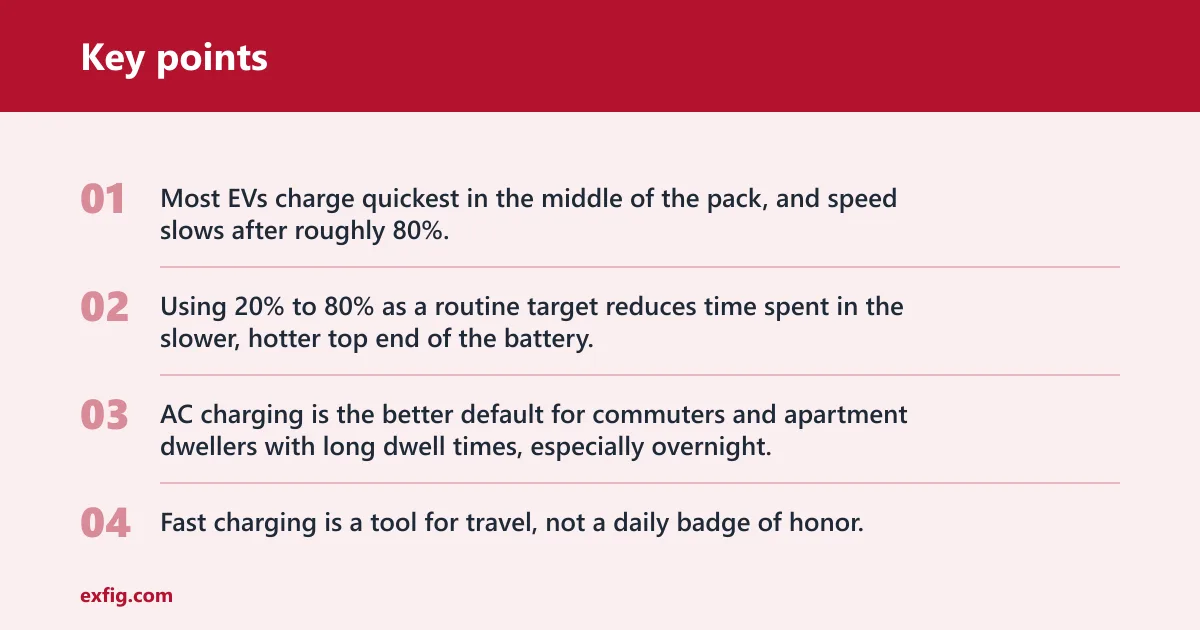
Most EVs charge quickest in the middle of the pack, and speed slows after roughly 80%. That means the healthiest and fastest public charging habit is often to leave before the last, slowest part of the curve.
Using 20% to 80% as a routine target reduces time spent in the slower, hotter top end of the battery. It also lines up with how many cars manage charging internally.
When frequent fast charging is acceptable
Frequent fast charging is a practical choice when the car spends most of its life on long trips, when the driver has no home charging, or when the schedule demands short stops. It is also acceptable when the vehicle and battery are designed for it and the pack stays in a moderate temperature range.
A common first-timer mistake is using a 250 kW station just because it is available, then sitting there from 80% to 100%. That last stretch is usually the slowest, and it often buys little extra range for the time spent.
When AC charging should be the default
AC charging is the better default for commuters and apartment dwellers with long dwell times, especially overnight. It is cheaper in use, gentler on the pack, and usually more convenient when the car is parked for many hours.
Fast charging is a tool for travel, not a daily badge of honor.
Charging decision matrix
Which charger should I use? This matrix gives the practical pick for each common scenario. Match the use case first, then worry about the power number.
| Scenario | Recommended charger type | Expected speed band | Battery-health tradeoff | When fast charging is worth the cost |
|---|---|---|---|---|
| Daily home charging | regular car charger | 2.3 kW to 11 kW, sometimes 22 kW if the vehicle accepts it | Lowest stress for routine top-ups and overnight parking. | Usually not needed unless the vehicle is away from home for most of the day. |
| Apartment charging | regular car charger | 3.3 kW to 11 kW is common where parking is limited | Low to moderate stress, with the benefit of slower heat build-up. | Worth it only when you cannot leave the car plugged in long enough on AC. |
| Highway top-up | Fast charger | 50 kW to 250 kW or higher, depending on the car and station | Moderate stress, especially after roughly 80% state of charge. | Yes, because time saved on the road usually matters more than session cost. |
| Emergency charging | Fast charger | Any working DC site that gets you enough range quickly | Higher stress is acceptable because the priority is getting moving. | Absolutely, if the battery is low and the next stop is safer or cheaper. |
Choose Fast charger if… / Choose regular car charger if…
Choose Fast charger if… you are on a road trip, need a highway top-up, or want the shortest possible stop between legs. It also makes sense when you need roughly 20% to 80% in about 20 to 45 minutes and do not mind paying for the convenience.
Choose regular car charger if… you park for hours at home, at work, or overnight and want the simplest daily routine. It is the better default for commuters and apartment charging because the car can sit long enough for the slower AC rate to be useful.
- Check your parking time. If the car will sit for hours, AC is usually enough. If you need usable range before the next stop, DC is the better fit.
- Match the car’s limit. Look at the vehicle’s AC acceptance rate and DC charging curve. A powerful station cannot override the car’s onboard charger or BMS limit.
- Use the middle of the pack. Aim for the 20% to 80% window when possible. That is where charging is usually fastest and where the battery spends less time under the most stressful part of the curve.
Frequently asked questions
What is the difference between a fast charger and a regular car charger?
A fast charger is usually a DC unit that delivers 50 kW or more and bypasses the vehicle’s onboard charger. A regular car charger is usually an AC unit that relies on the onboard charger inside the car, so it is typically slower and better suited to home or overnight use.
Why does a regular charger charge an EV more slowly?
Because AC charging depends on the car’s onboard charger. That component converts AC to DC, and its size sets part of the speed ceiling. Even a strong wall unit cannot make the car charge faster than the onboard charger allows.
Can I use a fast charger every day?
You can, but it is usually not the best default if AC charging is available. Frequent fast charging adds more heat and stress, especially near the top of the pack. If you mostly drive long distances or lack home charging, it can still be a practical routine.
What charging speed counts as fast charging?
Fast charging is often defined as 50 kW or more. The label matters less than the actual power the car can accept.
How long does it take to charge from 20% to 80%?
Many modern EVs can do that in approximately 20 to 45 minutes on a suitable DC fast charger. The exact time depends on charger power, battery size, chemistry, temperature, and how aggressively the BMS tapers current as the battery fills.