

What Is the Best Car Vent Phone Mount for Your Vent Type?

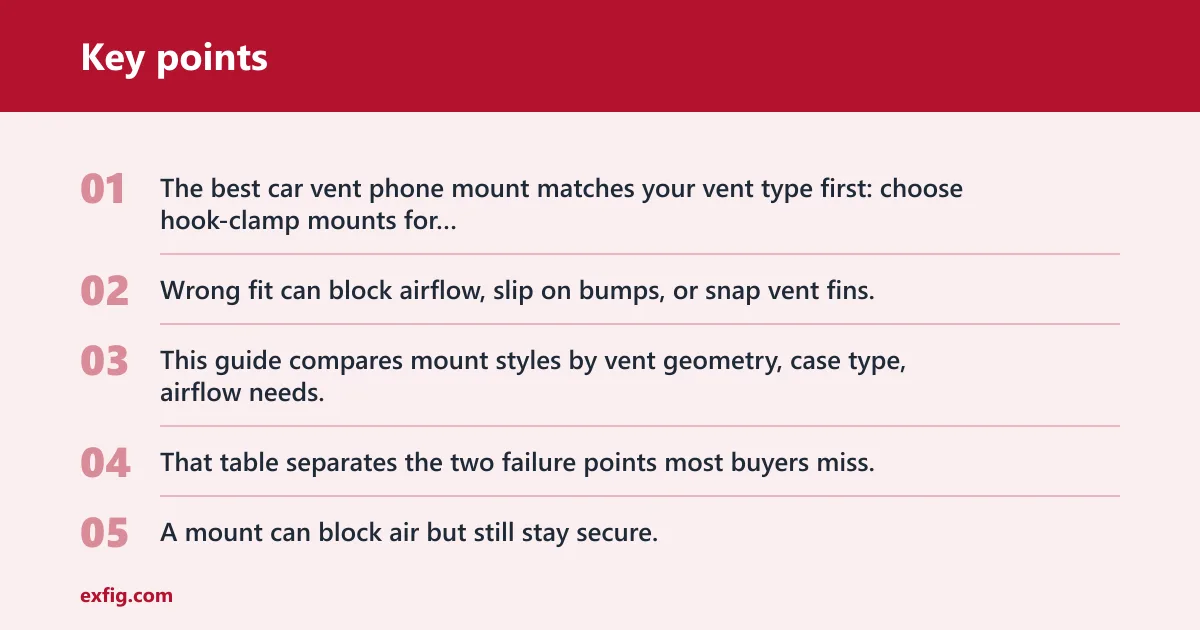
The best car vent phone mount matches your vent type first: choose hook-clamp mounts for horizontal slats, clip mounts for tight vertical slats, and avoid heavy magnets on fragile vents. Wrong fit can block airflow, slip on bumps, or snap vent fins. This guide compares mount styles by vent geometry, case type, airflow needs, and removal habits.
Vent fit decision table
| Vent type | Safest mount mechanism | Airflow blockage | Clip security | Case thickness | MagSafe needs |
|---|---|---|---|---|---|
| Horizontal vents | Hook-clamp or adjustable clip with a wide contact point | Pass: usually partial blockage only if the phone sits low | Pass: slats usually give stable left-right support | Pass: clamp-grip is safer for thick cases | Pass if the phone uses a MagSafe ring or plate for magnetic hold |
| Vertical vents | Hook-clamp or adjustable clip with rotation control | Pass: often less direct blockage, but the mount can still redirect flow | Pass with caution: grip must seat on the blade edge, not just the face | Pass: clamp-grip handles thicker cases better than plain magnets | Pass if the magnet aligns with a ring or plate and the vent stays rigid |
| Round vents | Special clip design or a non-vent mount | Fail risk: the mount can sit awkwardly and cut airflow unevenly | Fail risk: standard clips often lack a flat blade to bite on | Pass only with a purpose-built clip that does not rely on blade width | Pass only if the adapter stays centered and the vent is sturdy enough |
| Wide flat vents | Adjustable clip with long reach and strong grip force | Fail risk: large contact area can block more air than expected | Pass only after checking blade thickness and clip depth | Pass if the clamp opens far enough for the case | Pass with a ring or plate if the magnet sits level on the holder |
| Mixed vent designs | Adjustable clip after fit checking; otherwise choose dashboard or windshield | Pass or fail depends on where the clip lands | Pass only if the clip contacts a rigid slat section | Pass if the holder clears the case edge and button area | Pass if the magnetic surface stays centered and the vent does not flex |
That table separates the two failure points most buyers miss. One is geometry. The other is load. A mount can block air but still stay secure, or leave airflow open and still wobble because the clip has nothing solid to bite.
Which vent type do you have?
Start with the vent shape, not the phone. Horizontal vents are often the easiest fit for hook-style mounts. Vertical vents generally need a clip that grips from top to bottom. Round vents and wide flat vents need closer checking because the face can look right while the blade shape is wrong.
How to identify slat direction
Look at the vent blades from the driver seat. If the blades run side to side, the vent is horizontal. If they run up and down, it is vertical. That direction matters because many mounts rely on gravity and a hooked foot to stop rotation and drop.
Horizontal slats usually give the most predictable seating for a vent mount. Vertical slats can work well too, but only if the clip has enough depth and the mount can rotate to keep the phone readable without tilting into the vent face.
How to spot wide flat vents
Wide flat vents often appear on newer interiors. The slats are broad, the frame is shallow, and the clip may sit on more plastic than intended. That creates a loose-fit risk if the mount depends on a narrow hook or a short gripping foot.
Check two things: blade thickness and clip opening. If the blades are thin and the frame is wide, a small clip can wobble during turns. Adjustable vent clips with stronger grip force and a longer bite area tend to be the safer starting point.
Why round vents need special checking
Round vents are often among the hardest shapes to fit. They do not offer the flat, straight edge that many spring clips or hook feet expect. Some special clip designs wrap the outer ring, but many ordinary vent mounts will never seat cleanly.
If the holder touches only part of the ring, it can twist, rattle, or slide out when the car hits a dip. That is why round vents often push the buyer toward a dashboard, windshield, or dash-slot mount instead of a standard vent holder.
What works best on horizontal vents?
Horizontal vents usually give the best odds for a vent mount because the blades support a hook or clamp evenly across the face. A hook-clamp or adjustable clip is usually the safest starting point, while a pure magnetic holder works best only when the vent frame is stiff and the phone is not overly heavy.
Clip orientation and slat grip
On horizontal slats, the mount should sit so the clip grips the blade from above and below, not just by pressure on the front edge. That layout limits side slip and helps the holder stay centered when you tap the screen or remove the phone.
A magnetic vent phone mount can work here if the vent is firm and the phone has a MagSafe ring or metal plate. Without that centered contact, the magnetic head may hold in place yet let the phone drift on rough pavement.
Stability on braking and cornering
Horizontal vents usually resist front-to-back motion better than loose vertical fins, but they can still flex. A mount that hangs too far out from the vent adds leverage. That extra pull matters more under hard braking, on sharp turns, and on uneven roads.
WixGear describes one magnetic mount as holding up to bumps and sudden stops. That claim matters only if the vent itself is strong enough. A solid magnet cannot fix a weak slat or a clipped arm that slips under load.
When magnetic mounts fit best
Choose magnetic on horizontal vents when the phone already supports MagSafe or you are willing to add a ring or plate. Magnetic designs work best when quick removal matters more than absolute clamping force. They also keep the charging port open more often than a clamp head does.
For thicker cases, magnets can still work, but the case must allow the ring or plate to align well. If the case is soft, bulky, or textured enough to let the phone shift, a clamp-grip mount is the safer choice.
What works best on vertical vents?
Vertical vents can hold a phone securely, but the mount has to fight gravity in a different direction. A hook or clamp that seats cleanly on the blade is usually the best choice, and rotation matters more because the phone often needs to be turned to a readable angle after attachment.
Hook or clamp seating on vertical slats
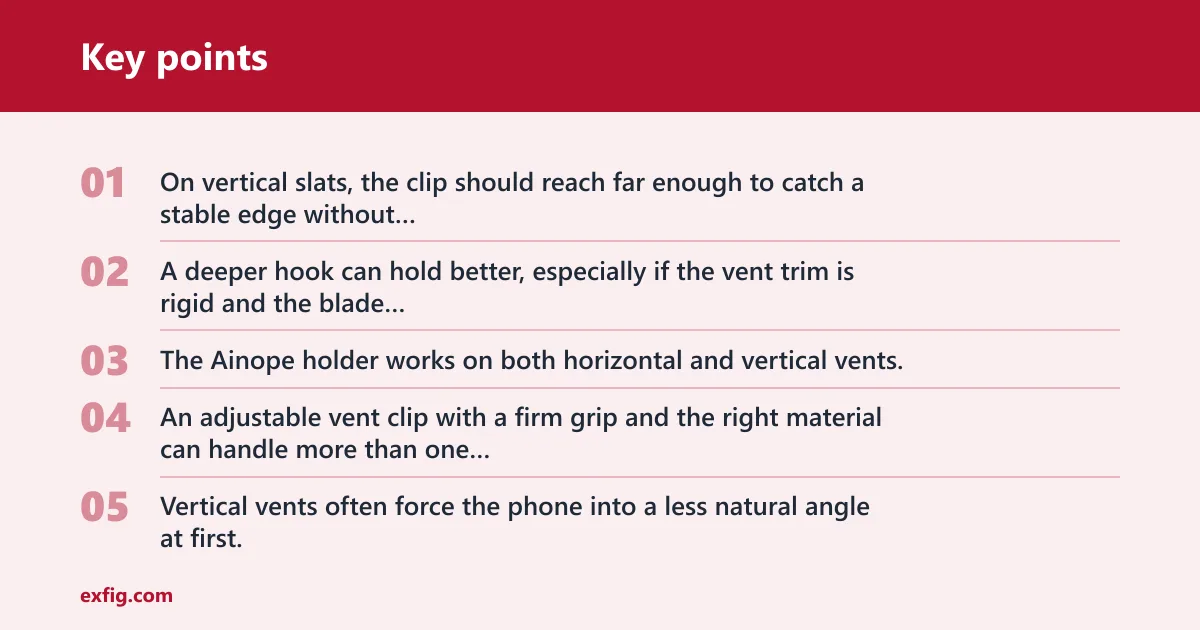
On vertical slats, the clip should reach far enough to catch a stable edge without crushing the blade. A shallow clip may slide down the fin. A deeper hook can hold better, especially if the vent trim is rigid and the blade thickness matches the clip opening.
The Ainope holder works on both horizontal and vertical vents, which is the kind of cross-fit claim worth looking for when your car has mixed slats. An adjustable vent clip with a firm grip and the right material can handle more than one vent layout, but only if the fit is checked first.
Rotation and viewing angle limits
Vertical vents often force the phone into a less natural angle at first. That is where 360-degree rotation helps. Vent mounts can rotate up to 360 degrees for better viewing angles, and that freedom matters when the blades point straight up and down instead of across the dash.
GearLab says the iOttie Easy One Touch 5 pivots through 260 degrees, which is enough for many cabins but not the same as a full spin. If your vent is deep or set far from the steering wheel, rotation range can matter as much as the clamp itself.
Case thickness and phone weight
Vertical vents are less forgiving when the phone is heavy or the case is thick. A clamp-grip mount generally handles that better than a plain magnetic head because the jaws hold the device rather than relying on magnetic pull alone.
Some vent holders fit phones with bulky cases while keeping the charging port free. That helps if the case adds bulk but still leaves enough room for a power cable. It does not help if the vent blade is too short to support the holder in the first place.
Can a vent mount fit round vents?
Sometimes, but round vents are the most likely to fail fit checks. The main issue is geometry: many clips are built for flat slats, not circular rings. A special clip design can work, but only when the holder wraps the vent cleanly and the vent housing is rigid enough to carry the load.
Why geometry is the main constraint
Round vents give the clip fewer stable contact points. Instead of a blade with clear top and bottom edges, the mount meets a curved ring. That can make the holder pivot, slide, or sit crooked even when it looks tight at first.
Loose seating is the usual warning sign. If the clamp has to squeeze too hard to stay put, the vent may be too delicate for repeated use. A strong clip helps only when the vent face can actually support that force.
Special clip designs that help
Some special clip designs spread pressure around the round frame instead of biting one narrow point. That can improve fit, but it does not solve every case. If the vent is soft plastic or the ring is thin, the holder may still shift under vibration.
One practical rule: if the mount needs to pinch the ring so tightly that the vent begins to flex, skip it. The better choice is a different mounting location. A dashboard or windshield mount may be more stable, even if it changes the viewing angle.
When to skip vent mounting
Skip vent mounting when the vent is decorative, fragile, or deeply recessed. Skip it when the phone blocks too much airflow or when the ring bends under the holder’s weight. Round vents often fall into that category, especially in compact cars and luxury cabins with slim trim.
For a car with two round vents and a 6.7-inch phone in a thick case, a standard clip may sit at an angle. A standard clip may hang at an angle, then twist every time the road surface changes. In that situation, a non-vent mount is the cleaner answer.
What mount style should you choose?
The best style depends on what the vent can support and how you remove the phone. Magnetic mounts are fastest to detach. Clamp-grip mounts are the most universal. Adjustable vent clips sit between those two and matter most when the vent shape is unusual or the blade thickness is uncertain.
Magnetic vent mount
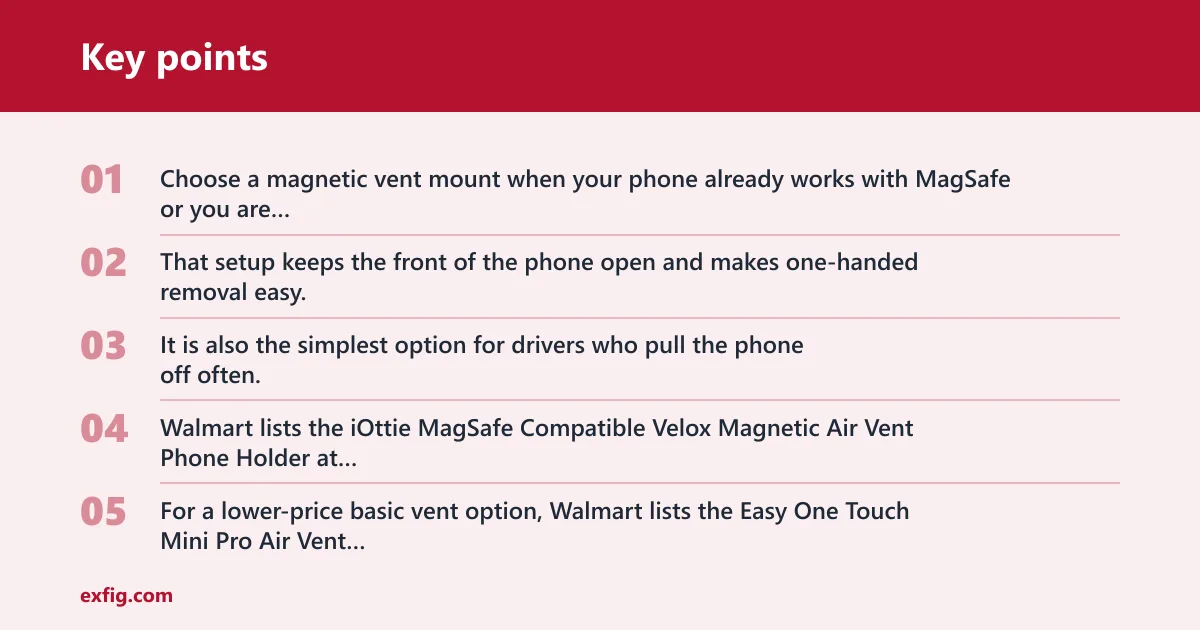
Choose a magnetic vent mount when your phone already works with MagSafe or you are willing to add a metal plate or ring. That setup keeps the front of the phone open and makes one-handed removal easy. It is also the simplest option for drivers who pull the phone off often.
Walmart lists the iOttie MagSafe Compatible Velox Magnetic Air Vent Phone Holder at $24.95. For a lower-price basic vent option, Walmart lists the Easy One Touch Mini Pro Air Vent Mount at $19.96. Price alone does not decide fit, but it can help separate a simple holder from a magnet-based one.
Clamp-grip vent mount
Choose a clamp-grip vent mount if you want universal phone compatibility and a more secure hold on a thick case. Clamp styles do not need a magnet ring, so they work better with many non-MagSafe cases and with phones that have uneven backs or textured shells.
These mounts usually make one-handed release simple through a quick-release button. A quick-release button helps move the mount or remove it at the destination, which matters if you park in different cars or want the phone out of sight when you leave.
The same source says the iOttie Easy One Touch 5 has a telescopic arm from 4.5 to 6.75 inches, and Walmart lists it with 1,876 reviews. That combination suggests a well-known clamp style, but the main check is still vent fit, not review count.
Adjustable vent clip
Choose an adjustable vent clip when the vent layout is mixed or the slat depth is uncertain. The best versions use a clip that can change grip force and adapt to different blade widths. Clip material matters too, because softer plastic can deform in heat or cold.
Some materials can warp grip performance in extreme heat and cold. That is one reason an adjustable clip should not be judged only by its opening width. It also needs a material that keeps its bite after long sun exposure or cold morning starts.
For mixed vents, this style is often the test-first option. If the clip sits securely and the phone still clears the vent face, it may be all you need. If not, stop before the clip starts stressing the slats.
Qi wireless charging car mount
Choose a Qi wireless charging car mount when you need charging as well as holding, and the plug has clear access. Qi certification matters because charging claims without it can be vague. You also need enough cable clearance and enough room for the phone size and coil position.
The same source says the Spigen OneTap Pro 3 offers up to 15W output. iOttie’s AutoSense Wireless Car Charger mounts to both a CD player and a vent, which is useful when the vent is not the only option. Charging mounts work best when the cable can route cleanly without forcing the phone sideways.
Choose magnetic if… / Choose clamp-grip if…
Choose magnetic if your phone case supports MagSafe or you are willing to add a ring or plate, the vent is firm, and you want the fastest one-handed removal. Choose clamp-grip if you want the safest universal hold, especially with a thick case, a heavy phone, or a vent that flexes.
Choose magnetic if you want a cleaner front face and do not mind aligning the ring. Choose clamp-grip if the case is thick enough that magnet strength becomes uncertain. Choose Qi charging if you want power through the mount and have room for the charging plug without bending the cable.
Picture a sedan with horizontal vents and a slim case. A magnetic holder can be the cleanest choice. Now picture a tall SUV with vertical vents, a rugged case, and a phone that gets removed several times a day. A clamp-grip mount is the safer call.
A common first-timer mistake is picking a vent mount without checking whether the clip works with horizontal, vertical, or round vents. Vent shape matters first. A wide phone on the wrong clip can still fall if the mount cannot sit flat on the slat or ring.
Frequently asked questions
What is the best car vent phone mount for vertical vents?
A hook-clamp or adjustable clip is usually best for vertical vents because it can seat on the blade edge and hold against gravity. Rotation matters too, since a vertical layout often needs the phone turned after attachment. Thick cases usually push the choice toward clamp-grip rather than magnetic hold.
What is the best car vent phone mount for horizontal vents?
Horizontal vents usually work best with a hook-clamp or strong adjustable clip because the blades give a flatter, more stable seat. Magnetic mounts can work well too if the vent is rigid and the phone uses MagSafe or a ring. The key is keeping the holder from leaning forward under load.
Will a vent phone mount fit round car vents?
Sometimes, but round vents are the hardest match because standard clips expect flat slats. A special clip design may work if it wraps the ring securely. If the vent flexes, twists, or sits deeply recessed, a dashboard or windshield mount is usually the safer choice.
How do I know if a vent mount will work with my vent type?
Check three things: slat direction, blade thickness, and how much the vent flexes when you press it. If the clip has to force the blades apart or only touches one edge, fit is poor. A good mount should sit flat, hold firm, and leave the vent trim intact.
Can a vent phone mount hold a phone with a thick case?
Yes, but clamp-grip mounts are usually safer than magnets for thick cases. Some vent holders fit phones with bulky cases while keeping the charging port free, yet magnetic mounts may still need a ring or plate to hold well. Thick, textured cases can weaken magnetic alignment.
Do vent phone mounts block airflow from the AC?
They can block airflow or just redirect it, and those are not the same problem. A centered mount may cover part of the vent opening without choking flow. A poorly seated holder can deflect the air sideways or downward and make the cabin feel different even if the vent is still partly open.
Do vent phone mounts damage air vents or break the clips?
They can if the clip is too tight, the vent is fragile, or the mount hangs too far out from the slat. Round vents and wide flat vents are the most common trouble spots. A mount that needs excessive force to stay put should be rejected before it stresses the vent blades.
Will a vent mount stay secure on bumpy roads?
It can if the vent is rigid and the clip has enough grip force. Magnetic mounts are more dependent on a strong vent and a well-centered phone, while clamp-grip mounts spread the load better. Bumps and sudden stops are where weak seating shows up first.
Do vent mounts work better than dashboard or windshield mounts?
Not always. Vent mounts avoid windshield obstruction and dashboard residue, but they depend on vent geometry. Some states restrict windshield mounts if they block the driver’s view, so a vent mount may be preferable where legality and visibility matter. If the vent is fragile, the dashboard often wins.