
What Is LED Hyper Flash and Why It Happens in Turn Signals?

LED hyper flash is a turn signal or hazard light that flashes much faster than normal because an LED turn-signal bulb typically pulls less current than the incandescent bulb it replaced, so the flasher module may read the circuit as a bulb failure. Ignore it and you can lose proper signal timing, trigger bulb-out warnings, or install the wrong fix. This guide shows how to spot the symptom and decide between load resistors, an LED-compatible flasher relay, or a wiring check.
What LED hyper flash means
Hyper flash is an unusually fast blink rate on a turn signal or indicator circuit. The vehicle expects the higher current draw of an incandescent or halogen bulb, but an LED turn signal bulb loads the circuit much less. That mismatch is what usually triggers the rapid flash, not a bad LED by itself.
How rapid blinking differs from normal timing
Normal turn signals blink at a steady, moderate cadence set by the flasher circuit or body control module. Hyper flash is noticeably faster. On many vehicles, the same rate change also appears in the hazards, which helps separate a front- or rear-lamp issue from a broader circuit problem.
Picture a rear bulb swap on one side only. The new LED lights normally at first, then the indicator starts blinking much faster than the other side. That points to a load mismatch on that circuit, not a general failure of every lamp on the car.
Why the vehicle thinks the circuit load is too low
Many flasher systems measure current draw. A halogen bulb may pull several times more current than a replacement LED, so the circuit looks open or underloaded. Some vehicles respond by speeding up the flash, while others add a dash warning or stop the circuit from working as expected.
Why this usually appears after LED bulb installation
Hyper flash most often shows up after a halogen-to-LED swap because the original bulb load is part of the system design. Once that load drops, the flasher logic may no longer see the circuit it was built to expect. That is why the symptom often starts immediately after installation.
Why LEDs trigger fast flashing
LED bulbs use less current than incandescent bulbs, and that lower load changes how the vehicle’s flasher circuit behaves. Some systems are simple and rely on heat or current draw alone. Others are electronic, or monitored by a body control module, and they can react with a warning, a faster blink, or both.
Incandescent load versus LED current draw
Incandescent and halogen bulbs provide the baseline electrical load many vehicles expect. LED replacements are more efficient, so they draw less current for the same visible light output. That difference is the core reason a turn signal that worked with stock bulbs may flash too fast after the swap.
How thermal and electronic flasher circuits respond
Older thermal flasher relays depend on heat from current flow. Lower current from LEDs may keep the relay from cycling at the normal rate, or it may cycle faster than intended. Electronic flashers are less dependent on heat, but many still look for a load range that matches the original bulb setup.
How CAN bus and bulb-out monitoring add warnings?
On some vehicles, a CAN bus or bulb-out monitoring system checks the turn-signal circuit and decides whether the load is too low. If it sees a mismatch, it may trigger a dash warning, a fast flash, or both. That behavior varies by make and model, so the same bulb can work in one car and fail in another.
What symptoms point to hyper flash?
Different symptoms point to different causes. One fast side often suggests a single bulb, socket, or ground issue. Fast flashing on both sides points more toward the relay, body control module, or a vehicle-wide load strategy. No flash or intermittent flashing often means a polarity, seating, or wiring fault rather than a pure load mismatch.
One side flashes fast
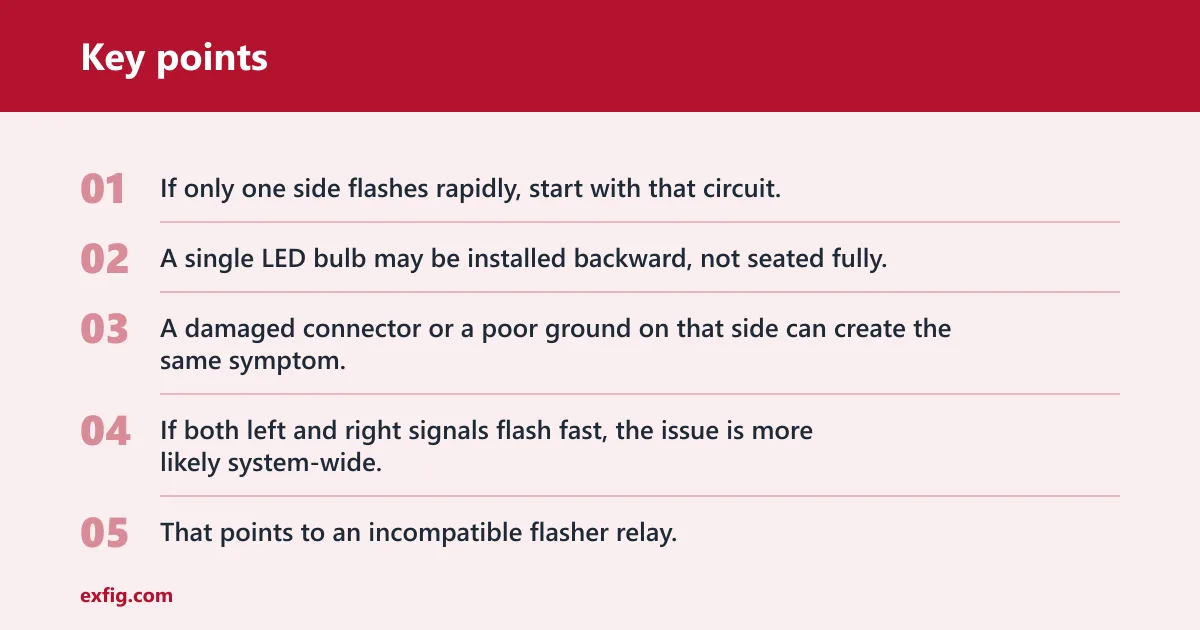
If only one side flashes rapidly, start with that circuit. A single LED bulb may be installed backward, not seated fully, or paired with a socket that does not match its polarity. A damaged connector or a poor ground on that side can create the same symptom.
Both sides flash fast
If both left and right signals flash fast, the issue is more likely system-wide. That points to an incompatible flasher relay, a vehicle that needs coding or a load strategy change, or a pair of LED bulbs that both draw below the expected threshold.
Dash warning appears
A bulb-out message usually means the vehicle’s monitoring system detects low current, open-circuit behavior, or a lamp fault. The warning may appear even if the LED turns on, because the system is checking electrical load, not just visible light.
No flash or intermittent flashing
No flash or a stop-start pattern usually points away from simple hyper flash. Check polarity, connector fit, and socket contact first. If the lamp works only after being moved or pressed in, the issue may be an adaptation problem, a weak ground, or a damaged terminal.
LED hyper flash troubleshooting matrix
| Symptom | Vehicle type | Likely circuit issue | Test to confirm | Recommended remedy |
|---|---|---|---|---|
| Rapid blink on one side | Halogen turn signal swapped to LED | Low load on one lamp, wrong polarity, weak socket contact, or side-specific ground fault | Compare that side to the other side, then test the lamp in the same socket for polarity and seating | Correct polarity, reseat the bulb, repair the connector, or add a load resistor if the circuit still reads low |
| Rapid blink on both sides | Older relay-based vehicle or BCM-controlled vehicle | Flasher relay or body control module sees both circuits as underloaded | Check whether hazards also flash fast; inspect whether both fronts or both rears were converted at once | Use an LED-compatible flasher relay if the vehicle supports one, or add matched load resistors where appropriate |
| Dash warning | Vehicle with CAN bus or bulb-out monitoring | Monitoring system detects current below threshold | Read the cluster message, then compare current draw against the stock bulb path if service data is available | Install a vehicle-specific LED solution, such as coding support, compatible relay, or properly wired resistors |
| No flash | Plug-in LED bulb conversion | Polarity reversed, poor contact, or incompatible socket | Flip the bulb if the design allows it, then check connector pins and socket depth | Reorient the bulb, clean terminals, or use an adapter designed for that socket |
| Intermittent flashing | Any LED indicator circuit | Loose connector, weak ground, heat-related contact loss, or vibration-sensitive fitment | Wiggle-test the harness with the signal on and inspect for dimming or dropout | Repair the ground, tighten the connector, replace damaged terminals, or secure the lamp so it cannot move |
Do you need a flasher relay?
An LED-compatible flasher relay is the cleanest fix when the vehicle uses a replaceable relay and the new unit is built for LED load. If the turn-signal system is controlled by a body module, or the relay is integrated and not serviceable, a relay swap may not be an option. Fitment must match the vehicle exactly.
When an LED-compatible relay is the cleanest fix
If the original relay is a separate, serviceable part and the parts catalog lists an LED version, that is often the simplest answer. It preserves the circuit without adding heat-producing resistors. It also avoids extra wiring if the new relay is designed for the vehicle’s pinout and flash logic.
When relay replacement is not an option
Many newer vehicles use body control modules instead of a simple plug-in flasher relay. In those cases, the relay may be built into the module or absent altogether. Then the fix shifts to load resistors, coding support, or a vehicle-specific adapter strategy.
Why fitment must match the vehicle
Relay shape, pin count, current rating, and flash behavior all matter. A relay that fits one socket may still be wrong for the circuit. Check the vehicle’s service information before buying one, because an incorrect relay can create no-flash, fast-flash, or hazard-light faults.
When should you use load resistors?
Load resistors are used when the vehicle needs to see more current, but a relay swap is unavailable or not practical. The resistor mimics halogen load by adding resistance in parallel with the LED circuit. That can stop hyper flash, but it also creates heat, so mounting and wiring matter.
How resistors mimic halogen load
A resistor adds artificial electrical load so the flasher circuit sees something closer to the original bulb. That can bring the blink rate back to normal on many vehicles. It is a workaround, not a lamp upgrade, and it should be sized and installed for the circuit it is correcting.
Where to wire them safely
Load resistors are commonly wired in parallel with the turn-signal circuit, not in series with the LED bulb. They should be attached to a metal surface or another heat-safe location, away from plastic housings, loom wrap, and painted panels. Secure the wiring so vibration cannot loosen the connection.
Why heat and mounting matter
Resistors can get hot enough to damage nearby plastic or insulation. That makes them a poor choice where space is tight, airflow is poor, or there is nowhere safe to anchor the part. If heat management is a problem, an LED-compatible relay or coding solution is often the better path.
Suppose a rear turn signal blinks normally for five seconds, then speeds up after the housing warms and the resistor shifts against the lens cover. That kind of intermittent fault is a warning sign: the fix may be electrically correct but physically unsafe.
What wiring checks should you make?
Before swapping parts, check the basics. LED turn signal bulbs can be polarity-sensitive, and a socket can fit loosely enough to cause a false load fault. A clean circuit with good grounds and solid contacts often fixes symptoms that look like hyper flash but are really connection problems.
Polarity and socket orientation
Some LED replacements work only when the polarity is correct. If the bulb does not light, or lights only intermittently, reverse the bulb if the design allows it. Make sure the socket keying matches the bulb and that no terminal is pushed back in the connector.
Bulb seating and connector condition
A bulb that is not fully locked in can cause rapid blinking, dim output, or no flash at all. Inspect the connector for corrosion, heat damage, or loose pins. A tight fit matters because an unstable electrical path can mimic a failed bulb.
Ground faults and damaged wiring
A poor ground can create symptoms that look like an LED load mismatch, especially on one side only. Check the ground point, inspect for broken insulation, and look for pinched wires near the lamp housing. If the hazard lights also behave strangely, the fault may be farther upstream in the circuit.
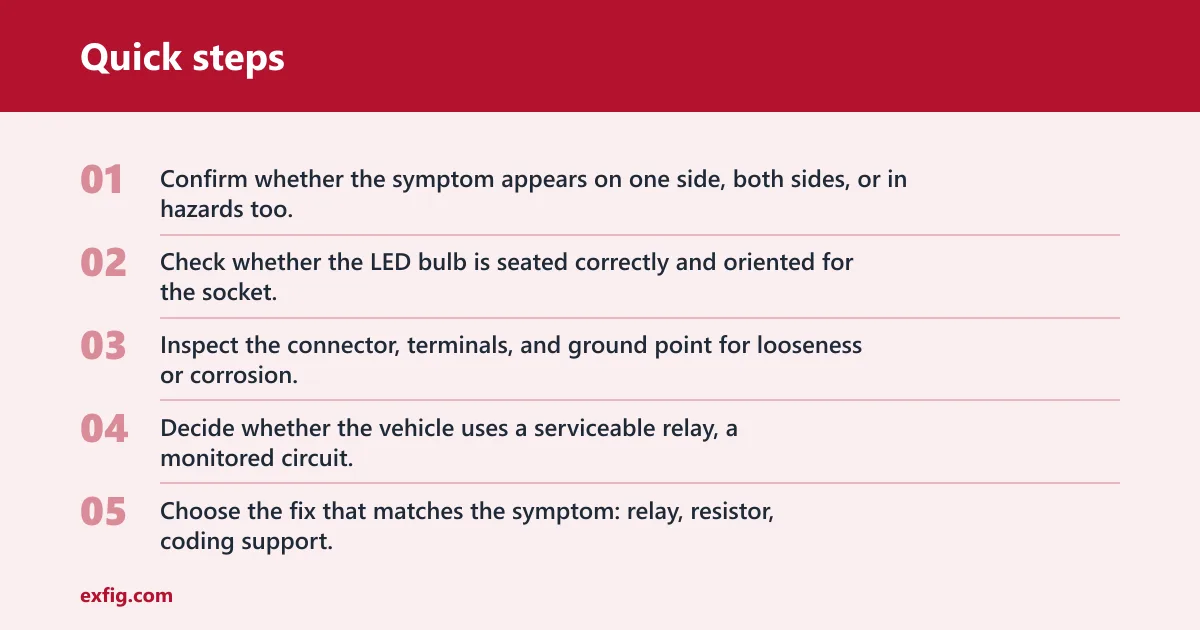
- Confirm whether the symptom appears on one side, both sides, or in hazards too.
- Check whether the LED bulb is seated correctly and oriented for the socket.
- Inspect the connector, terminals, and ground point for looseness or corrosion.
- Decide whether the vehicle uses a serviceable relay, a monitored circuit, or a module-controlled system.
- Choose the fix that matches the symptom: relay, resistor, coding support, or wiring repair.
Frequently asked questions
Why does an LED light flash?
An LED light flashes in a vehicle when the turn-signal circuit is pulsed on and off by the flasher system. If the flash is too fast, the circuit is usually seeing too little load from the LED bulb compared with the original incandescent bulb. That is hyper flash.
Why do LED bulbs flash after installation?
LED bulbs flash after installation because the vehicle still expects the higher current draw of the stock bulb. The lower load can trigger fast blinking, a warning message, or both. In some cases the bulb also needs polarity correction or a better socket fit.
Why does LED light keep flashing in a car?
A LED light keeps flashing in a car when the circuit never sees the expected electrical load or when the wiring path is unstable. Common causes include a missing resistor, an incompatible relay, a bad ground, or a bulb that is not fully locked into the socket.
What causes signal light to flash rapidly?
A signal light flashes rapidly when the flasher circuit reads the load as too low. The most common reason is a halogen-to-LED swap. The same symptom can also come from a failed bulb, a poor connection, or a monitoring system that is designed to flag low current.
What is the difference between hyper flash and normal flashing?
Normal flashing is the steady blink rate the vehicle was designed to use with stock bulbs. Hyper flash is the same circuit cycling much faster because the load is below the expected level. Normal flashing signals a healthy circuit; hyper flash signals a load mismatch or related fault.
Do I need a flasher relay for LED bulbs?
You may need an LED-compatible flasher relay if your vehicle uses a replaceable relay and the factory unit depends on incandescent load. If the relay is built into a body module, a relay swap may not work. In that case, resistors or vehicle-specific coding are more likely fixes.