Why Does My Car Speaker Only Work Sometimes?

If a car speaker works only sometimes, the usual causes are a loose connection, a failing speaker, bad head unit output, or an amplifier issue; check one component at a time before buying parts. Ignoring it can hide a short or overheating amp channel, and random audio cuts often worsen with vibration or temperature changes. This guide shows how to pinpoint whether the speaker, wiring, head unit, or amplifier is at fault.
How to isolate the cause of intermittent audio
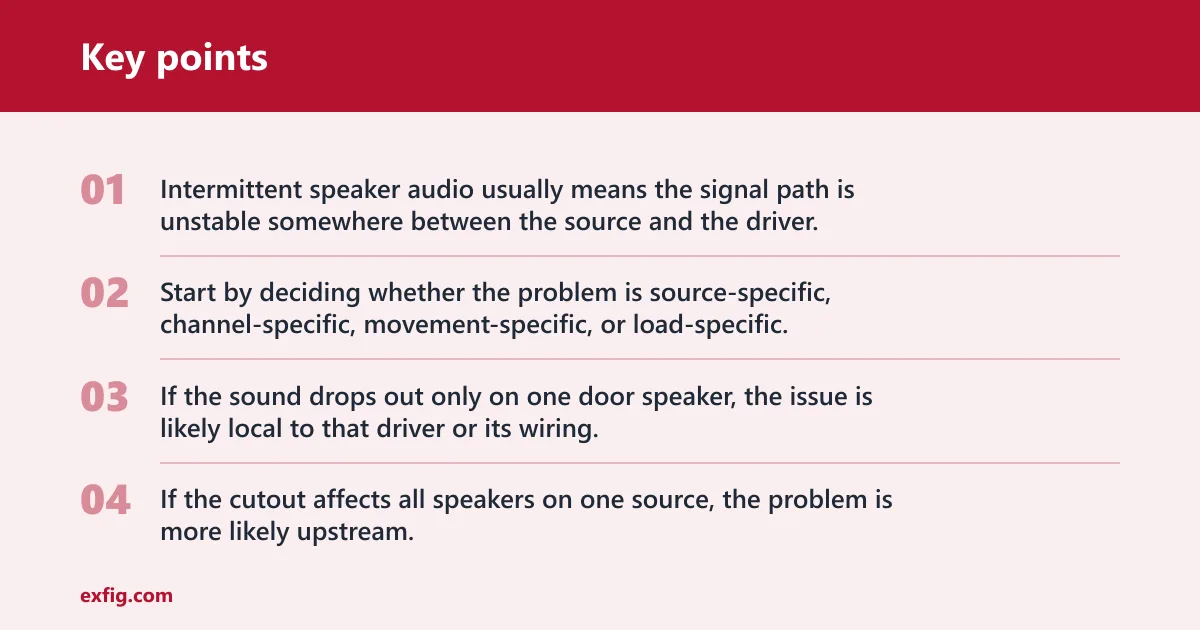
Intermittent speaker audio usually means the signal path is unstable somewhere between the source and the driver. The fault may be in the full-range speaker itself, the speaker wiring, the head unit output, or an aftermarket amplifier that drops out under heat or load.
Start by deciding whether the problem is source-specific, channel-specific, movement-specific, or load-specific. That split saves time because a fault that follows Bluetooth only is not the same fault as one that appears when a door opens, a bass note hits, or the radio warms up.
How to tell a speaker fault from a system fault
A bad speaker usually fails on one location only, while a bad head unit or amplifier can affect more than one speaker or one input path. A weak channel, open voice coil, loose connector, or broken door-jamb wire can all create the same symptom: audio that comes and goes.
Use the symptom pattern first. If the sound drops out only on one door speaker, the issue is likely local to that driver or its wiring. If the cutout affects all speakers on one source, the problem is more likely upstream.
Check the source first
Before pulling panels, confirm whether the fault follows one input or all inputs. A radio, Bluetooth stream, and AUX feed can all use different signal paths inside the head unit, so one bad input does not prove the speaker is bad.
Source-specific check
- Switch inputs one by one. Play the same audio level through radio, Bluetooth, and AUX, then note when the speaker cuts out. Keep volume moderate so you are not confusing distortion with an intermittent fault.
- Compare the result. If the same speaker fails on every source, the problem is probably downstream of the input stage. If only one source fails, inspect that source device, input circuit, or the head unit’s source selector path.
- Check the output path. If the fault appears only on one source and not the others, the head unit may have an internal source fault rather than a speaker or wiring issue.
Suppose Bluetooth plays normally, but FM radio drops in and out on the front left speaker only. That pattern points away from the speaker cone and toward the head unit or the radio input path, because the fault follows the source rather than the load.
Fader and balance settings
Set balance to center and fade to center before any deeper diagnosis. A shifted fader can make one speaker seem dead when the system is simply routing audio away from that corner.
Also check any loudness, surround, or speed-compensation setting if the head unit has one. These settings should not mute a healthy speaker, but they can make a weak channel easier to misread.
Head unit output channel faults
If one speaker stays dead across every source while the other speakers work normally, the head unit may have a single bad output channel that affects only one speaker. A failed internal amplifier stage can send clean audio one moment and nothing the next, especially when temperature changes or the volume rises.
Common head unit clues include one channel only, no change when swapping sources, and a fault that stays on the same output even after the speaker is swapped. That is different from a system-wide source fault, which would usually affect more than one speaker or more than one channel.
Car speaker fault checklist
Use this checklist to sort the fault before you replace anything. The table separates the four common failure patterns into a direct test, the expected result, the meaning of a failure, and the next part to inspect.
| Branch | Exact test to run | Expected result | What failure means | Next component to inspect |
|---|---|---|---|---|
| Source-specific | Play the same track through radio, Bluetooth, and AUX at the same volume with balance and fade centered. | The fault repeats on every input if the problem is downstream. | If only one input fails, the issue is in that source path or the head unit input stage. | Head unit source selector, input circuit, or source device. |
| Channel-specific | Move balance fully left, then fully right, and note whether the fault stays on one side. | The failure stays with one left/right channel if that channel is bad. | If the fault follows one side, the speaker, its wiring, or that output channel is suspect. | Speaker wiring, speaker, or head unit output channel. |
| Movement-specific | With the system on low volume, gently open and close the door or move the cable near the door jamb. | No change in audio while the door moves. | If audio cuts in and out, the door-jamb flex point or connector is failing. | Car door wiring loom, connector pins, and continuity. |
| Load-specific | Check speaker resistance and listen for scratchy sound, rubbing, or dropouts under bass-heavy tracks. | The speaker load stays stable and the sound remains clean. | If resistance is open, very low, or unstable, the driver or amp stage may be failing. | Speaker cone, voice coil, and amplifier output. |
Why do my door speakers only work sometimes?
Door speakers often fail at the door-jamb flex point, where the wiring bends every time the door opens and closes. Broken strands inside the insulation, a loose connector, or poor pin fit can let the speaker work until vibration or door movement interrupts the circuit.
If the problem changes when you move the door, the fault is usually mechanical rather than electronic. That means the speaker may be fine, but the wiring feeding it is opening and closing with movement.
Door-jamb wiring loom failures
The flex point in the door jamb is a common break location because the wiring bends thousands of times over the life of the car. The wire may look intact from the outside while the copper inside has fractured into a few remaining strands.
A movement-related failure often shows up as crackling, brief loss of one door speaker, or sound that returns when the door is positioned differently. That pattern is a strong clue that the door wiring, not the speaker cone, is the fault.
Loose connector, corrosion, and pin fit
Pull the connector only after disconnecting power if the design allows it, then inspect each terminal for corrosion, discoloration, or a terminal that does not grip tightly. Poor pin fit can create intermittent contact that changes with vibration, temperature, or door movement.
Look for bent pins, spread terminals, or moisture intrusion near the lower door area. A connector that feels secure by hand can still have weak contact at the metal terminal level.
- Inspect the connector. Unplug the speaker connector and examine both sides for green corrosion, bent pins, or a loose latch. Reconnect it firmly and make sure it seats fully.
- Flex the wiring gently. With the audio playing at low volume, move the cable near the door jamb while listening for cutouts. If the sound changes, the break is likely inside the moving section of wire.
- Check continuity. Use a multimeter in continuity mode across the suspected wire path. A healthy wire should show a steady path, while an open reading points to a broken conductor.
Why is only one speaker working in my car?
If only one speaker is working, the fault may be a single speaker, a single channel, or a wiring issue that affects only one branch of the system. The key question is whether the problem stays with the speaker location or follows the output channel when you test it.
That distinction matters because one dead driver does not mean the whole audio system is failing. It may be one bad full-range speaker, one failed tweeter or woofer path, or one output stage in the head unit or amplifier.
Left/right channel isolation
Use the balance control to send audio fully left, then fully right. If the problem stays on the same physical speaker, the issue is local to that speaker or its wiring. If it follows the left or right channel no matter which speaker is attached, the source channel is suspect.
Front and rear speaker layouts can make this confusing. A door-mount location may combine woofer and tweeter roles through a crossover or factory network, so one damaged branch can make the whole door seem dead.
Single speaker versus single channel diagnosis
A single bad speaker usually stays silent or sounds distorted only at one location. A bad channel often affects every speaker tied to that output path, even if the speaker itself is healthy.
Say the front left door speaker is dead, but swapping that speaker to the right channel makes it play normally. That points to the original left channel, not the speaker. If the same speaker stays dead on both sides, the speaker or its local wiring is the likely fault.
Test the speaker and wiring with a multimeter
A multimeter helps separate a broken wire from a failing driver. Use continuity mode for open circuits in the wiring and resistance mode for the speaker load itself. That gives you a basic electrical diagnosis before any part replacement.
Continuity mode for broken wires
- Disconnect the speaker. Remove the speaker from the circuit so the meter reads the wire path, not the driver coil. This prevents false readings from parallel components.
- Probe each conductor. Touch the meter leads to both ends of the same wire, from the head unit side to the speaker side if accessible. A steady beep or near-zero reading means continuity; no beep means the wire is open.
- Wiggle the wiring. Bend the loom at the door jamb and near connectors while watching the meter. If continuity drops in and out, the wire has an internal break or poor terminal contact.
Resistance checks for speaker load
A healthy 4-ohm speaker commonly reads a little under 4 ohms on a meter because DC resistance is lower than the nominal rating. Many healthy car speakers are commonly reported around 3 to 4 ohms on a 4-ohm driver, while an open circuit can point to a failed voice coil and a near-zero reading can indicate a short.
Use the reading as a guide, not a verdict alone. A speaker that reads open, jumps around when tapped lightly, or changes when the cone moves by hand is suspect, especially if it also sounds scratchy or rubs.
Picture a door speaker that reads about 3.2 ohms, then drops to open when the door is opened wider; that pattern can point to broken door-jamb wiring. That pattern points to a broken conductor in the door-jamb wiring, not a dead speaker coil, because the load changes with movement instead of staying fixed.
Polarity and signal tracing
Check polarity if the speaker plays weakly, thinly, or out of phase with another driver on the same side. Reversed polarity does not usually cause intermittent cutout, but it can mask the real fault by making the system sound wrong even when the wiring is intact.
Signal tracing means following the circuit from the source to the speaker, one segment at a time. If the head unit output is present, the wiring is continuous, and the speaker still fails, the driver itself becomes the main suspect.
Check the speaker, fuse, and amplifier
When wiring checks out, move to the speaker cone and voice coil, then to any fuses and amplifier behavior. A speaker can fail mechanically or thermally, and an aftermarket amplifier can cut audio intermittently through protect mode, thermal shutdown, or bad gain structure.
Speaker cone and voice coil damage
A damaged cone, torn surround, or rubbing voice coil can create scratchy sound, weak output, or audio that cuts in and out when the cone moves. Thermal failure can open the voice coil after the speaker heats up, then let it work again after it cools down.
If the speaker sounds rough at bass-heavy passages, the coil may be rubbing under excursion. That is a load-specific fault, and it is different from a wiring break that depends on door movement.
Fuse checks
- Inspect the radio fuse. Check the vehicle’s radio fuse for a blown element and verify the correct rating from the fuse box label or owner information. A blown radio fuse can kill output or take down the head unit entirely.
- Check inline fuses. If there is an inline fuse near the amplifier or accessory wiring, inspect it for a broken link, heat discoloration, or a loose holder. A loose holder can fail intermittently before the fuse fully opens.
- Verify the amplifier fuse. Check the amplifier fuse near the battery or power feed. If it is blown, inspect for shorted wiring or an amp fault before replacing it, or the new fuse may fail again.
Aftermarket amplifier faults
An aftermarket amplifier can create intermittent audio if it enters protect mode, overheats, or loses remote turn-on power. Gain set too high can also drive clipping, which may trigger shutdown on some amps and stress the speaker load over time.
If the amp’s power light changes, the sound drops after heat soak, or the problem appears after louder listening, suspect the amplifier before the speaker. A bad amp channel can mimic a bad speaker very closely.
- Check remote turn-on. Confirm the amp receives remote power when the head unit is on. If the remote lead drops out, the amplifier can switch off and on with no warning.
- Review gain settings. Reduce gain if the amp clips on loud passages or bass-heavy songs. Clipping can trigger protect mode and make the fault appear only under load.
- Watch for heat shutdown. If sound returns after cooling, thermal shutdown is likely. Improve ventilation and inspect speaker load, wiring resistance, and amp impedance compatibility.
Frequently asked questions
Why does my car speaker only work sometimes?
The usual causes are a loose connector, broken wire in the door-jamb loom, failing speaker coil, bad head unit output, or an amplifier issue. The most useful first move is to separate source-specific faults from channel-specific and movement-specific faults before replacing parts.
Why do car speakers cut in and out while driving?
Movement, vibration, heat, and load are the main clues. A wire with broken strands may open as the car flexes, while a weak amplifier or failing voice coil may cut out when the system warms up or when bass-heavy tracks demand more current.
Can a bad wiring connection make car speakers work intermittently?
Yes. A loose connector, corroded terminal, or pin with poor contact can break signal flow only part of the time. That is why continuity testing and a wiggle test matter; they often expose faults that look fine during a static visual inspection.
How do I fix my speakers in my car?
Fix the fault you have isolated, not the one you suspect. If the issue is source-specific, inspect the head unit input path; if it is movement-specific, repair the door wiring; if it is load-specific, replace the speaker or address the amplifier or fuse fault first.