Are Component Speakers Worth It Without an Amp?

Component speakers make sense without an amp only when you want better tweeter placement and more tuning control. For the loudest output per dollar, coaxials usually do better on factory power. Skip that tradeoff and you can end up with quieter output, thin midbass, and a higher bill for little gain. This guide compares efficiency, install complexity, sound quality, and when factory head-unit power is enough.
Component speakers vs coaxials
Component speakers can beat coaxials on front-stage placement and tone control, but they are not the easiest or most efficient choice on factory power. If your main goal is louder sound from the same radio, a high-sensitivity coaxial usually gives more output with less work.
Separate tweeter and woofer
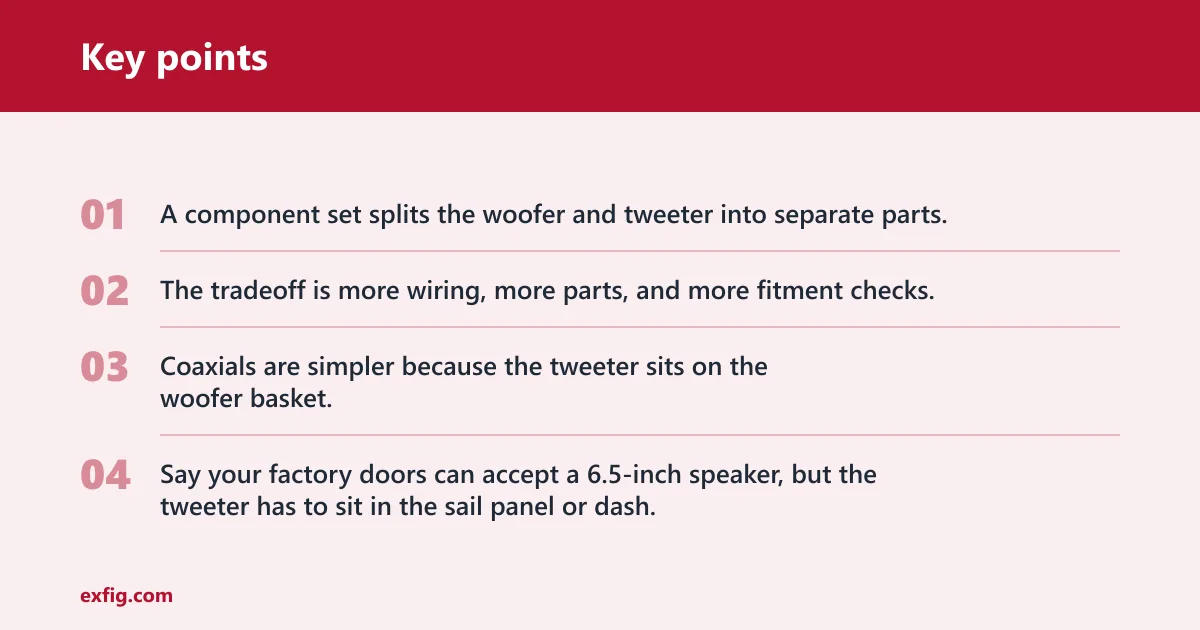
A component set splits the woofer and tweeter into separate parts. That split lets you place the tweeter higher in the cabin and aim it better, which can help move the sound stage up from the door panel. The tradeoff is more wiring, more parts, and more fitment checks.
Install complexity versus coaxials
Coaxials are simpler because the tweeter sits on the woofer basket. That usually means fewer mounting parts and less routing work. Component speakers add a crossover network and a separate tweeter mount, so they ask more from the installer before they reward you with better placement and tuning control.
Say your factory doors can accept a 6.5-inch speaker, but the tweeter has to sit in the sail panel or dash. A component set can help with image height. If you would rather avoid extra wiring and still want a clear gain from the stock radio, a high-sensitivity coaxial is the safer move.
Can factory stereo power run them?
Yes, some component speakers can run from factory stereo power, but the stock radio limits loudness, dynamics, and control. Head unit power can be enough for an easy upgrade, yet it will not make every component set sound strong, especially when sensitivity is low or the tweeter is bright.
What head unit power can and cannot do
A factory stereo can supply basic signal and power for a stock-stereo upgrade, and that is the point of many no-amp setups. It can get music playing cleanly at moderate volume. It cannot create the same headroom, bass control, or overall authority that an external amplifier can provide.
When a stock radio is enough
Stock radio power is enough when the speaker is efficient, the load is compatible, and the cabin does not demand a lot of output. That makes it a good fit for commuters who want better clarity and a cleaner front stage without expanding the system. It is a poor fit for people chasing loud, punchy output from weak factory power.
Speaker sensitivity and impedance
Sensitivity matters most when you do not add an amplifier. Higher-sensitivity speakers play louder from the same radio output, while a 4-ohm load is the common compatibility target for stock systems. Impedance helps match the system, but it does not turn a weak head unit into a strong one.
Why higher sensitivity matters without an amp
Sensitivity is the quickest way to judge how much sound a speaker can make from limited power. For no-amp use, start with higher sensitivity first, and aim for around 90 dB as a practical floor. A very efficient speaker near 100 dB can play noticeably louder from the same factory stereo power.
4-ohm compatibility in stock systems
Many stock systems are built around 4-ohm speakers, so that load is the common compatibility target. A 4-ohm speaker is often the right starting point, but compatibility does not guarantee satisfying output. The radio still has to drive the speaker, and weak output remains weak output.
What 90 dB and 100 dB mean
The difference between 90 dB and 100 dB matters more when power is limited. On factory power, that gap can be the difference between a speaker that sounds strained and one that reaches a comfortable volume without as much effort. For no-amp use, that matters more than raw power handling.
A common first-timer mistake is buying a component set for its power rating, then discovering the factory radio cannot wake it up. A 100W RMS per pair rating helps with durability context, but it does not mean the speaker will necessarily sound loud from head unit power.
What sensitivity do component speakers need without an amp?
For no-amp use, look for higher sensitivity first, then confirm the impedance and fitment. Around 90 dB is a sensible floor for many factory-radio installs, while higher numbers are generally better if you want more output without adding an amplifier. Low-sensitivity sets usually need more power than a stock radio can give.
Use sensitivity as the first filter
If two speakers both fit, choose the one that can turn limited power into more sound. That usually means the higher-sensitivity model. It is the most practical spec for no-amp buyers because it affects loudness from the radio you already have.
Do not ignore the rest of the system
Sensitivity alone does not guarantee a good result. Door mounting depth, tweeter control, and the quality of the factory signal all matter. A speaker can look perfect on paper and still sound underfed, bright, or poorly balanced once installed.
Do component speakers need a crossover if I’m not using an amp?
Yes. Component speakers still need a crossover network without an amplifier, because the system needs to split highs and lows between the tweeter and woofer. The crossover is part of the speaker system, not an optional add-on that only matters with external power.
How passive crossovers split the signal
The crossover sends low frequencies to the woofer and high frequencies to the tweeter. That keeps each driver in its own range and prevents the tweeter from seeing bass it cannot handle. Without that split, the system can sound harsh or fail early.
Why crossover placement matters
Because the crossover is separate hardware, it needs a place to live inside the door, kick panel, or cabin space behind the trim. That adds install complexity compared with coaxials. It also gives you a chance to route the tweeter and woofer more carefully for better front-stage placement.
Tweeter control and crossover network
Tweeter control is one of the clearest reasons to choose components without an amp. Some sets include triple-level tweeter adjustment, which helps tame bright factory interiors and lets you trim high frequencies to match the cabin. That flexibility can matter more than raw volume in a harsh-sounding car.
Triple-level tweeter adjustment
Triple-level tweeter adjustment gives you multiple high-frequency settings, so you can reduce glare if the dash or glass makes the top end sound sharp. That can be useful in cars that already sound bright from the factory. It also helps when you want a more relaxed top end on long drives.
Why tuning flexibility matters more without an amp
Without amplifier power, you cannot rely on brute force to fix a bad tonal balance. Tweeter attenuation lets you shape the result at the speaker level. That is one reason component speakers can still make sense on factory power even when they are not the loudest choice.
No-amp component speaker decision matrix
This comparison separates sound potential from install effort. That matters because the best speaker on paper may still be the wrong choice if you cannot add an amplifier or you want a simple upgrade from the factory radio.
| Factor | No-amp component speakers | Coaxials on head unit power | Daily commuter | Budget upgrader | Sound-tuning hobbyist |
|---|---|---|---|---|---|
| Sensitivity | Needs careful selection; 90 dB or better is the safer target | Often easier to find high-sensitivity options for stock power | Choose coaxials if loudness matters most | Choose coaxials for the strongest output per dollar | Choose components if sensitivity and tuning both check out |
| Installation complexity | Higher; separate tweeter, crossover network, and more wiring | Lower; fewer parts and simpler mounting | Prefer coaxials if you want fewer install steps | Prefer coaxials to keep labor and parts down | Components fit if you want placement control more than speed |
| Tweeter control | Better; some sets offer triple-level tweeter adjustment | Usually limited or absent | Good if factory treble sounds sharp | Usually unnecessary for a basic upgrade | Best fit when you want to tune the top end |
| Factory-radio friendliness | Works in some cases, but depends on sensitivity, impedance, and signal quality | Usually friendlier for stock systems | Good if the radio is weak but you want easy gains | Best match for stock stereo power | Acceptable if you can trade volume for control |
| Expected payoff | Better front stage and tuning, but not the loudest result per dollar | More volume and simpler gains from the same budget | Worth it only if front-stage placement matters | Usually the better buy | Worth it when tuning flexibility matters most |
What the matrix means in practice
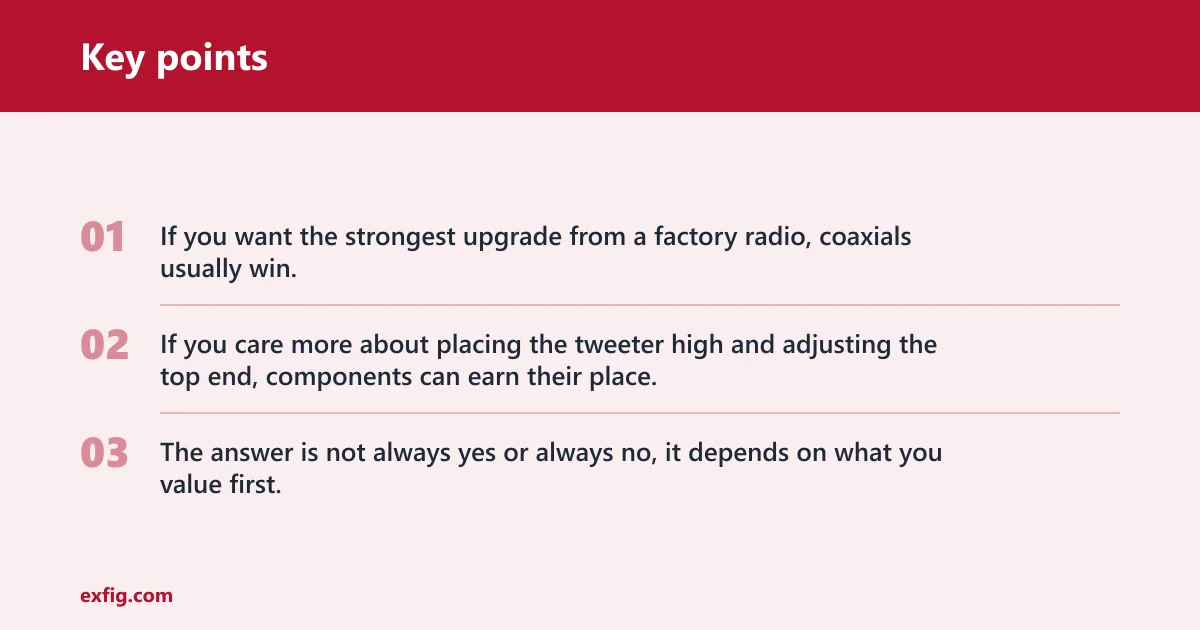
If you want the strongest upgrade from a factory radio, coaxials usually win. If you care more about placing the tweeter high and adjusting the top end, components can earn their place. The answer is not always yes or always no, it depends on what you value first.
What fitment checks matter most?
Fitment checks decide whether a no-amp component upgrade is painless or frustrating. Mounting depth, door clearance, and real-world power handling all matter. A speaker can be a good electrical match and still fail physically in the door.
Mounting depth and door clearance
Door fitment can be the limiting factor, especially with larger magnets and separate crossovers. A 2.1-inch mounting depth example belongs on your checklist because depth often decides whether the speaker clears the window track or trim. Measure before you buy, not after the panel is off.
RMS power handling and real-world expectations
RMS power handling tells you how much continuous power the speaker can manage, not how loud it will sound on a factory radio. A 100W RMS per pair rating is useful for durability context, but it does not fix weak output from the head unit. Treat it as a protection spec, not a loudness promise.
- Measure the door first. Check mounting depth, basket diameter, and clearance behind the door card. If the speaker cannot physically fit, none of the other specs matter.
- Check the radio load. Aim for a 4-ohm speaker unless the vehicle manual or adapter plan says otherwise. That keeps you aligned with common stock-system compatibility.
- Verify sensitivity. Favor higher sensitivity for no-amp use, with around 90 dB as a practical starting point and higher numbers preferred when available. This is the spec that most affects loudness from the factory radio.
- Inspect tweeter control. Choose a set with attenuation settings if the cabin is bright or reflective. Triple-level tweeter adjustment can help you avoid harsh top end.
- Match the goal to the speaker type. Pick coaxials for simpler installs and stronger value on head unit power. Pick components only when tweeter placement and tuning control matter enough to justify the extra work.
Frequently asked questions
Are component speakers worth it without an amp?
Yes, but only in the right use case. They are worth it when you want better tweeter placement and more tuning flexibility than coaxials can offer. If your main goal is the loudest result from factory power, coaxials usually make more sense.
Will component speakers sound better than coaxials on head unit power?
Sometimes, but not always. On head unit power, a good component set can image better and sound smoother up front. A high-sensitivity coaxial can still sound louder and fuller overall, especially if the factory radio is weak or the component set is not very efficient.
Can component speakers run off a factory stereo?
Yes, some can. Good candidates are high-sensitivity, 4-ohm sets that fit the car well and include a crossover suited to stock power. Even then, the result depends on the quality of the factory signal and how much output you expect.
What are the downsides of component speakers without an amplifier?
The main downsides are lower loudness per dollar, more installation work, and more chances for fitment problems. If sensitivity is low or the tweeter is bright, the result can be disappointing on factory power. That is why spec matching matters before you buy.