
Beginner’s Guide to Vent Phone Mounts Explained

A vent phone mount clips to a dashboard air vent with a hook or clamp, a cradle, and a joint; a metal hook, one-handed release, and adjustable feet are often a practical starting point. Poor vent fit can block airflow, sag under phone weight, or scratch fragile vent fins. This guide explains the parts, terms, and features that affect fit, stability, and cooling.
How vent mounts work and what makes them different
A vent phone mount holds a phone by anchoring to the vent grille, then extending a short support to keep the screen in view. The mount’s clip or hook does the anchoring, the arm sets distance from the vent, and the cradle or magnet keeps the phone from sliding off.
How the clip, arm, and cradle work together
The clip is the anchor point. The arm determines how far the phone sits from the vent face, and that distance matters because longer reach adds force on the mount and can increase wobble. The cradle or magnetic plate handles retention, which is the part most shoppers mean when they ask whether a mount feels “secure.”
Vent mounts differ from dash and windshield mounts in one practical way: the air vent is doing double duty as a mount point and an air path. That means fit, airflow, and vent shape matter at the same time.
Where vent mounts differ from other mount types
Walmart lists car phone mounts across dashboard and vent categories. That browsing setup matters because vent mounts face different constraints than suction-based holders: slat thickness, grille shape, and airflow obstruction become part of the decision, not just the phone size.
Vent mount parts and terms
Most listings use a short set of parts terms, but they do not always explain what each part changes in real use. The plain-language version is simple: one piece anchors to the vent, one piece positions the phone, and one piece holds the phone itself.
Vent clip
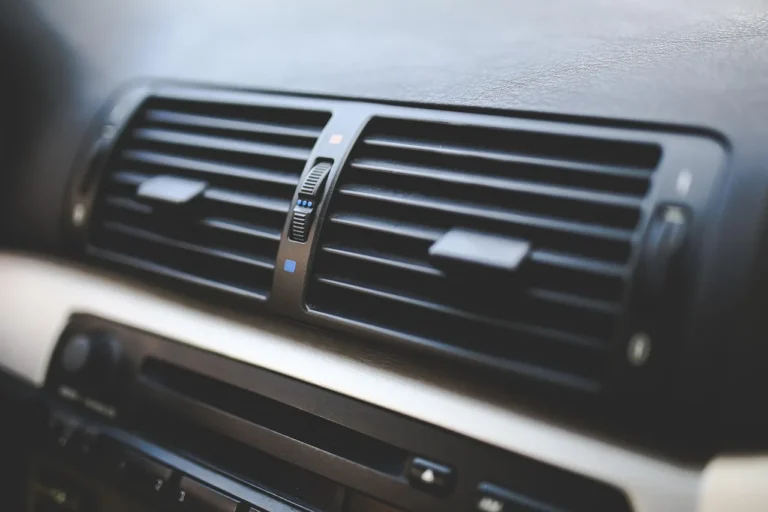
The vent clip attaches to AC slats or grille bars. It needs enough grip to resist movement and vibration, and compatibility varies by vent shape and thickness. A clip that works well on thick horizontal slats may slide on thin vertical fins or fail to sit squarely on a round vent.
Mounting arm
The mounting arm is the section between the clip and the phone holder. It may be a short rigid arm or a flexible gooseneck. Shorter arms usually stay steadier, while longer arms can add more strain and wobble, especially when a heavy phone sits far from the vent face.
Phone cradle
The phone cradle is the part that actually retains the device. It may use clamp-style jaws or a magnetic plate interface. A clamp cradle should fit the phone width and case thickness, while many versions also include one-hand release for quick removal at stoplights, drive-throughs, or delivery use.
Ball joint
The ball joint enables full rotation and lets you move between portrait and landscape viewing. It helps with angle changes, but low-quality joints can loosen over time, especially when they support a heavier phone or sit at the end of a long arm.
One-hand release
One-hand release is a convenience feature, not a structural feature. It matters for frequent stop-and-go use because it speeds removal and re-docking. The tradeoff is simple: if a design makes release too easy, it can give up retention strength, so the latch or jaws still need a firm hold.
Magnetic vs clamp vent mounts
Magnetic vent mounts hold the phone with magnets and usually use either a metal plate or a MagSafe-style ring. Clamp vent mounts grip the phone with mechanical jaws. Magnetic setups are faster and cleaner to use, while clamp versions usually hold heavier phones or bulky cases with more certainty.
Magnetic vent mounts
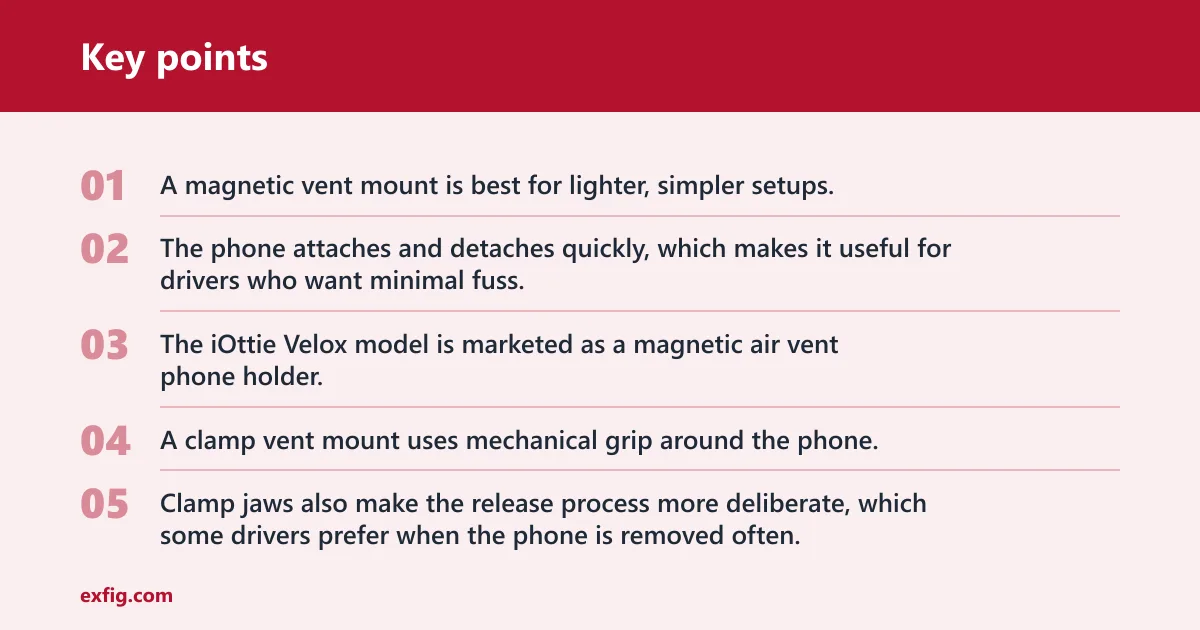
A magnetic vent mount is best for lighter, simpler setups. The phone attaches and detaches quickly, which makes it useful for drivers who want minimal fuss. The catch is that magnetic force does not change the size of the phone, so a thick or very heavy case can make the setup feel less confident than a clamp.
The iOttie Velox model is marketed as a magnetic air vent phone holder. That wording tells you the retention method first, which is exactly the detail beginners need before comparing fit or stability claims.
Clamp vent mounts
A clamp vent mount uses mechanical grip around the phone. It is usually more secure with heavier phones or cases, but the holder body tends to be bulkier than a magnetic version. Clamp jaws also make the release process more deliberate, which some drivers prefer when the phone is removed often.
Suppose a phone has a thick protective case and weighs enough to tug on the holder at every brake tap. A clamp mount with wider jaws and adjustable feet is more likely to stay planted than a small magnetic plate that was designed for lighter phones.
MagSafe-style setups and metal plates
MagSafe-style mounts change compatibility because the ring on the phone or case helps center the hold. Plate-based magnetic mounts depend on a metal plate placed on the phone or inside the case. That can work well, but the plate adds another compatibility question: case thickness, placement, and whether the plate interferes with wireless charging.
Which vent shapes do they fit?
Vent geometry changes how well a clip can bite and how much it can flex under load. Horizontal slats, vertical slats, and round vents each present a different contact shape, so the same mount can feel firm in one car and less stable in another.
Horizontal vents
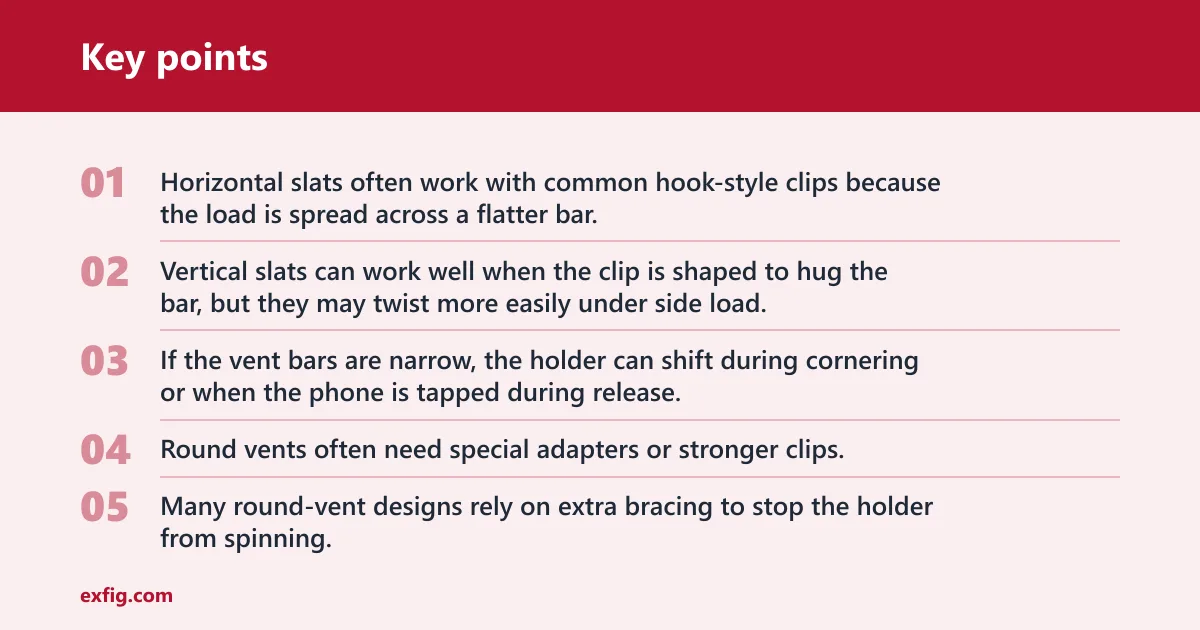
Horizontal slats often work with common hook-style clips because the load is spread across a flatter bar. They can still slip if the slats are thin or flexible, especially when the phone arm sits far out and starts to act like a lever.
Vertical vents
Vertical slats can work well when the clip is shaped to hug the bar, but they may twist more easily under side load. If the vent bars are narrow, the holder can shift during cornering or when the phone is tapped during release.
Round vents
Round vents often need special adapters or stronger clips. Their curved shape gives less surface area for a standard hook, so a mount that feels fine on flat slats may rotate or slide. Many round-vent designs rely on extra bracing to stop the holder from spinning.
| Part or feature | What it does | Common listing wording | What can go wrong | Which vent shapes it tends to suit best |
|---|---|---|---|---|
| Vent clip | Anchors the mount to the slat or grille bar | Metal hook, air vent clip, grille hook | Slips on thin fins, scratches brittle plastic, twists under vibration | Horizontal slats first, then sturdy vertical slats |
| Mounting arm | Sets how far the phone sits from the vent | Short arm, flexible gooseneck, extended reach | Longer reach adds wobble | Short, rigid arms suit most vents |
| Phone cradle | Holds the phone with jaws or a magnet | Clamp holder, magnetic plate, MagSafe-style mount | Too narrow for thick cases, weaker hold on heavy phones | Any vent shape if the clip is stable |
| Ball joint | Lets you rotate and tilt the phone | 360-degree rotation, swivel head, adjustable angle | Can loosen over time | Best when the vent clip is rigid |
| One-hand release | Speeds removal without two-handed squeezing | One-touch release, quick release, easy eject | Can reduce retention if the latch is too light | Any vent shape, if grip remains firm |
| Support hardware | Adds bracing, feet, or secondary support | Adjustable feet, stabilizer arm, support leg | Extra parts can still flex or rattle | Useful on round vents and flexible slats |
Vent mount failures and airflow tradeoffs
Most complaints about vent mounts come from three failure modes: wobble, grip loss, and heat or cold effects. These are not abstract problems. They show up as a mount that droops after a few miles, rattles on rough pavement, or blocks the very airflow the vent was meant to provide.
Wobble, strain, and loose joints
Wobble usually comes from force on the mount, not from the phone alone. A long arm, a heavy case, or a ball joint that has worn in too loosely can let the phone sway. In a stop-and-go commute, that movement can make the screen harder to read and the mount feel less trustworthy.
Grip loss on thin or flexible slats
Some vent slats flex before the clip does. When that happens, the mount may seem snug at rest but shift under vibration or when the phone is pressed. Round vents can be even harder because the contact point is smaller and the clip has less flat surface to brace against.
Heat, cold, and blocked airflow
Airflow obstruction matters because the mount sits directly in the vent stream. In summer, blocked air can leave the phone warmer than expected, which is a problem for battery health and comfort. In winter, a mount may partly block defrost airflow and change how quickly warm air reaches the cabin.
A common first-timer mistake is putting the holder on the strongest center vent and then wondering why the cabin feels uneven. That placement may keep the screen easy to see, but it can also send less air to the driver or interfere with windshield defrost.
Vent phone mount glossary and failure modes
This section pulls the terms together so listing language is easier to read. If a product page says “magnetic,” “360-degree,” or “one-hand release,” those words should point to a specific function, not a vague promise.
- Clip geometry: the shape of the part that grabs the vent. Flat hooks suit many slats; curved or reinforced hooks help on round vents.
- Retention method: the way the phone stays put. Magnetic systems depend on attraction; clamp systems depend on jaw pressure.
- Articulation: the way the mount moves. A ball joint or swivel head changes viewing angle, but too much movement can create wobble.
- Force from distance: the effect created by reach. The farther the phone sits from the vent, the more the clip has to resist motion.
- Release mechanism: the action that frees the phone. One-hand release helps convenience, but the mount still needs enough clamp force to stay secure.
What features matter most for your setup?
The best features depend on the phone, the vent, and the climate. Heavy phones and thick cases favor stronger retention; frequent stop-and-go use favors easier release; hot or cold driving favors a mount that does not block the main airflow path or heat the phone body unnecessarily.
-
Check phone weight and case thickness.
Use a clamp if the case is bulky or the phone is heavy enough to pull a magnetic mount off center. A MagSafe-style setup can work well if the case supports it, but plate-based magnetic mounts need enough contact area and clean alignment.
-
Match the clip to the vent shape.
Horizontal slats are often the easiest fit. Vertical slats may need a clip that bites more deeply, and round vents often need special adapters or a stronger hook because the contact patch is smaller.
-
Prefer short, rigid support.
A short arm usually resists wobble better than a long gooseneck. One Bracketron listing includes a 7.5-inch flexible gooseneck, which is useful when reach matters, but extra reach also creates more force on the mount.
-
Choose release speed carefully.
The Bracketron TripGrip 2.0 advertises one-hand release and 360-degree rotation, which shows how convenience and adjustment are often paired in listings. Make sure the release feature does not look like it sacrifices the grip needed for bumpy roads.
-
Watch for airflow conflicts.
Center vents can cool or heat the phone quickly, but they can also be the most likely to interfere with comfort. If defrost or cabin temperature control matters, choose a position that keeps the screen visible without blocking the main air path.
Say a driver uses a thick case and switches between portrait navigation and landscape music controls. A clamp mount with a rigid arm and a firm ball joint is the safer starting point, because the case thickness and the extra force from rotation both argue for stronger retention.
For a quick market clue, the onn kit includes vent, suction, and cup holder setups, and the onn dashboard and windshield mount is priced at $7.88. That kind of product page is useful for comparison because it shows how the same seller may package multiple mounting styles with different hardware.
The YOOVEE mount is listed for 4-7 inch phones, and Walmart shows it as a dashboard, windshield, and air vent mount. The onn dashboard and windshield cell phone mount has 2,660 reviews shown on Walmart, while the YOOVEE mount has 1,319 reviews shown on Walmart. Those figures do not tell you fit by themselves, but they do show how listings often bundle size claims with review counts.
Frequently asked questions
What is a vent phone mount and how does it work?
A vent phone mount clips to the vehicle’s air vent and holds the phone in front of the driver with a cradle, magnet, or clamp. The clip anchors to the slat or grille, the arm sets position, and the holder keeps the phone visible without occupying the dash or windshield.
What parts does a vent phone mount have?
The main parts are the vent clip, mounting arm, phone cradle or magnet, ball joint, and release mechanism. Some models also add adjustable feet, support arms, or stabilizer pieces. Each part affects a different problem: fit, wobble, rotation, and how easily the phone comes off.
What’s the difference between magnetic and clamp vent mounts?
Magnetic mounts use magnets and usually allow faster attachment and removal. Clamp mounts use jaws or arms to grip the phone more mechanically, which often suits heavier phones and thicker cases better. The tradeoff is speed versus hold strength, especially on rough roads.
Will a vent mount fit horizontal, vertical, or round vents?
It depends on the clip shape and vent thickness. Horizontal vents are often easiest, vertical vents can work with the right hook, and round vents often need special adapters or stronger clips. The mount may fit physically but still wobble if the contact point is too small or flexible.
Can a vent phone mount hold a phone with a thick case?
Yes, but the best choice is usually a clamp mount with adjustable feet or wide jaws. Magnetic mounts can work with some cases, especially MagSafe-style ones, but thick or heavy cases reduce holding confidence. Case thickness is one of the first specs to compare, not an afterthought.
How do I know if my vent is strong enough for a phone holder?
Look for rigid slats, enough thickness for the clip to bite, and a shape that gives the hook a clear edge. Thin fins, loose louvers, and round vents are more likely to flex or twist. If the vent moves by hand, it is more likely to move with a phone attached.
Will a vent phone mount block airflow from the AC?
Usually, yes, at least partly. A vent mount sits in the air path, so it can reduce airflow to that vent and change cabin comfort. That matters most in hot weather, winter defrost use, and any setup where the vent is the main source of driver cooling or heating.
What features matter most in a vent phone mount?
Start with clip grip, retention method, and arm length. Then check whether the mount offers one-hand release, a firm ball joint, and enough clearance for your case. For most buyers, the most important feature is not a marketing word but the part that prevents wobble on the exact vent shape in the car.