
When Should You Replace a Vent Phone Mount?

Replace a vent phone mount as soon as it slips, wobbles, cracks, overheats, or stops clamping tightly to the vent blades. One failure is enough. If you keep using it, the phone can drop into the footwell, block controls, or pull your attention off the road. Use this checklist to judge grip, stability, heat damage, and vent fit.
Signs your vent mount needs replacement
A vent mount is worn out when it no longer holds safely, not when the calendar says so. Small movement can be normal. Repeated droop, cracking, or a mount that will not stay fixed through braking or bumps means replacement, while dirt, pad wear, or a loose screw may still be repairable.
Loose retention and wobble
If the clip no longer bites into the vent slat, or the mount shifts every time the car turns, the retention system is failing. A small wiggle from a long arm is different from a base that walks out of position.
Cracks, bent parts, and worn pads
Hairline cracks in the clip, bent hooks, flattened silicone pads, and chalky plastic all point to material fatigue. Once plastic starts to split or the pad turns smooth, the mount usually loses grip faster under heat and vibration.
Slippage during bumps or turns
A mount that holds still in the driveway but slips on speed bumps, hard braking, or a quick lane change is not carrying the load safely. That is a safety failure, especially with heavier phones and thick cases that move the center of gravity outward.
Vent clip, hook, and slat damage
The clip and hook decide whether the mount stays attached. If either one is cracked, bent, or no longer matches the vent slat shape, tightening will not restore safe retention. Damage to the vent itself can turn a mount problem into a car-repair problem.
Plastic fatigue and spring tension loss
Vent clips depend on spring tension and hook shape. Heat cycling from AC and summer parking can soften plastic, then repeated loading lets the clip spread open or lose bite. That is material creep, and it usually gets worse once it starts.
Vent-slat compatibility and brittle slats
Horizontal, vertical, and round vents do not behave the same. A mount that works on one may rock or twist on another, especially if the slat is thin, brittle, or already loose. Round vents and thin blades need gentler contact and a better fit.
When a damaged clip should come off the car
Remove the mount from service if the hook appears cracked, the slat is splitting, or the vent assembly flexes under hand pressure. Do not keep using a clip that is biting into a brittle blade; the next bump can break the slat and leave you with a worse repair.
How do I know my vent phone mount is worn out?
You know a vent mount is worn out when it cannot hold its original position after cleaning, re-tightening, and re-seating. Loss of grip, repeated angle drift, cracked plastic, or a mount that falls off under normal road vibration are stronger signals than cosmetic wear.
Normal wear shows up as slight looseness at the joint or a pad that needs cleaning. Replace-now wear shows up as broken retention, bent hardware, or a clip that will not keep the mount attached when the car hits bumps or the cabin heats up.
Magnetic and clamp failures
Magnetic and clamp mounts fail in different ways. A magnetic mount loses holding power as the plate, case, or phone changes; a clamp mount loses grip as pads wear or the jaws spread. Both can be safe when matched to the right load and unsafe when pushed past it.
Weak magnet arrays and thick cases
Magnet strength has to match phone weight and case thickness. A thick case can move the phone far enough away from the magnetic face that the hold drops sharply, and heavier phones can slide on bumps even if they seem fine at rest.
Magnetic mounts also depend on alignment. If the phone now sits off-center, rotates under acceleration, or slides down after a hot soak in the cabin, the array is probably too weak for that phone and case combination.
Clamp jaw wear and release problems
Clamp arms should close with firm grip force and still allow one-hand release. If the jaws no longer close evenly, the pad has worn through, or the release button sticks, the mount is becoming unreliable and harder to use safely with one hand.
For larger phones, check the jaw width and the published phone size range. Walmart lists a YOOVEE mount advertised for 4-7 inch phones, which shows how size limits matter in practice. If your current phone no longer fits without strain, the mount is being overworked.
Phone size, weight shift, and support limits
Phone mass matters more on a vent mount than on a dash mount because the load hangs from the vent. Heavy phones and thick cases create more swing, and that swing multiplies force on bumps. MagSafe-compatible setups still need enough magnet force to keep the phone from sliding.
Suppose a phone moves from a slim case to a thicker protective case and starts drooping over rough pavement. The mount has not changed, but the load has. That is a replacement trigger for the magnet array or the whole mount if the design has no stronger option.
Will a broken vent mount fall off on bumps or hot days?
Yes, it can. A broken vent mount is more likely to detach on bumps, during hard braking, or after heat softens the plastic and reduces spring tension. If the mount already slips by hand, road vibration can push it past the point where it stays attached.
Hot days make weak points worse. Plastic softening, pad creep, and loosened joints all reduce holding force. A mount that feels acceptable in cool weather can fail after the cabin bakes, especially if the phone is heavy or the vent slats are brittle.
Ball joint drift and angle loss
The ball joint should hold an angle after you set it. Some movement during adjustment is normal; a joint that slowly droops, twists, or cannot stay aimed at the driver means friction has dropped below useful range. Tightening should help only if the joint is still within its hold range.
Friction loss versus normal adjustment
A healthy joint moves when you want it to and stays put after you stop. If the mount slowly tilts downward under the phone’s weight, the friction surface is worn or the tightening collar is no longer clamping properly.
When tightening still leaves the mount drooping
If extra tightening only makes the joint harder to adjust but does not stop drift, the socket is worn out. Over-tightening can crack plastic housings or strip the adjuster, so stop once the joint no longer responds to normal hand force.
Signs the joint is past its hold range
Look for angle creep after a few minutes, rotation that changes with temperature, and a joint that sags more after hitting bumps. That means the friction surfaces have worn enough that replacement is safer than another round of tightening.
Heat, weight, and vent type
Heat exposure is a major reason vent mounts fail. AC and heat cycling, summer parking, and constant load can soften plastic, reduce spring tension, and create material creep. The mount may look intact while its grip has already dropped below safe use.
AC cycling, summer heat, and material creep
Cold air on the vent, then cabin heat after shutdown, then heat again the next drive cycle, puts repeated stress on plastic parts. Over time, that cycling changes fit. A hook that once held firm may slowly open or shift out of alignment.
Heavy phones and thick cases
Heavier phones place more load on the clip, joint, and vent slat. Thick cases can reduce magnetic hold and increase lever force on clamp arms. A mount that worked with a lighter phone may now be at the edge of its design range.
Horizontal, vertical, and round vent fit
Horizontal slats usually give the most predictable support, while vertical slats can let the mount twist. Round vents may need special hooks or a different mount style. If the mount rocks because the vent shape does not match the hook shape, replacement is the safer path.
Vent mount replacement table
| Symptom | Likely cause | Safe temporary fix | Replace now/not yet | Best replacement type |
|---|---|---|---|---|
| Loose vent clip | Spring tension loss, plastic fatigue, or wrong vent-slat fit | Clean slat and clip, reseat the hook, confirm slat thickness | Not yet if grip returns; replace now if it still slips | Metal-hook vent mount or better-matched vent clip |
| Cracked hook | Brittle plastic or heat cycling damage | None beyond removal | Replace now | New mount with metal hook or a different mount style |
| Weak magnet | Thick case, heavier phone, or poor alignment | Remove extra case bulk, realign the phone, clean the contact face | Not yet if hold returns; replace now if it still slides | Stronger magnetic array or clamp-style mount |
| Slipping clamp | Pad wear, jaw wear, or grip force loss | Clean pads and check jaw travel | Not yet if clamping returns; replace now if release is unreliable | Clamp mount with fresh pads and wider jaw range |
| Ball-joint drift | Friction loss or loosened adjuster | Tighten once within normal hand force | Not yet if it holds; replace now if it sags again | Mount with stiffer joint or dashboard alternative |
| Vent-slat damage | Cracked, bent, or brittle vent blades | Remove the mount and avoid re-clipping there | Replace now | Suction cup or dashboard mount |
When should I replace a vent phone mount instead of tightening it?
Replace it when tightening no longer restores safe grip, when the clip or joint has visible damage, or when the mount slips under normal driving loads. Tightening is only for parts that still have intact material and enough friction left to hold. Cracks and bent hardware are not adjustment problems.
Start with the simplest fix: clean the pads, check slat fit, and retighten once. If the mount still drops angle, slides on bumps, or loosens again after a short drive, it has crossed from maintenance into replacement territory.
-
Clean contact points.
Wipe the vent slat, clip, magnetic face, or clamp pads with a dry microfiber cloth first. Dust and skin oils often hide the difference between true wear and a simple grip problem. -
Reseat the mount.
Remove it and clip it back onto a different slat position if the vent allows it. A better bite on a thicker or more stable blade can rule out poor placement. -
Test under load.
Attach the phone, then check it through a stop, a turn, and a small road bump. If the mount shifts again, stop treating it as a minor adjustment issue. -
Retire damaged parts.
Replace the clip, pad, or whole mount if any piece is cracked, stretched, or warped. Heat-damaged plastic usually fails again even after a temporary fix.
Repair, replace, or switch mounts?
Fix the cheapest safe part first. A worn pad or loose screw can justify a part swap, but a cracked clip, broken hook, or vent damage usually means a full replacement or a switch to another mount type. Cost matters, but so does whether the old design still fits your phone and vent.
What to fix first
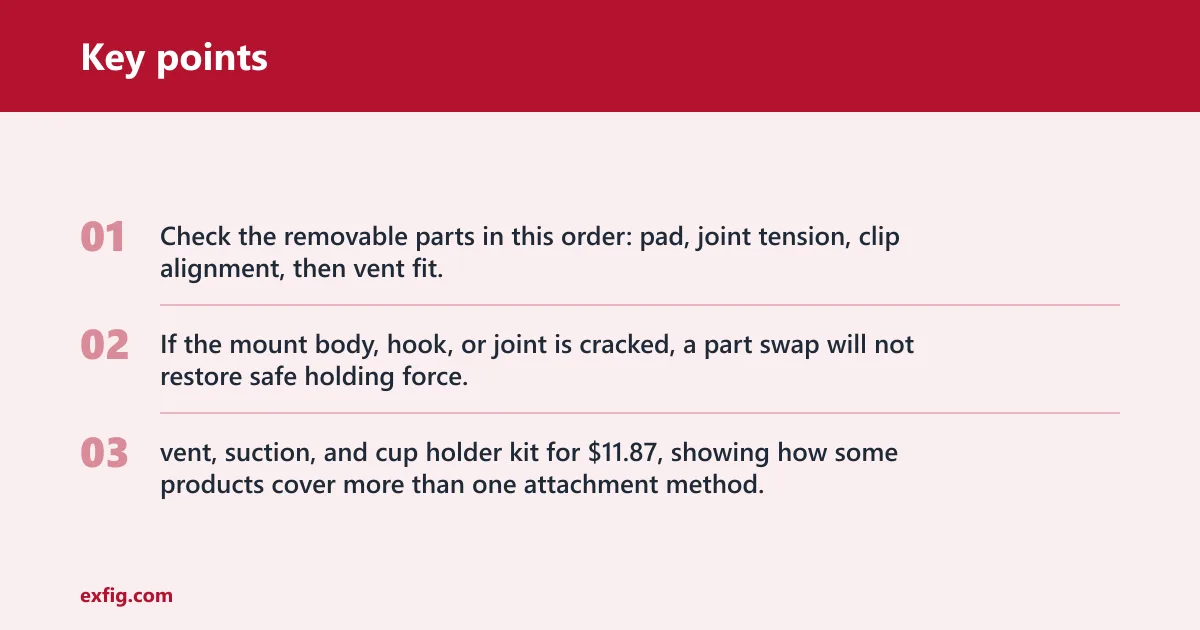
Check the removable parts in this order: pad, joint tension, clip alignment, then vent fit. If the mount has a replaceable pad or insert, that is usually the first repair to try because it is the least expensive and least risky.
When a part swap is enough
A new adhesive pad, replacement magnetic plate, or fresh clamp insert is enough when the structure is sound and only the wear surface is tired. If the mount body, hook, or joint is cracked, a part swap will not restore safe holding force.
When to move to suction cup or dashboard mounting
Switch to a suction cup or dashboard alternative when vent slats are brittle, the vent shape does not fit well, or the phone may be too heavy for the clip system. A suction cup can offer better stability on a heat-resistant dash, though it can leave residue and depends on surface prep.
The same source lists vent-compatible car phone mounts alongside dashboard mounts in one category, which reflects that many drivers move between mount types based on vehicle layout. Walmart also lists an onn. vent, suction, and cup holder kit for $11.87, showing how some products cover more than one attachment method.
For a simple price comparison, Walmart shows an iOttie air vent magnetic holder priced at $24.95 and an onn magnetic universal phone mount for $7.88. Price alone does not tell you durability, but it does show that repair and replacement choices can vary by budget and mount style.
What signs mean my vent clip is damaging my car vents?
Look for bent slats, white stress marks, cracking, or a vent blade that now sits looser than the others. If the clip has a sharp hook shape or the vent flexes every time you remove the mount, the mount is creating damage rather than adapting to the vent.
Do not keep clipping into a vent that is already brittle or misaligned. A damaged vent can break away from the HVAC assembly, which is more expensive than replacing a mount. Round and thin vents deserve extra caution because they can deform under point pressure.
Do magnetic vent mounts wear out faster than clamp mounts?
Neither style always wears out faster. Magnetic mounts can seem to age faster when the phone gets heavier or the case gets thicker, because the hold margin disappears quickly. Clamp mounts often fail more visibly through pad wear, jaw spread, or release problems.
The bigger difference is failure mode. Magnetic mounts lose hold with load changes, while clamp mounts tend to lose mechanical grip or joint stiffness over time. The better choice is the one that still matches your phone weight, case thickness, and vent type.
Can I keep using a vent mount if my phone is heavier now?
Only if the mount still holds the phone securely through bumps, braking, and heat. A heavier phone can change the load on the clip, joint, and magnet or jaws. If the mount starts to droop or slip, the safe response is a stronger mount or a different mount type.
Check whether the current phone still fits the published size range and whether the magnetic face or clamp jaws still cover enough contact area. If the answer is no, do not keep compensating with tighter angles or extra pressure on the vent slats.
How long do vent phone mounts usually last?
There is no honest calendar answer that fits every mount. Lifespan depends on material, heat exposure, phone weight, vent shape, and how often the mount is removed. A well-matched mount can last much longer than a poorly matched one, but wear signs matter more than age.
Warranty and replacement policy matter here too. iOttie support includes warranty as a help category, and that is worth checking when a part fails early. Broken-part coverage may differ from wear-and-tear limits, so a cracked hook may qualify while a worn pad may not.