What Does OBD2B Compliant Mean?

OBD2B compliant is most often used to describe a Honda/Acura ECU and wiring generation, not a general vehicle compliance class. If you assume the label alone is enough, you can buy the wrong cable, misread the vehicle, or waste time on a no-communication fault. This guide shows how to verify OBD2 and OBD2B claims on a listing or under the dash, and why a compliant vehicle can still fail to connect.
What the label usually means
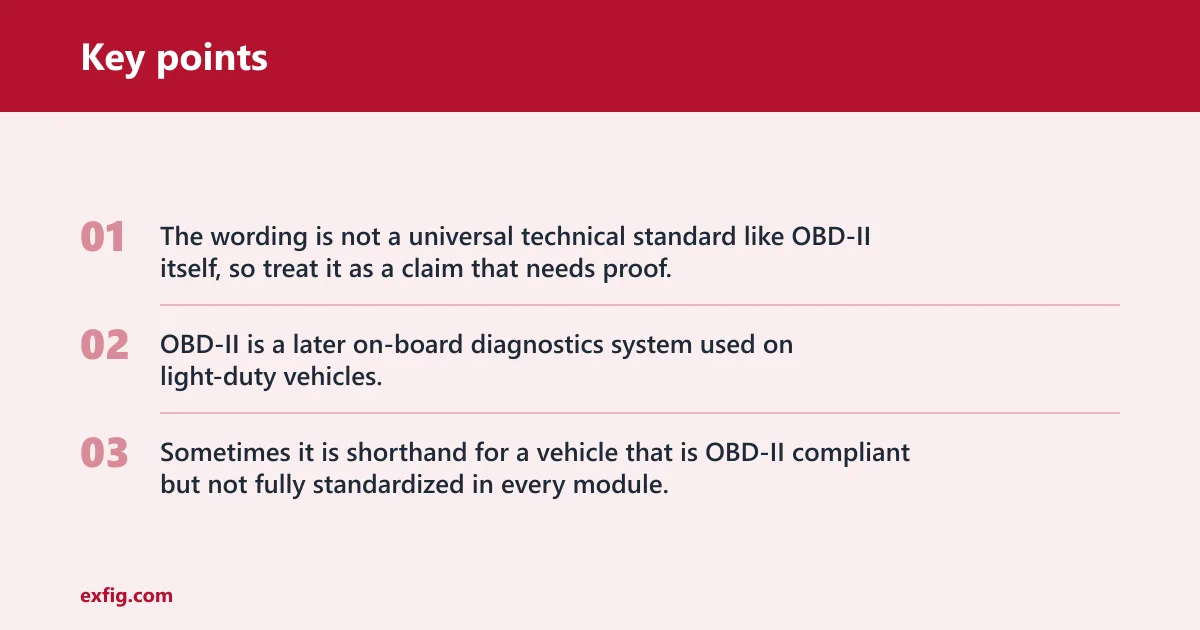
In practice, OBD2B compliant is a label that usually points to a later Honda/Acura OBD-II-era ECU and wiring setup, often with a 16-pin diagnostic link connector and emissions data available through a generic scan tool. The wording is not a universal technical standard like OBD-II itself, so treat it as a claim that needs proof.
OBD-II is a later on-board diagnostics system used on light-duty vehicles. It typically monitors emissions, stores fault codes, streams live data, and uses a 16-pin diagnostic connector. In the U.S., it became mandatory for 1996-model-year gasoline vehicles and light trucks, though diesel, heavy-duty, and non-U.S. applications can differ.
Why the label appears in listings
Used-car ads, import listings, and parts pages often use OBD2B to signal a later Honda/Acura wiring and ECU setup or “more compatible with scan tools.” Sometimes it is seller language. Sometimes it is shorthand for a vehicle that is OBD-II compliant but not fully standardized in every module.
That is why the phrase should never replace the actual evidence: connector shape, pin power, protocol support, and model year. A listing can say OBD2B and still describe a vehicle that needs an adapter, a specific protocol, or a tool with better network support.
Is OBD2B a formal standard?
No. OBD2B is not the same kind of formal, universal standard as OBD-II. It is often a marketplace label, a regional shorthand, or seller wording tied to later ECU and wiring claims. Verify the vehicle itself instead of treating the phrase as a technical certification.
Seller wording versus technical standard
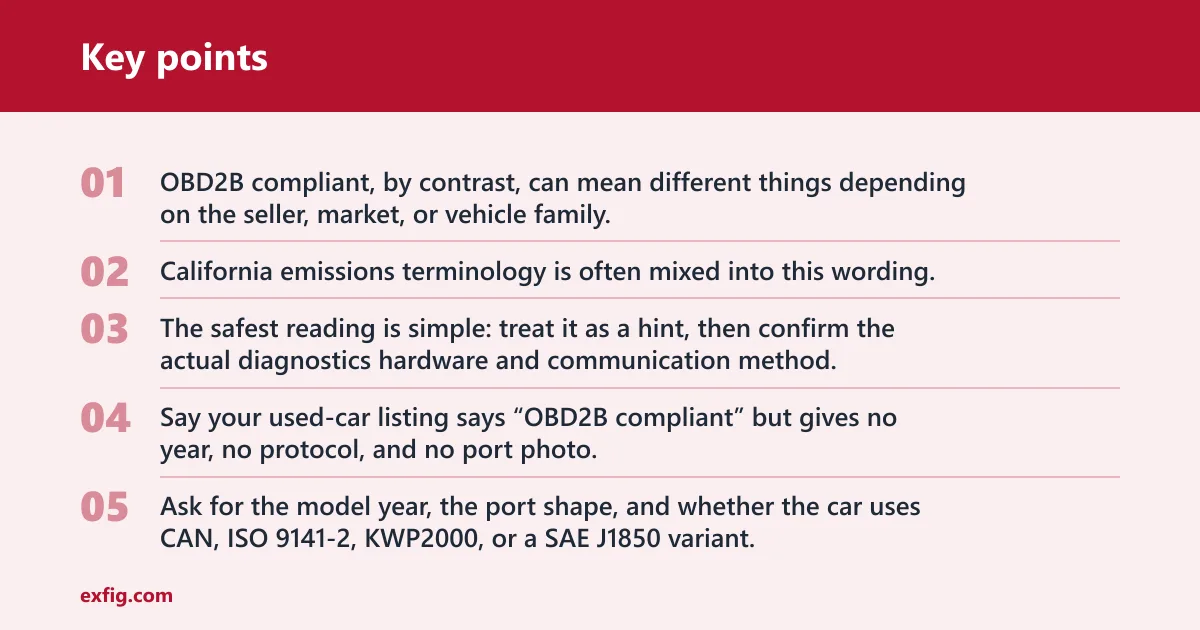
OBD2 compliant usually means the vehicle conforms to OBD-II and should support generic emissions code reading with the right tool. OBD2B compliant, by contrast, can mean different things depending on the seller, market, or vehicle family. That difference matters because a scan tool does not connect to a label; it connects to a powered port using a supported protocol.
California emissions wording and label drift
California emissions terminology is often mixed into this wording. Some listings use OBD2B to imply stricter emissions certification, but that does not make OBD2B a single recognized technical class. The safest reading is simple: treat it as a hint, then confirm the actual diagnostics hardware and communication method.
Say your used-car listing says “OBD2B compliant” but gives no year, no protocol, and no port photo. That is not enough to buy a scanner cable. Ask for the model year, the port shape, and whether the car uses CAN, ISO 9141-2, KWP2000, or a SAE J1850 variant.
OBD2 compliance vs scanner compatibility
OBD2 compliance usually means a generic scan tool can read universal emissions trouble codes such as P0xxx codes, and often live data tied to emissions monitoring. It does not guarantee access to every module, every proprietary parameter, or bidirectional functions such as component actuation.
A generic OBD-II scan tool is built for standard emissions communication. It can work on a compliant vehicle, but it is not the same as an OEM-level diagnostic system. If you want enhanced body, ABS, airbag, or transmission data, the vehicle and the tool both need to support that access.
What generic tools can and cannot do
- They can usually read universal emissions codes.
- They often read standard live data related to emissions control.
- They usually cannot access every manufacturer-specific module.
- They may not support bidirectional commands or advanced relearns.
That gap is where many buyers get misled. A car can be OBD2 compliant and still leave a cheap scan tool with only partial data, or no communication at all, if the protocol or power feed is wrong.
What the 16-pin DLC has to show
The 16-pin Data Link Connector is the physical diagnostic port used by OBD-II systems. SAE J1962 defines the connector form factor. A scanner, adapter, or cable has to fit the port correctly, but fit alone does not prove communication will work.
On standard implementations, pin 16 supplies battery power. Pins 4 and 5 are generally the chassis and signal grounds. If pin 16 is dead, or one of the grounds is missing, a scan tool may not power up or may connect unreliably even on a vehicle that is otherwise OBD-II compliant.
Connector fit is only the first check
- Inspect the port shape. Confirm that the vehicle has the standard 16-pin SAE J1962-style DLC. A mismatched or damaged shell can stop the tool from seating correctly.
- Check pin 16 power. Pin 16 should have battery voltage in standard OBD-II setups. If it does not, suspect a blown fuse, wiring fault, or port damage before blaming the scanner.
- Verify pins 4 and 5. These should be grounds. Missing ground on either pin can cause no power, unstable communication, or false no-link symptoms.
Picture a vehicle with a 16-pin port that looks normal, but the cigarette-lighter fuse feeding pin 16 is blown. A basic scan tool may stay dark even though the car is genuinely OBD2 compliant. The issue is not the label; it is the power feed.
Which OBD-II protocols matter?
OBD-II communication depends on protocol as well as the connector. Commonly listed protocols include CAN, ISO 9141-2, ISO 14230-4, also called KWP2000, and SAE J1850 variants. A protocol mismatch can stop communication even when the vehicle is physically compliant.
Protocols you will see most often
- CAN. Common on later vehicles and widely supported by modern scan tools.
- ISO 9141-2. Used on many older OBD-II vehicles.
- ISO 14230-4 (KWP2000). Another common legacy protocol.
- SAE J1850 variants. Found on certain older U.S. applications.
If your scanner only supports CAN and the vehicle uses an older protocol, the tool may power up but still fail to read data. The same is true in reverse: a vehicle can be OBD2 compliant and still reject a too-new or too-limited scanner.
Obd2b compliant mean decision table
This table helps separate the label from the evidence. Use it to judge whether a vehicle is really OBD2 or OBD2B compliant, and what to check next if the scanner does not connect.
| Label wording | Model year | Connector shape | Pin 16 power | Supported protocol | Likely scanner result | Next troubleshooting step |
|---|---|---|---|---|---|---|
| OBD2 compliant | 1996 or newer, U.S. gasoline/light truck | 16-pin SAE J1962 DLC | Present | CAN or legacy OBD-II protocol | Generic code reading should work | Check whether the tool supports the vehicle’s protocol |
| OBD2B compliant | Later model, listing says “B” only | 16-pin DLC, but verify | Verify with meter | Often implied, not guaranteed | May work, may show no link | Confirm year, port wiring, and protocol before buying a cable |
| OBD2 compliant | 1996 or newer, but import or swap | May be adapted to 16-pin | May be missing at the adapter | Protocol may differ from the tool | Partial data or no communication | Check the adapter pinout and the vehicle network |
| California emissions wording | Any year with CARB-style phrasing | Usually 16-pin, but not always enough | Usually present | Depends on model | Emissions codes may read, OEM modules may not | Do not assume California wording equals OBD2B |
Why a compliant car still will not connect
An OBD2 compliant car can still refuse communication for three common reasons: the scan tool does not support the protocol, the port does not have power, or the grounds and wiring are damaged. A blown fuse, a bent terminal, or a bad adapter can create the same no-link symptom as a noncompliant vehicle.
- If it does not, the tool may power up but never complete a session.
- Check port power. Measure pin 16 for battery voltage. If it is missing, inspect the vehicle’s fuse and wiring before replacing the scanner.
- Confirm the grounds. Verify pins 4 and 5. A poor ground can make a port look dead even when the connector is intact.
- Inspect the connector. Look for pushed-back terminals, corrosion, or damage at the DLC. Physical damage often shows up as intermittent communication.
A common first-timer mistake is assuming “no connection” means “bad scanner.” That is often wrong. A dead pin 16, a bad ground, or a protocol mismatch can produce the same symptom on a vehicle that is otherwise fully OBD-II compliant.
Frequently asked questions
What does OBD2 compliant mean?
OBD2 compliant usually means the vehicle follows the OBD-II diagnostic standard and should support generic emissions code reading through a compatible tool. It does not guarantee access to every module or every manufacturer-specific function. The connector, power feed, and protocol still have to match.
What does OBD2B compliant mean?
OBD2B compliant is not a single universal standard like OBD-II. It is often seller wording, a regional shorthand, or a later ECU and wiring claim tied to Honda/Acura applications. Treat it as a clue, then confirm the vehicle’s year, connector, and protocol.
What does OBD2 compliant mean on a car?
On a car, OBD2 compliant means the vehicle should have the 16-pin DLC and support standard emissions diagnostics. In many cases, a generic scan tool can read universal P0xxx codes. That still does not mean every scanner will access every system in the car.
What is the difference between OBD2 and OBD2B compliant?
OBD2 is the recognized diagnostic standard. OBD2B is usually a marketplace label, not a separate global standard. OBD2 tells you what the vehicle should support; OBD2B tells you very little until you verify the actual connector, power, and protocol details.
Does OBD2 compliant mean all scanners will work?
No. OBD2 compliance usually means generic emissions data should be readable, but a scanner still needs the correct protocol support, power at the port, and a working connection. Some tools also lack access to enhanced OEM modules or bidirectional functions even on compliant vehicles.
Why would an OBD2 compliant car still not connect?
A compliant car can still fail to communicate because the tool does not support the vehicle’s protocol, pin 16 has no power, pins 4 and 5 are not grounded properly, or the DLC is damaged. Adapter issues and wiring faults can produce the same symptoms.