Do USB-C Car Chargers Charge Faster Than USB-A Chargers?

USB-C car chargers are faster than USB-A chargers only when the charger, cable, and device all support higher wattage, often 18W, 20W, 30W, or more. Use the wrong port or cable, and a phone may charge slowly while tablets and laptops stay underpowered. This guide compares wattage, port types, and charging limits so you can choose the right charger.
USB-C vs. USB-A at a glance
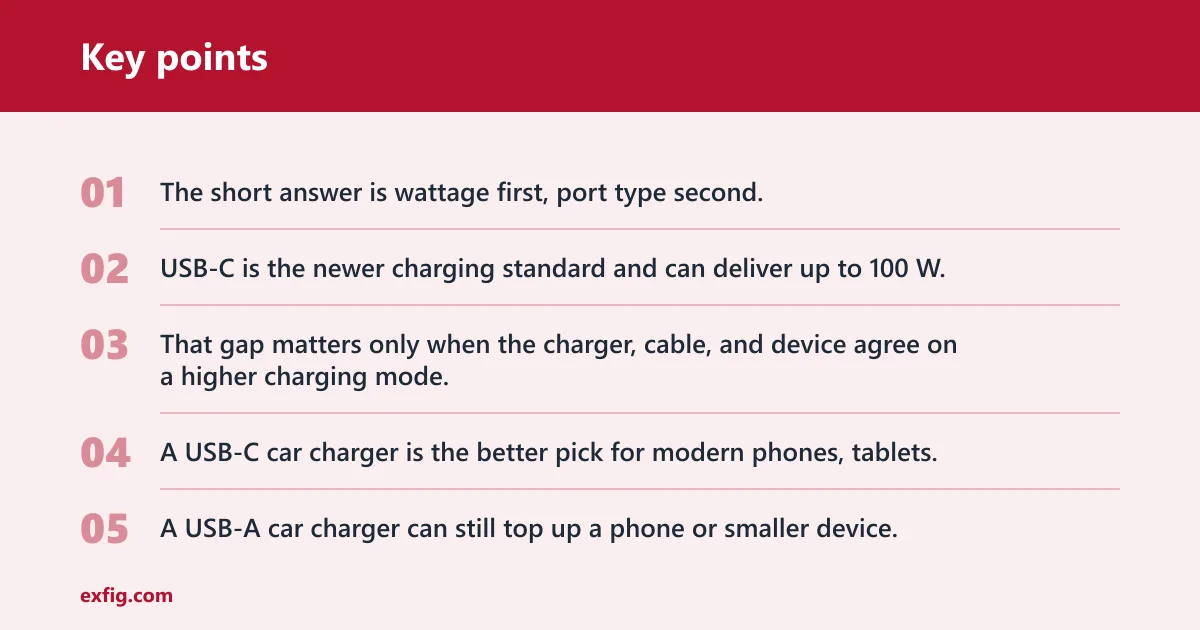
The short answer is wattage first, port type second. USB-C is the newer charging standard and can deliver up to 100 W, while USB-A is the older rectangular USB port and is typically limited to around 12 watts for charging. That gap matters only when the charger, cable, and device agree on a higher charging mode.
A USB-C car charger is the better pick for modern phones, tablets, and some laptops because it can support higher-wattage charging through USB Power Delivery. A USB-A car charger can still top up a phone or smaller device, but it usually does so more slowly.
Car charging adds one more limit: the vehicle’s 12V/24V car power outlet. The outlet feeds the charger, and the charger can only deliver what that in-car setup allows. A strong USB-C charger in a weak setup still will not reach its full rating.
| Feature | USB-C car charger | USB-A car charger |
|---|---|---|
| Port type | Reversible USB-C | Legacy rectangular USB-A |
| Typical charging ceiling | Can support up to 100 W | Typically around 12 watts |
| Fast-charge standard | USB Power Delivery | Usually basic charging |
| Best fit | Phones, tablets, some laptops | Phones and smaller devices |
| Speed depends on | Charger wattage, cable, device support | Charger wattage, cable, device support |
Car charging decision table
Use the device first, then choose the wattage. A 12W port is fine for basic top-ups, but about 18W is a better floor for modern phones, about 45W is a practical target for many tablets, and about 60W is the level to discuss for laptop charging in a car.
| Device type | Minimum useful car-charger wattage | Required cable type | Expected speed tier |
|---|---|---|---|
| iPhone | 18W | USB-C to Lightning cable | Fast |
| Android phone | 18W | USB-C to USB-C cable | Fast |
| iPad / tablet | 45W | USB-C to USB-C cable | Very fast |
| Laptop | 60W | USB-C to USB-C cable | Very fast |
For older or lower-power devices, a bigger charger does not always mean a faster result. The device sets its own ceiling. If the phone caps at a lower draw, the charger will not force extra power into it.
Say your phone only needs a commute top-up. A 12W USB-A charger may be enough if you are just trying to stop the battery from dropping further on a short drive. If you want a meaningful recovery during a 30-minute trip, 18W USB-C is the better target.
Is USB-C always faster in a car?
No. USB-C is only faster when the charger, cable, and device all support the same higher-power mode. A USB-C port alone does not guarantee quick charging, and a low-wattage USB-C charger can behave much like a basic USB-A charger.
The charger can be the limit. The cable can be the limit. The device can be the limit. You need all three parts aligned before you should expect fast charging from a car outlet.
When the charger sets the limit
If the charger is rated too low, the result is slow charging even with USB-C. For example, a charger near the 12W range is still a basic top-up device, while 18W is the point where many phones start to charge noticeably faster.
When the cable slows charging
The cable matters because it must carry the power level the charger is trying to deliver. A USB-C charger with the wrong cable can fall back to a slower rate. That is especially important for iPhone users, since fast charging needs a USB-C to Lightning cable.
When the device caps the speed
Some devices simply stop at their own limit. An older phone or small accessory may not use the extra wattage from a higher-output charger, so paying for a large USB-C unit will not help much if the device cannot accept it.
A common first-timer mistake is buying a 60W USB-C charger for a small phone and assuming it will always charge at 60W. The phone only draws what it supports. If that device tops out lower, the extra capacity sits unused.
How many watts do you need?
For car charging, the useful numbers are 12W, 18W, 45W, and 60W. Those levels map to real device needs better than port labels do. USB-PD matters here because it is the USB-C charging standard behind common fast-charge outputs.
12W and what it suits
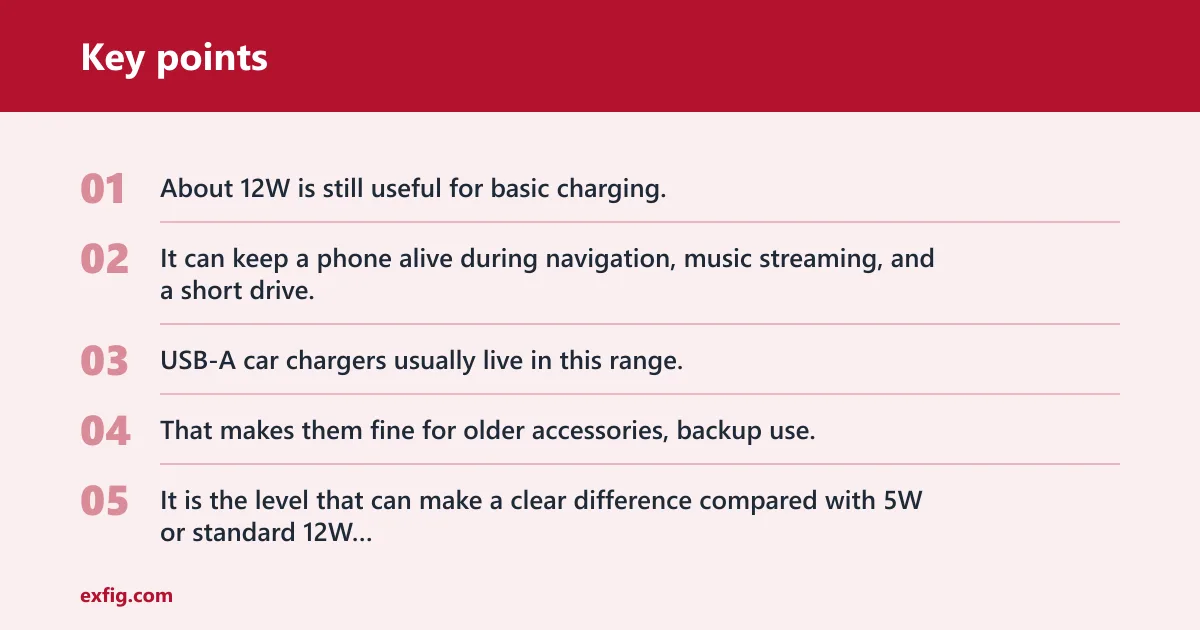
About 12W is still useful for basic charging. It can keep a phone alive during navigation, music streaming, and a short drive, but it is not the best choice when you want a fast battery refill.
USB-A car chargers usually live in this range. That makes them fine for older accessories, backup use, or drivers who only need slow charging for one device at a time.
18W for fast phone charging
18W is a solid floor for many phones. It is the level that can make a clear difference compared with 5W or standard 12W charging. In one example, an iPhone XR reached 17% in 30 minutes on a 5W charger, then reached 50% in 30 minutes on an 18W USB-C charger.
That difference is large enough to matter on a short drive. It is also why USB-C car chargers are often worth it for daily phone use, even when you do not own a tablet or laptop.
45W for tablets
45W is a better fit for larger devices such as an iPad Pro. USB-C charging can take that device much farther than the best USB-A option, which left an iPad Pro at only a little more than 10% after 30 minutes. A good USB-C charger and cable could charge that iPad Pro at up to 45 W.
That is the point where USB-C starts to matter beyond phones. Tablets have larger batteries, so they benefit more from the extra headroom.
60W for laptops
60W is the practical car-charging level to discuss for laptops. USB-C chargers can charge laptops at 60 W or more, which makes them suitable for models such as MacBook, Dell XPS, and Chromebooks when the laptop supports USB-C charging.
Do not assume every USB-C port in a car can charge a laptop. The charger needs enough wattage, the cable needs to support it, and the laptop needs to accept charging over USB-C.
Will a USB-C car charger fast charge your device?
Sometimes yes, sometimes no. A USB-C car charger can fast charge an iPhone, Android phone, tablet, or laptop only when the charger output, cable type, and device input match. The same charger can be fast for one device and slow for another.
iPhone and USB-C to Lightning
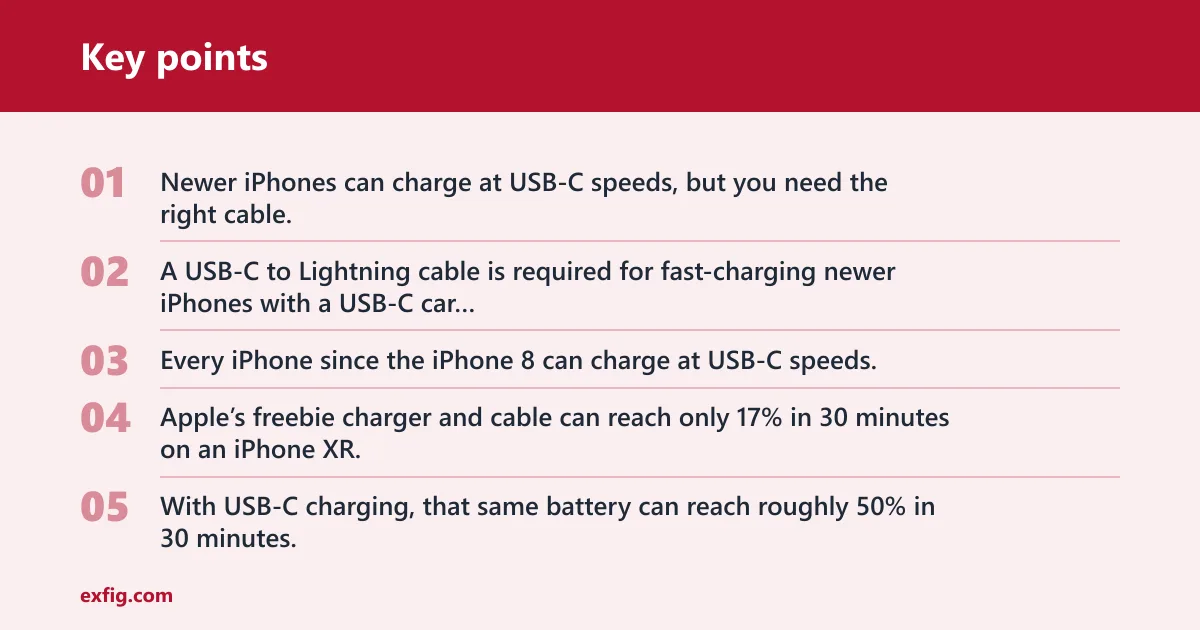
Newer iPhones can charge at USB-C speeds, but you need the right cable. A USB-C to Lightning cable is required for fast-charging newer iPhones with a USB-C car charger. Every iPhone since the iPhone 8 can charge at USB-C speeds.
Apple’s freebie charger and cable can reach only 17% in 30 minutes on an iPhone XR. With USB-C charging, that same battery can reach roughly 50% in 30 minutes.
Android phones and USB-PD
Many Android phones charge well from USB-C because USB Power Delivery is built for that use. An 18W USB-C charger is a strong starting point, and higher-wattage chargers can help when the phone supports them.
If the phone supports fast charging but the cable or charger does not, the result drops back toward basic charging. The port alone does not decide the speed.
iPad and tablet charging
Tablets benefit more from USB-C than small phones do because they can actually use more power. A 45W charger is a better match for an iPad Pro than a USB-A charger around 12W, which is why tablet charging from the car can feel much quicker with USB-C.
Suppose you are traveling with a tablet for maps, media, or work files. A 45W USB-C charger is the safer choice if you want the battery to recover during the trip instead of merely slowing the drain.
Laptop charging from the car outlet
Charging a laptop from a car is possible, but only with the right wattage and a USB-C-capable device. A 60W USB-C charger is the level to look for in many cases, and some laptops need even more headroom depending on their design.
That is where the vehicle outlet matters again. A 12V/24V car power outlet must feed the charger cleanly enough for the charger to reach the laptop’s needed draw.
Choose USB-C if… / Choose USB-A if…
USB-C is the better choice when you care about speed, larger devices, or one charger that can handle more than a basic phone top-up. USB-A still has a place when your needs are simple and your devices do not gain much from higher wattage.
Choose USB-C if you want higher output
- You want 18W or more for meaningful phone charging.
- You charge an iPhone and can use a USB-C to Lightning cable.
- You want tablet charging around 45W.
- You want laptop charging around 60W or more.
Choose USB-A if you only need basic phone charging
- You only need a slow top-up for a small phone or accessory.
- You already have a good USB-A cable and do not need fast charging.
- You are fine with around 12W charging speed.
- You want the simplest backup charger for short trips.
Mixed-port chargers and what to expect
Mixed-port chargers can be useful because they cover both older and newer devices. One example has both USB-C and USB-A ports. That kind of layout lets one passenger use USB-C fast charging while another uses a USB-A cable for a slower device.
In mixed-port chargers, do not assume every port performs the same. The USB-C side may support higher wattage and USB-PD, while the USB-A side may stay near the usual lower charging range.
Choose mixed ports if your car carries a mix of devices. Choose a stronger USB-C-only unit if your main goal is one fast charging port for a phone, tablet, or laptop.
Frequently asked questions
Do USB-C car chargers charge faster than USB-A chargers?
Usually, yes. USB-C car chargers can charge faster than USB-A chargers when the charger, cable, and device all support higher wattage. USB-A is typically limited to around 12 watts, while USB-C can reach much higher outputs, including common fast-charge levels like 18W, 45W, and 60W.
Is USB-C always faster than USB-A in a car?
No. USB-C is faster only when the full charging path supports it. A low-wattage USB-C charger, the wrong cable, or a device with a lower charging limit can all reduce the speed. The port shape alone does not decide the result.
How many watts do I need for fast charging in my car?
For most phones, 18W is a good floor. Around 12W is basic charging, 45W is a better target for tablets, and 60W is the practical level for many laptops. Pick the wattage based on the device you want to charge, not just the connector type.
Will a USB-C car charger fast charge an iPhone?
Yes, if you use the right cable and a charger with enough output. Newer iPhones need a USB-C to Lightning cable for fast charging with a USB-C car charger. Every iPhone since the iPhone 8 can charge at USB-C speeds.
Can a USB-A car charger fast charge an Android phone?
Sometimes, but usually not as well as USB-C. USB-A charging is generally limited to around 12 watts, which is slower than common USB-C fast-charge outputs. If your Android phone supports USB-PD or higher-wattage charging, USB-C is the better fit.
How fast can a tablet charge from a car charger?
Tablets often need more power than phones to charge well in a car. A 45W USB-C charger is a practical choice for an iPad Pro or similar tablet, while a USB-A charger near 12W will usually feel much slower. The cable and tablet charging limit still matter.
Can I charge a laptop from a USB-C car charger?
Yes, if the charger, cable, and laptop all support it. USB-C chargers can charge laptops at 60 W or more, which is the practical level for many MacBook, Dell XPS, and Chromebook models. A USB-C port alone is not enough without the right wattage.