Cheap vs Premium Vent Phone Mounts: What You Get

Spending about $20 to $35 usually offers strong value for vent phone mounts. That range usually gets you a firmer clamp, better vent protection, and a mount that fits more cases. Premium models mainly add stronger arms, one-hand release, and charging support. Cheap mounts can slip, rattle, or bend vent blades, turning a $10 save into a broken vent and a phone that drops under braking. This guide breaks down what budget, midrange, and premium vent phone mounts actually include, which upgrades matter, and which ones are mostly packaging.
What cheap and premium mounts trade off
| Factor | Cheap | premium vent phone mounts | Winner |
|---|---|---|---|
| Up-front cost | Lowest entry price. Examples include Walmart’s onn. Car Phone Mount Kit at $11.87 and Spigen OneTap MagFit around $17. | Usually costs more because you are paying for stronger hardware, charging parts, or cooling hardware. Examples include LISEN at about $25, Anker 637 MagGo at $35 to $45, and ESR CryoBoost at roughly $36. | Cheap |
| Retention and stability | Often good enough on flat, strong vents, but basic clips and lighter arms can slip, rattle, or flex on rough pavement. | Usually adds firmer arms, better release hardware, and in some cases a more stable cradle or stronger magnet system. | premium vent phone mounts |
| Phone compatibility | Magnetic versions generally need MagSafe or a metal plate. Clamp versions handle more phones, but cheap clamps may have looser joints or smaller jaws. | Premium magnetic models are often better suited to heavier phones, while premium clamp mounts usually open wider and tend to handle larger cases more confidently. | premium vent phone mounts |
| Charging convenience | Most cheap mounts do not charge. If you want power, you usually add a separate cable and car charger. | Wireless charging is a common premium add-on, but it also tends to add cost, heat, and the need for a power source. Some models add active cooling to help. | premium vent phone mounts |
| Hidden ownership cost | You may still need a charger, a cable, a MagSafe ring, or a metal plate. That can erase the savings fast. | Charging models can need a better USB adapter and sometimes longer cable routing. Heat-related charging slowdown can also make the headline feature less useful. | Cheap |
Cost
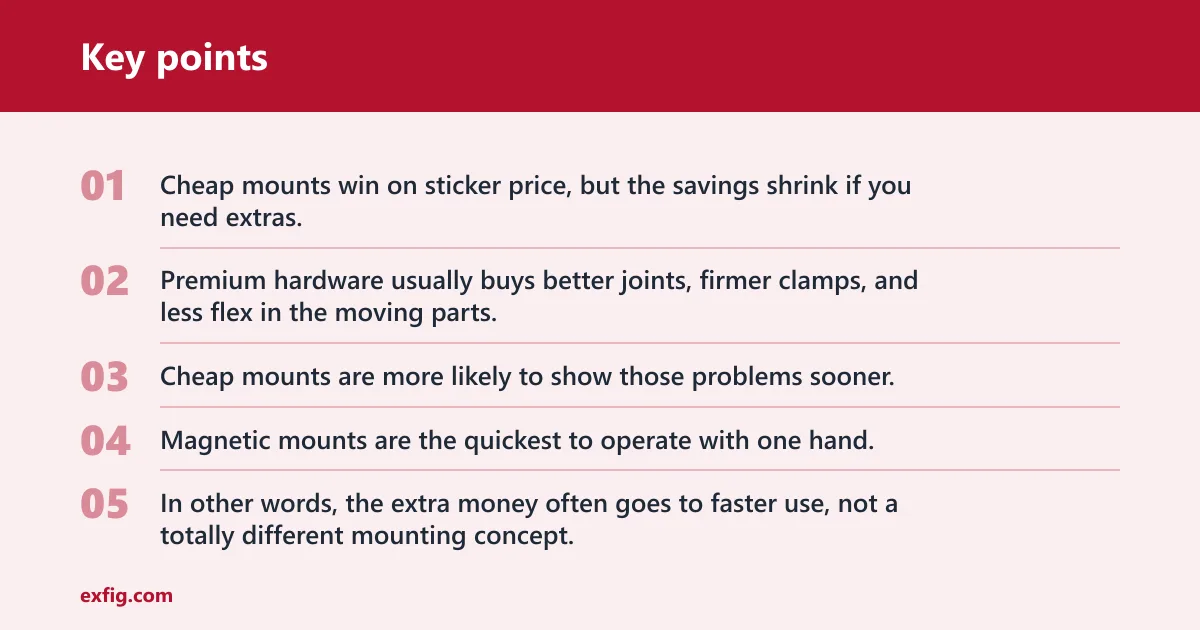
Cheap mounts win on sticker price, but the savings shrink if you need extras. A magnetic mount for a non-MagSafe phone may need a metal plate or ring, and a charging model needs a proper power source plus a cable. That can move a “budget” setup much closer to the midrange tier.
Durability and retention
Premium hardware usually buys better joints, firmer clamps, and less flex in the moving parts. That matters because vent mounts fail in different ways: the clip can slip, the arm can droop, or the phone can wobble enough to feel unsafe on rough pavement. Cheap mounts are more likely to show those problems sooner.
Performance
Magnetic mounts are the quickest to operate with one hand. Mechanical clamps usually hold a wider range of phones more predictably, while wireless charging adds convenience but also heat and charging-speed tradeoffs. In other words, the extra money often goes to faster use, not a totally different mounting concept.
Best-fit use case
Cheap works best when your vent is strong, your phone is compatible, and you want a basic holder with minimal spend. Premium makes more sense if you want charging, use a thick case, or need a mount that is less fussy about daily loading and unloading.
What do you actually get for the extra money?
The extra money usually buys three things: stronger retention, easier daily use, and charging hardware. That does not mean every premium model is better in every car. It means the premium tier reduces specific failure modes, especially when the phone is heavy, the case is thick, or you want one-handed removal.
Magnetic retention
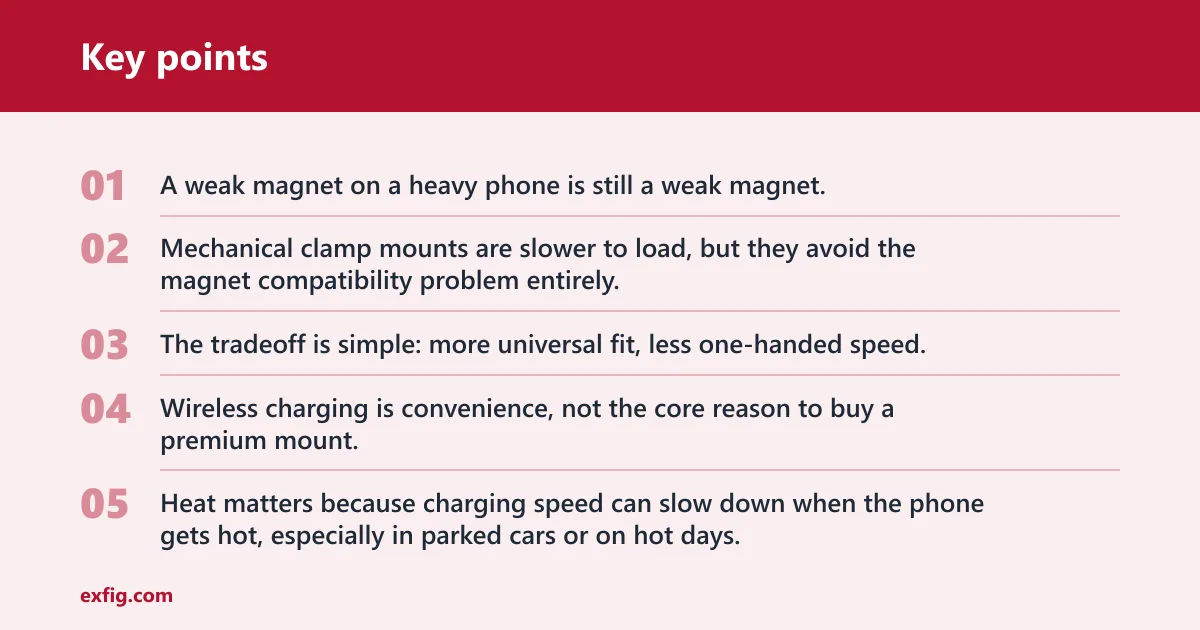
Magnetic mounts are attractive because they let you dock and remove the phone fast, and that is the key premium convenience for many drivers. Hold strength depends on the magnet, the phone’s weight, and whether a case adds thickness between the phone and the mount. A weak magnet on a heavy phone is still a weak magnet.
Suppose you have a slim iPhone with MagSafe. A magnetic vent mount can be a clean fit. Put the same mount behind a thick rugged case, and the grip may feel weaker or require a MagSafe-compatible case to stay reliable.
Mechanical clamp strength
Mechanical clamp mounts are slower to load, but they avoid the magnet compatibility problem entirely. They grip the phone directly, with or without a case, so they are often the safer choice for thick cases, non-MagSafe phones, and mixed-device households. The tradeoff is simple: more universal fit, less one-handed speed.
Wireless charging
Wireless charging is convenience, not the core reason to buy a premium mount. It is useful if you are already using navigation and power drain is a problem, but it adds cost and heat. Models such as LISEN at about $25, Anker 637 MagGo at $35 to $45, and ESR CryoBoost at roughly $36 show how the price climbs once charging enters the design.
Heat matters because charging speed can slow down when the phone gets hot, especially in parked cars or on hot days. That is why some charging mounts add cooling fans, but that is another feature to pay for and maintain.
Will a cheap vent clip work in your car?
Sometimes, yes. Cheap vent clips work best on strong, straight vents with firm plastic and enough lip for the clip to bite. They fail more often on thin, brittle, sloped, vertical, or round vent slats, where the contact patch is small and the mount can shift under braking or vibration.
-
Check the vent shape.
Look at the slats before you buy. Horizontal vents with sturdy fins are usually the easiest fit, while round vents and steeply sloped vents are more likely to create alignment or grip problems. -
Check the vent material.
Press lightly on the vent fins. If they flex a lot or feel brittle, the clip may crack the plastic or slip off over time. Thin vent fins are a common weak point because the clip has less surface to hold. -
Check the load path.
A heavier phone increases stress on the clip and the vent blade. If the mount hangs far from the vent face, vibration puts more force on the slat. -
Try a safer alternative.
If the vent looks weak or oddly shaped, switch to a suction dash mount or a cup holder mount instead. Suction dash mounts are safer when vents are unreliable, and cup holder mounts with a mechanical lock hold up best on bumpy roads.
A common first-timer mistake is choosing the cheapest magnetic clip for a car with thin vertical vents. The phone seems fine in the driveway, then the mount creeps sideways after a few sharp turns and leaves the screen tilted toward the shifter.
Do premium mounts hold thicker cases better?
Premium mounts can help, but only if the problem is the mount hardware rather than the case format. Clamp mounts are the most case-agnostic option because they grip the phone directly. Magnetic mounts depend on MagSafe alignment or a metal plate, and thick cases can reduce hold reliability if the magnet-to-phone distance gets too large.
MagSafe and metal plate fit
For iPhone users, a MagSafe-compatible case usually gives the cleanest magnetic fit. For non-MagSafe phones, a metal plate or ring can work, but that adds another part and can change how the phone sits in your hand or pocket. Thicker cases often make the magnetic bond less trustworthy, especially on rough roads.
Case thickness limits
The thicker the case, the more you should favor a clamp. That is not because magnetic mounts are bad; it is because magnets lose practical margin as distance increases. If your case is bulky, a clamp avoids that compatibility problem altogether.
Clamp mounts versus magnetic mounts
Clamp mounts usually need two hands to load, but they are the better answer when fit matters more than speed. Magnetic mounts are worth paying for when one-handed dock-and-go matters and the phone is already MagSafe-ready. Those are different jobs, not different quality tiers.
How vent mounts compare with dash, windshield, or cup holder mounts for stability
Vent mounts are not always the most stable option. They are easy to install and often fine for daily commuting, but if your vents are weak, oddly shaped, or exposed to heat, another mounting style may hold up better. Suction dash mounts are safer when vents are unreliable, and cup holder mounts with a mechanical lock are the best choice for bumpy roads.
Vent mounts
Vent mounts are the cheapest and easiest to install. They also keep the phone near eye level, which can be useful for navigation. Their downside is that they depend on vent geometry and plastic strength, so the same mount can work well in one car and fail in another.
Dash and windshield mounts
Suction mounts often feel more stable than vent clips because they do not rely on thin vent fins. They can lose suction in hot conditions, though, so the tradeoff shifts from vent damage risk to heat and adhesion risk. If your vents are weak, that tradeoff is often worth it.
Cup holder mounts
Cup holder mounts are usually less elegant, but the mechanical lock gives them an advantage on rough roads. They sit lower and can be less convenient for quick glances, yet they avoid vent damage and often handle heavier phones well.
Choose Cheap if… / Choose premium vent phone mounts if…
Choose Cheap if your vent is strong and horizontal, your phone is already compatible, and you only want a basic holder for occasional navigation. It also makes sense if you are trying to minimize cost and do not need wireless charging or a premium arm.
Choose premium vent phone mounts if you use a thick case, want easier one-handed use, need charging on the mount, or want better odds of stable positioning on rough roads. It is the better pick when the mount has to solve more than one problem at once.
Cheap
Choose Cheap for a lightweight phone, a strong vent, and a low-cost backup mount. It is also the smarter choice if you are comparing a simple magnetic clip against paying for charging hardware you will rarely use.
Premium vent phone mounts
Choose premium vent phone mounts if your daily setup includes a larger phone, a thick case, or repeated dock-and-go use. Pay extra only for the features that solve your problem: stronger retention, charging, or a better fit on a vent that cheap clips do not like.
Frequently asked questions
What do you actually get for the extra money in a premium vent phone mount?
You usually get stronger retention, better daily convenience, and sometimes wireless charging. The premium price can also buy a more stable arm or a better release mechanism. If the mount adds charging, remember that you may still need a cable and car charger, so the real cost is higher than the sticker price.
Are cheap vent phone mounts less stable on rough roads?
Often, yes. Cheap mounts are more likely to flex at the joints or slip on the vent because they use lighter hardware and simpler clips. The biggest difference shows up on rough pavement, where vibration can turn a barely stable mount into one that slowly rotates or drops.
Do premium vent mounts grip thicker phone cases better?
Sometimes, but only if the premium model solves the right problem. Clamp mounts are generally better for thick cases because they grip the phone directly. Premium magnetic mounts can still struggle if the case is bulky or blocks MagSafe alignment, so the case type matters more than the price tag.
Is wireless charging the main difference between cheap and premium mounts?
No. Wireless charging is only one premium option. The more important differences are retention strength, fit, and easier loading. Charging adds convenience, but it also adds heat and extra cost, and it does nothing if the mount itself does not fit your vent well.
Will a cheap vent clip damage or slip on thin vent slats?
It can. Thin or brittle slats give the clip less material to hold, so the mount may slip, bend the vent blade, or crack weak plastic. Sloped and round vents are also harder because the clip has less flat surface to grab securely.
How do vent mounts compare with dash, windshield, or cup holder mounts for stability?
Vent mounts are the easiest to install, but they depend on vent strength and shape. Suction dash mounts are safer when vents are unreliable, and cup holder mounts with a mechanical lock hold up best on bumpy roads. If your vents are weak or oddly shaped, another mount style is usually the better buy.