
Best Vent Phone Mounts for Trucks and SUVs with Deep Vents

The safest top pick for deeper truck and SUV vents is a hook-based mount with a long, adjustable rear hook and a wide clamp, because that shape is more likely to reach behind thick slats without working loose on rough roads. Choose a vent phone mount with an adjustable hook that reaches about 20–25 mm behind the blade, plus a wide clamp that fits thick cases. If the hook is too short, the mount slips, blocks airflow, or tears vent fins on rough roads. This guide shows how to measure vent blade depth and pick the right mount geometry for trucks and SUVs.
Quick picks
| Best for | Why it fits deeper vents | Useful clue |
|---|---|---|
| Deep horizontal truck vents | Lamicall vent mount | Opens wide and uses two clamps in back |
| Horizontal or vertical vents | Ainope holder | Works on horizontal and vertical vents |
| Thick vent grates | WixGear-style hook mount | Described as compatible with thick vent grates |
| Fast phone removal | Beam Electronics | Expands up to 3.7 inches and has a quick-release button |
| Mixed mounting needs | Walmart kit options | Some listings include vent, dash, and windshield mounts |
| MagSafe phones | MagSafe-compatible Velox magnetic air vent phone holder | Built for magnetic attachment, not clamp width |
For most deep-blade truck and SUV vents, start with a hook-based mount, not a shallow spring clip. A magnetic mount can still work, but only if the vent slats are stiff enough and the phone is not too heavy for the magnet and plate layout.
What a deep vent fit needs
Blade depth and thickness
Deep vent blades need a hook that can reach behind the slat and stay there under vibration. Thick slats change the contact point, so a hook that looks compatible on paper can still pop loose if the rear lip is too short or the jaw opening bottoms out before it grabs.
Blade thickness matters because it affects how much of the hook actually bites. A mount that fits slim sedan vents may press against the face of a truck slat instead of wrapping behind it, which reduces hold and can lead to creep over time.
Hook depth and blade spacing
Blade spacing decides whether the rear hook has room to slide in. If the slats sit close together, the mount needs a narrow head and a hook that can engage without levering against the next blade.
For deeper vents, the best hook geometry is long enough to catch behind the slat and narrow enough to clear the surrounding fins. Wider jaws help with thicker blades, but only if the rear hook still reaches the support point.
Flex resistance and behind-vent clearance
Truck and SUV vents often flex more than smaller car vents because the slats are larger and the trim behind them can be uneven. If the vent moves when you press it, a mount with a broad support footprint and anti-slip padding is less likely to shift on bumps.
Behind-vent clearance is the hidden measurement many buyers miss. The hook needs room to sit behind the blade without pressing against duct walls, crossbars, or a curved housing that forces the clip outward.
Which vent mount works best for deeper blades?
For deeper blades, a hook-style vent mount is usually the safest first choice because it can anchor behind the slat instead of depending only on spring tension. Clamp-style mounts help when you need a broader cradle for a thick case, while magnetic mounts are simplest for lighter phones and flatter vent faces.
Vent clip hook geometry
Hook length is the main fit feature to check. A longer adjustable hook gives you more reach behind thick truck slats, and anti-slip padding helps reduce paint wear and chatter from vibration.
Look for material strength that does not twist when you tighten it. If the hook bends easily, it may hold on a smooth vent at first and then creep downward after repeated potholes or cabin heat.
Magnetic vent mounts
Magnetic vent mounts are quick to attach and remove, and some drivers like them for shared or rental vehicles. They work best when the plate placement keeps the phone centered and the vent slat is stiff enough to carry the load without sagging.
Magnet strength matters more with larger phones and heavier cases. A metal plate placed behind a thick case can reduce wireless charging performance, and it may interfere with NFC if it sits in the wrong spot on the phone back.
Walmart lists a MagSafe-compatible Velox magnetic air vent phone holder, which makes it a better fit for MagSafe users than for cases that need a wider clamp or more rear-hook support.
Clamp-style vent mounts
Clamp-style mounts are better when you need one-hand release and a wider grip around the phone or case. The clamp arm width, rotation angle, and rear support all matter if the mount has to stay stable on rough roads.
Lamicall’s vent mount opens wide and uses two clamps in back, which is the kind of geometry that helps on deeper vents with thick slats. Beam Electronics expands up to 3.7 inches and has a quick-release button, which can help when you want faster phone removal without giving up a wider hold.
Vent phone mount fit checklist
This checklist helps you decide whether a truck or SUV vent is a pass or fail before you buy. Measure the vent, then compare the mount’s hook reach, jaw width, and case clearance against the numbers below.
| Measurement field | Recommended target for deep-blade truck and SUV vents | Pass or fail guidance |
|---|---|---|
| Vent blade depth | 20–25 mm or more of usable rear reach | Pass if the hook can reach behind the blade without forcing the slat outward. |
| Blade thickness | Thick enough to sit firmly in the hook jaw without wobble | Pass if the clamp closes on the blade without bottoming out. |
| Blade spacing | Enough gap for the hook body and padding | Pass if the mount slides in without touching the next slat. |
| Clip or hook depth | At least 20–25 mm of rear engagement | Pass if the rear lip stays behind the blade during bumps. |
| Clearance behind the vent | Room for the hook, padding, and any rear clamp arms | Pass if nothing behind the vent blocks full seating. |
| Phone or case thickness | Bulky cases need a wider clamp or looser jaw opening | Pass if the case fits without forcing the side arms open at the limit. |
- Measure the vent first. Check blade depth, blade thickness, and the space behind the vent before you pick a mount. If the slat is deep but the cavity behind it is cramped, a long hook may still fail.
- Match the hook to the slat. Pick a hook that reaches at least 20–25 mm behind the blade and still leaves room for padding. That reduces slip on potholes and keeps the mount from levering against the vent face.
- Check case clearance. If your phone uses a thick case, confirm that the clamp can close without pushing on the buttons or blocking the charging port. A narrow jaw may hold the phone but make cable access awkward.
Say your truck has a deep horizontal vent with about a 22 mm rear cavity and a thick case on a large phone. A short clip may seem fine in the parking lot, then creep downward after a few rough miles. A longer hook with a wider clamp is the better fit because it uses the vent geometry instead of fighting it.
A common mistake is assuming every vent clip will grip the thick, deep blades in a truck or SUV without checking the mount’s hook depth first. Suppose the phone is small, but the vent slat is curved and thick; the mount can still fail if the hook cannot seat behind the blade or if the vent flexes when you turn the dial nearby.
How do you choose one for a truck or SUV?
Choose by rough-road stability first, then by case thickness and cabin layout. Trucks and taller SUVs are commonly reported to transmit more vibration into the dash area, so the mount needs a rear hook or clamp that resists creep and keeps the phone readable without constant readjustment.
Rough-road stability
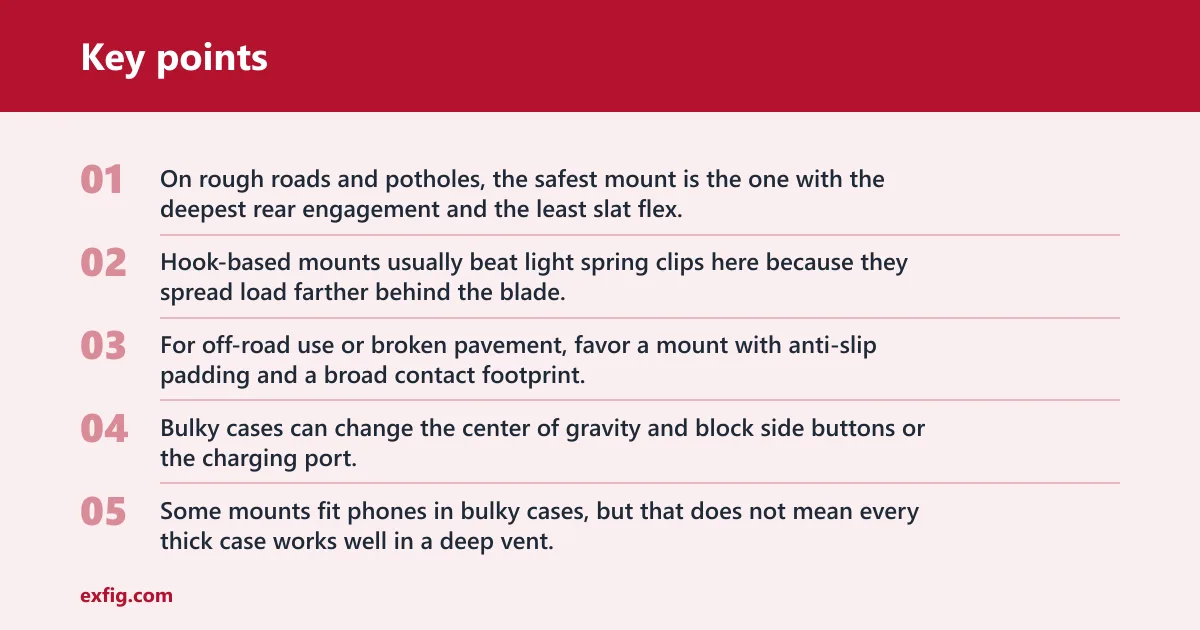
On rough roads and potholes, the safest mount is the one with the deepest rear engagement and the least slat flex. Hook-based mounts usually beat light spring clips here because they spread load farther behind the blade.
For off-road use or broken pavement, favor a mount with anti-slip padding and a broad contact footprint. A magnetic mount can work if the vent is stiff and the phone is not heavy, but it gives you less mechanical lock than a clamp.
Case thickness and charging access
Bulky cases can change the center of gravity and block side buttons or the charging port. If you use wireless charging, confirm that the mount does not force the phone into a crooked angle that leaves the charging coil off-center.
Some mounts fit phones in bulky cases, but that does not mean every thick case works well in a deep vent. A clamp that opens wide is usually better than a tight magnetic plate if you need consistent one-hand placement.
Airflow and cabin layout
Vent mounts can block airflow, especially in small center vents or sunken vents with narrow outlets. In an SUV, it is often smarter to place the mount on a side vent if the center vents are part of the main cabin cooling path.
Horizontal vents are often easier for hook-style mounts. Vertical vents can work too, as Ainope’s holder shows, but curved vents and round vents need more careful checking because the hook may not sit flat long enough to stay put.
Which mount type fits your phone and case?
MagSafe and non-MagSafe phones need different mounting logic. Magnetic mounts are quickest for compatible phones, while clamp-style and hook-based mounts are better when the case is thick, the phone is heavy, or the vent blades are deep and flexible.
MagSafe and non-MagSafe phones
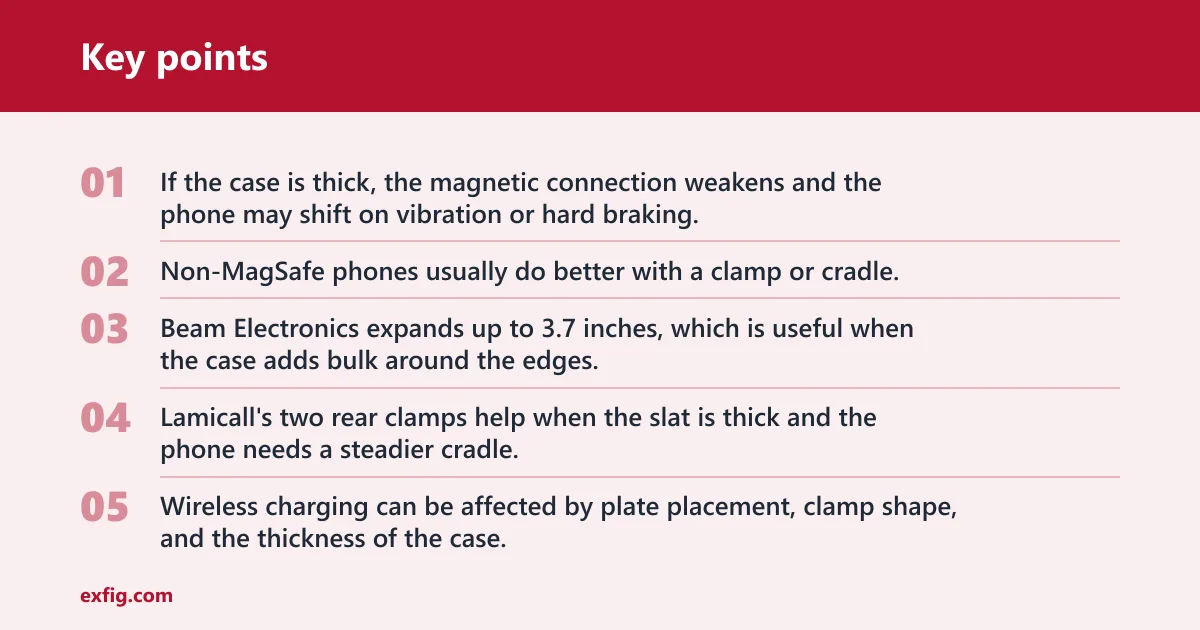
A MagSafe-compatible mount works best when the phone back can sit flat on the magnet and the case does not add too much distance. If the case is thick, the magnetic connection weakens and the phone may shift on vibration or hard braking.
Non-MagSafe phones usually do better with a clamp or cradle. That keeps the phone centered even when the vent mount itself has to fight thick slats or a curved vent body.
Bulky case clearance
Case clearance is not only about width. The mount also needs enough room near the buttons and charging port so you can plug in a cable without twisting the phone sideways.
Beam Electronics expands up to 3.7 inches, which is useful when the case adds bulk around the edges. Lamicall’s two rear clamps help when the slat is thick and the phone needs a steadier cradle.
Wireless charging and NFC
Wireless charging can be affected by plate placement, clamp shape, and the thickness of the case. If the plate sits between the coil and the phone, charging speed can fall or the charger may not start at all.
NFC can also be less reliable if a metal plate sits over the antenna area. If tap-to-pay or device pairing matters, keep the metal plate centered away from the phone’s NFC zone or choose a mount that avoids a plate altogether.
Frequently asked questions
What vent phone mount works best with deeper vent blades?
A hook-based vent mount with a long adjustable rear lip is usually the best match for deeper blades. It reaches behind the slat instead of pinching the face of the vent, which helps on trucks and SUVs with thicker grates and more vibration.
Will a vent phone mount fit thick truck and SUV vent slats?
It can, but only if the hook depth and jaw opening match the slat thickness. Products described as compatible with thick vent grates, such as WixGear-style hook mounts, are a better starting point than shallow clips that depend on spring tension alone.
Which vent mount stays secure on rough roads and potholes?
The most secure choice is usually a hook or clamp mount with anti-slip padding and a broad rear contact area. Magnetic mounts are simpler, but on rough roads they depend more on vent stiffness and magnet strength, so they are better for lighter phones.
Can a vent phone mount work with a thick phone case?
Yes, but the clamp width and arm opening must fit the case without forcing the mount to overextend. Some mounts fit phones in bulky cases, but a thick case can still block the charging port or push the phone off-center if the cradle is narrow.
Do magnetic vent mounts hold heavier phones better than clamp mounts?
Usually no. Magnetic mounts are quick and clean, but heavier phones put more stress on the vent and the magnet interface. Clamp mounts spread the load around the phone body, which often makes them more stable for larger phones and thicker cases.
How do I know if my vent is too deep or curved for a phone mount?
If the hook cannot seat behind the blade without bending the slat outward, the vent is too deep or the cavity is too tight for that mount. Curved vents are harder because the hook may contact only one point, which increases slip and reduces long-term hold.
Will a vent mount block airflow in an SUV or truck?
It can, especially on sunken or narrow center vents. Side vents, horizontal vents, and mounts with a smaller footprint reduce the chance of blocking cabin air, but the safest placement depends on how much the vent contributes to cooling or defrost flow.