LED Interior Lights for Cars: Complete Guide

Choose LED interior lights for cars by matching the bulb code or the festoon length in millimeters; many cabins use T10/194, DE3175, 36 mm, 39 mm, or 42 mm bulbs, while strip kits can suit custom accent lighting. Get it wrong and you can end up with loose fitment, dead bulbs from reversed polarity, flicker, dim glow, radio noise, or dash warning errors. This guide covers socket identification, replacement bulbs versus strip kits, brightness and color choices, CANbus claims, installation steps, and fixes for common compatibility problems.
For most owners, start with the light location, not the marketing name on the package. Dome and map lights usually need a direct-replacement bulb in a wedge or festoon base; footwells, dash trim, and under-seat glow usually make more sense with a 12V strip kit.
Types of LED interior lighting and where they fit
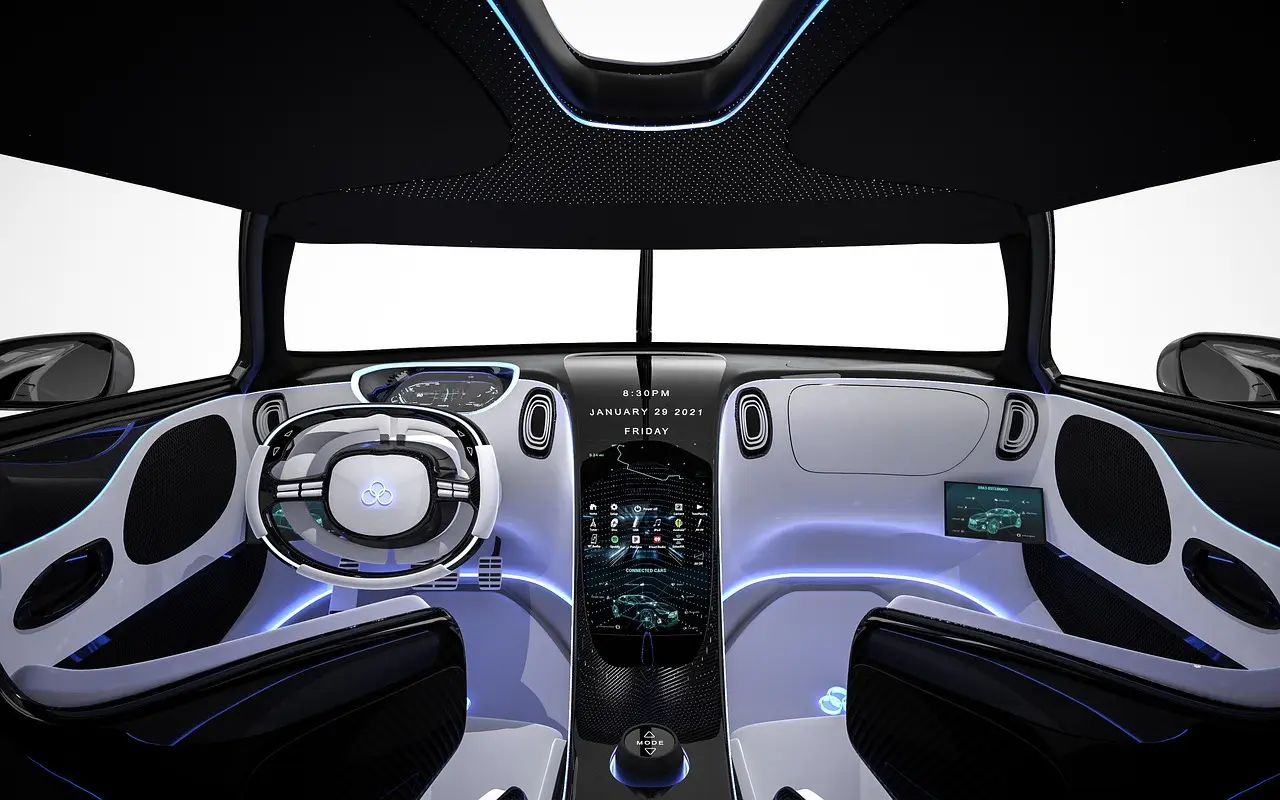
LED interior lights are either direct-replacement bulbs for factory cabin sockets or 12V strip kits for custom accent lighting. Bulb replacements fit dome, map, vanity, glove box, trunk, and door lights; strip kits fit footwells, dash accents, and under-seat glow where no factory bulb socket exists.
Two upgrade paths
Direct-replacement bulbs swap into the original socket. Common interior formats include wedge bulbs such as T10, 194, and 168, plus festoons such as DE3175 and lengths around 31 mm, 41 mm, and 42 mm.
Strip kits are a separate category. They use 12V power, adhesive mounting, and small bars or flexible strips to add ambient light where the vehicle did not come with a bulb location. Retail listings commonly include RGB kits with plug-and-play 12V power, a four-strip kit with four 12-inch RGB strips, a 24-inch white ambient product, and a 12.6-inch RGB light with app control. A longer market example is a 6-meter RGB interior light strip.
Where each type fits best
Use replacement bulbs when the goal is factory-style light output from an existing lens or reflector. That covers dome lights, map lights, vanity mirror lights, glove box lights, trunk or cargo lights, and many door or courtesy lights.
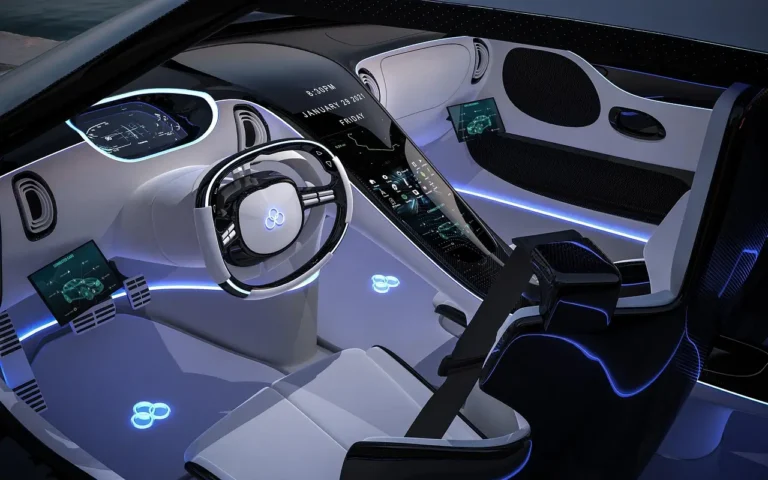
Use strip kits when the goal is accent color, floor illumination, or light under trim panels. RGB and white strip kits work well in footwells, under the dash, along the center console, and under front seats. They are a poor substitute for a focused reading light.
Why interior circuits behave differently
Most passenger vehicles use 12V electrical systems, but interior lighting circuits are often tied to dimmers, retained-accessory timing, or body control modules. That matters because an LED can be polarity-sensitive, can react to residual current, and can trigger bulb monitoring in some late-model vehicles.
LEDs are directional light sources, unlike incandescent and CFL bulbs. That helps in some housings and hurts in others. A chip that points sideways can fill a map-light lens better than a single forward-firing emitter, even if both claim similar output.
📊 LED lifetime is often defined by a 30% light-output drop. Source: Energystar.
How do you choose bulbs vs strip kits?
Choose direct-replacement bulbs for factory bulb sockets and 12V strip kits for added ambient lighting where no socket exists. Older vehicles often use simple switched 12V dome and map circuits that accept bulb swaps easily, while newer trims may use dimming modules, bulb checks, or tighter housings that call for slimmer LEDs, closer fitment checks, or CAN-bus-specific bulbs.
Factory replacement jobs
Bulbs make sense when the lens, reflector, and switch already exist. Dome, map, vanity, glove box, trunk, and door lights all fall into this group.
That title tells you less than the socket itself. A T10 wedge can fit many positions, but the length of the LED body and chip placement still decide whether the lens closes cleanly.
Ambient lighting jobs
Strip kits make sense when the goal is color or low-level floor light rather than task lighting. RGB kits can add amber, red, green, blue, or mixed colors. White strips are better when the aim is seeing dropped items on the floor rather than changing the cabin mood.
Say your car has dim footwells but a strong dome light. A strip kit under the lower dash fixes the dark floor area without overdriving the dome housing with an overly bright bulb that creates glare every time a door opens.
Vehicle age and trim level matter
Older vehicles usually use simple switched interior circuits with little or no bulb monitoring. Bulb swaps are often straightforward there. Newer vehicles may pulse the circuit for bulb checks, fade lights out gradually, or keep low current on the line after shutdown. Those behaviors can cause glow, flicker, or false warning messages with basic LEDs.
Factory ambient-light trims can also change the choice. If the car already has integrated light pipes and controller outputs, adding generic adhesive strips may look uneven or conflict with factory dimming behavior.
What bulb sizes fit your interior lights?
Interior bulb fitment starts with socket family, then exact size, then physical clearance. Socket shape matters more than a broad “fits most cars” listing.
Wedge bulbs: T10, 194, and 168
T10 describes the wedge base shape. In interior applications, sellers often group T10, 194, and 168 together because those bulbs share the same wedge family. They commonly appear in map lights, door lights, trunk lights, glove box lights, and some dome assemblies.
Polarity can matter with LED wedges. If the bulb fits but does not light, remove it, rotate it 180 degrees, and reinstall before assuming the bulb is faulty.
Festoon bulbs: DE3175, 31 mm, 41 mm, and 42 mm
Festoon bulbs sit between spring contacts. Common interior examples include DE3175 and lengths such as 31 mm, 41 mm, and 42 mm. Many dome, vanity mirror, and trunk lights use this style.
Another market example is a festoon LED sold for 6411, 6413, and 6418 applications. That kind of title helps only if the contact spacing and body shape match the original bulb and the lens still closes without pressure.
Why socket shape beats listing title
Owner’s manuals can list the original bulb code, but they are not always complete for every interior position. Existing bulb markings help, and the socket itself often settles the question faster than the package title does.
Suppose a listing says “31 mm to 42 mm festoon compatible.” That sounds broad, but a 42 mm bulb can bow the contacts in a 41 mm housing or crack a brittle vanity lens. One millimeter can decide whether the fit is secure.
Interior fitment matrix
Common cabin positions
| Light position | Usual bulb base or type | Polarity matters? | Typical upgrade risk | Best LED form factor |
|---|---|---|---|---|
| Dome light | Festoon: DE3175, 31 mm, 41 mm, 42 mm; sometimes T10/194 | Sometimes | Medium: lens clearance, retained-voltage glow, heat in enclosed housings | Multi-chip festoon matched to exact length, or low-profile panel style if the housing allows it |
| Map light | T10/194/168; sometimes festoon | Often | Medium: glare, directional beam mismatch, tight lens fit | Compact wedge with side-firing chips for better spread |
| Door/courtesy light | T10/194/168 | Often | Low to medium: moisture at door edge, loose wedge contact | Short wedge bulb with good contact tabs |
| Trunk/cargo light | T10/194/168 or festoon 41 mm/42 mm | Often | Low: usually simple circuits, but cargo lenses can be shallow | Wide-spread wedge or festoon with multiple chips |
| Glove box light | T10/194/168 | Often | Medium: small housing, switch sensitivity, easy to mis-seat | Short low-heat wedge bulb |
| Vanity mirror light | Festoon 31 mm or 42 mm; sometimes T10 | Sometimes | High: brittle lenses, heat, very limited clearance | Exact-length low-profile festoon |
| Footwell light | T10 in factory-equipped cars; otherwise 12V strip kit | Often for bulb sockets | Low for strips, medium for factory sockets with dimming circuits | Adhesive white or RGB strip kit, or compact wedge for factory housings |
| Dash accent | Usually 12V strip kit rather than bulb replacement | No, if controller handles input | Medium: visible wiring, reflections in glass, distraction | Thin diffused strip with dimming control |
| Under-seat lighting | 12V strip kit | No, if controller handles input | Low to medium: adhesive failure, exposed wiring | Short strip bars or flexible RGB/white strips |
Use the matrix as a starting point
This matrix covers common patterns, not every trim level. The same model can use different bulb bases by year, market, or sunroof package. Confirm with the owner’s manual, bulb markings, socket shape, and a voltage tester or multimeter before ordering multiples.
How bright and what color should interior LEDs be?
Choose brightness by task and housing design, not by the biggest number on the listing. Reading lights need controlled, even light; ambient strips need lower output and smooth spread. For color, 3000K is often considered easier on the eyes, 6000K is commonly seen as neutral-white, and 6500K can look sharper but harsher.
Brightness depends on beam spread
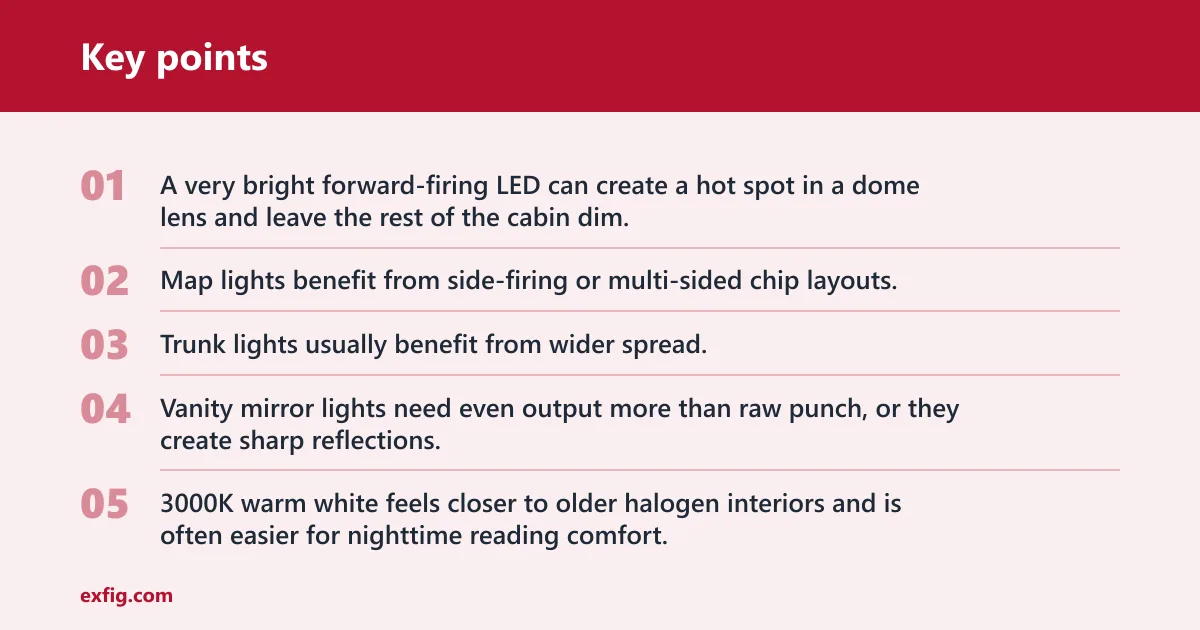
LED lighting products can be up to 90% more efficient than incandescent bulbs, but interior light quality still depends on where the chips point. A very bright forward-firing LED can create a hot spot in a dome lens and leave the rest of the cabin dim.
Map lights benefit from side-firing or multi-sided chip layouts. Trunk lights usually benefit from wider spread. Vanity mirror lights need even output more than raw punch, or they create sharp reflections.
Color temperature tradeoffs
3000K warm white feels closer to older halogen interiors and is often easier for nighttime reading comfort. 6000K xenon white gives a cleaner white appearance that many owners want for dome and map lights. 6500K cooler white can look brighter at a glance, but it can also add glare on light-colored trim and glossy screens.
A common first-timer mistake is choosing the coolest white available for map lights, then finding that receipts, screens, and mirrors throw more glare than expected. In a beige interior, 3000K or 6000K often reads more comfortably than 6500K.
Thermal design still matters
ENERGY STAR says LEDs are commonly reported not to burn out in the same way as traditional bulbs; they tend to dim gradually over time. LED lifetime is often defined by a 30% light-output drop. That does not mean every interior LED lasts well. Cheap bulbs with poor heat sinking can fade early in sealed dome or vanity housings where heat has nowhere to go.
Look for enough aluminum mass or another heat-control design when the bulb sits behind a small lens. The lower current draw compared with halogen helps, but it does not cancel bad thermal design.
Do LED interior lights work in every car?
LED interior lights work in many cars, but not every bulb works properly in every interior circuit. The main trouble spots are polarity-sensitive sockets, CAN-bus or bulb-monitoring systems, retained-voltage circuits that leave a faint glow, and housings with too little space for taller LED replacements.
Polarity and simple no-start cases
Many wedge LEDs are polarity-sensitive. Incandescent bulbs are not, so the factory socket may not care which way the original bulb went in. If the LED does not turn on, reverse it before moving to deeper diagnosis.
When CAN-bus matters?
Error-free or CAN-bus-compatible LEDs include circuitry meant to mimic more load or stabilize the circuit. That matters only when the vehicle monitors that interior bulb closely enough to flag low current or pulse the circuit in a way a basic LED does not tolerate.
Interior positions vary. A simple trunk bulb in an older car may need no special circuitry at all. A late-model vanity or dome circuit tied into a body control module may show flicker or a warning unless the bulb is matched to that system.
Residual current and late-model behavior
Some interior circuits feed tiny residual current even when the light appears off. Halogen ignores that. LED does not always. The result can be faint glow, periodic flash, or a delayed shutoff pattern that looks like a fault even when the bulb is technically working as designed.
Why do interior LEDs flicker, glow, or fail?
Interior LEDs flicker, glow, or fail for a short list of reasons: wrong base or length, reversed polarity, weak contact at the socket, poor internal driver electronics, residual current from the car’s control module, or too much heat in a confined housing. The fastest diagnosis is symptom-first.
No light at all
No light usually points to one of four issues: wrong bulb family, wrong festoon length, reversed polarity, or poor contact pressure. With wedges, the metal pads may not touch firmly. With festoons, weak spring tension can leave the end caps barely contacting the holder.
Flicker and pulsing
Flicker while on often points to voltage variation, a weak LED driver, or a circuit that is being pulse-width controlled by the vehicle. Flicker after shutdown often points to retained-voltage behavior or bulb monitoring.
Radio noise can also show up with very cheap strip-kit controllers or low-quality LED drivers. If the problem appears only after adding strips with app or music-sync control, the controller is often the first suspect.
Dim glow when off
Dim glow after the doors close usually means the circuit still carries a small amount of current. Some CAN-bus-compatible bulbs solve this, and sometimes a different LED design works better than adding a resistor. Resistors add heat, which is a bad trade in small plastic housings.
Heat, loose fit, and early failure
If the bulb works at first but fades, discolors, or fails early, suspect heat. If it cuts in and out over bumps, suspect fit. A bulb that physically enters the socket can still be wrong if it does not lock under the lens or if the contact tabs are too thin.
Diagnosis checklist
- Confirm the socket. Remove the original bulb and compare the base shape and, for festoons, the exact length in millimeters. Check the owner’s manual and any marking on the old bulb before trusting a product title.
- Reverse the LED. If a wedge or some festoon LEDs do not light, turn the bulb around and test again. Polarity is one of the most common no-light causes in interior swaps.
- Check contact pressure. Look for loose wedge fit, weak festoon spring tension, or corrosion on the socket. A bulb that lights only when pushed sideways usually has a contact issue, not a brightness issue.
- Test circuit voltage. Use a voltage tester or multimeter at the socket if the bulb still fails. This separates a bulb problem from a blown fuse, switch fault, or a body-control circuit that is not providing full 12V at that moment.
- Watch the shutoff behavior. Close the doors and wait through the normal fade-out cycle. If the LED glows faintly or pulses after shutdown, the circuit likely has residual current or monitoring behavior that a different LED design may handle better.
- Test fit before reassembly. Turn the light on, close the lens gently, and verify nothing binds. Reassemble trim only after checking that the lens clips, dimming behavior, and bulb temperature all look normal.
Installation and tools
What to have ready
A plastic trim tool or plastic pry tool helps prevent lens damage. Keep the owner’s manual nearby, and have a voltage tester or multimeter ready if a bulb does not work immediately.
Basic installation flow
- Open the lens carefully. Use a plastic trim tool at the factory notch, not a metal screwdriver on the visible edge. Brittle dome and vanity lenses crack easily, especially in older cars.
- Match the old bulb. Compare the removed bulb’s base and, for festoons, measure the contact-to-contact length if the marking is unclear. This avoids forcing a 42 mm bulb into a 41 mm holder or choosing a tall wedge that hits the lens.
- Bench the fit loosely. Insert the new LED and test it before snapping the lens or trim back into place. If it does not light, reverse polarity where applicable, then retest.
- Check lens clearance. Refit the lens without force and verify the bulb does not touch it. Tight vanity mirror housings and shallow map-light lenses are the spots where DIY risk is highest.
- Route strips cleanly. For strip kits, clean the mounting surface, dry-fit the wire path, and keep wires away from seat tracks, pedals, and side-airbag zones. Adhesive strips fail early when stuck to dusty or textured plastic.
Cost, battery impact, and safety
What interior LED upgrades usually cost
Single replacement bulbs are usually the lowest-cost path, while multi-bulb cabin kits cost more because they bundle several sizes. RGB strip kits range from short four-strip sets to longer app-controlled kits, and professional installation adds labor if wiring must be hidden through the console or under trim.
A practical shopping range is this: basic single bulbs are often sold individually or in small packs; full-cabin bulb kits usually cost more than buying one bulb but less than a custom ambient-light install; strip kits vary by controller features such as app control or music sync; professional labor usually costs more than the hardware unless the car already has easy accessory power access. Price the whole job, including any CAN-bus-specific bulbs needed to solve warning or glow issues.
Battery load and current draw
LEDs generally draw less current than the halogen or incandescent bulbs they replace. That helps when a dome light is left on by mistake, but no interior light is safe for the battery if it stays on long enough. Lower draw reduces strain; it does not remove it.
Because LEDs are more efficient, the same visible cabin light usually needs less electrical input. That is helpful in glove box, trunk, and vanity positions that can be left on accidentally by a misaligned switch.
Safety and thermal limits
The main safety issues are heat in enclosed housings, wiring quality on strip kits, and distracted driving from bright moving colors. A low-current LED can still run too hot if its heat sink is undersized and the lens traps heat around it.
US legal and practical limits
Interior versus exterior rules
In the US, interior lighting is generally treated differently from exterior lighting, but that does not make every setup road-safe. Bright interior lights, changing colors, or reflections on the windshield can create distraction issues even if the hardware itself is sold openly for interior use.
Where legal problems usually start
Steady white dome or map bulbs used normally are rarely the issue. Problems usually start with visible colored strips near the windshield, lights bright enough to reflect in side glass, or music-sync patterns moving while the car is in motion.
Keep ambient strips low, dim, and out of direct sight lines. If a strip can be seen as a flashing source from outside the car, or if it reflects on the windshield, the setup is harder to defend as practical road-use lighting.
Frequently asked questions
Are LED interior lights brighter than halogen bulbs?
Often, yes, but brightness alone does not decide whether the result is better. LED directionality, chip placement, and the shape of the dome or map-light lens matter more inside the cabin than a big output claim. A well-aimed LED usually beats a poorly aimed brighter one.
Do I need CAN-bus compatible LEDs?
Only if the vehicle’s interior circuit shows symptoms that point to monitoring or low-load sensitivity, such as bulb-out warnings, pulsing, or faint glow after shutdown. Many older or simpler interior circuits work fine with standard LEDs, so CAN-bus bulbs are not an automatic requirement.
How much do car interior LED lights cost?
Costs vary by path. Single replacement bulbs are usually the cheapest, full-cabin bulb kits cost more because they cover several positions, and RGB strip kits vary with controller features such as app control or music sync. Professional installation can exceed hardware cost when wires must be hidden cleanly.
Are LED interior lights legal in the US?
Usually, interior LED replacements are less sensitive legally than exterior bulb changes, but bright or colored ambient lighting can still create trouble if it distracts the driver or reflects into the windshield. For road use, keep interior lighting dim, stable, and out of direct sight lines.
Are LED interior lights safe for the battery?
Generally, yes, because LEDs draw less current than comparable halogen or incandescent interior bulbs. Still, any light left on long enough can drain a 12V battery. Lower draw helps most in dome, trunk, glove box, and vanity positions that are easy to leave on accidentally.
Can I install LED interior lights myself?
Most owners can handle basic bulb swaps with a plastic pry tool and a little patience. The higher-risk jobs are tight vanity mirror housings, brittle lenses, and vehicles with sensitive electronics that react to low-load LEDs with flicker, glow, or warning messages.